
Record holders
Best Jumpers in the Animal Kingdom: 6 Ranked
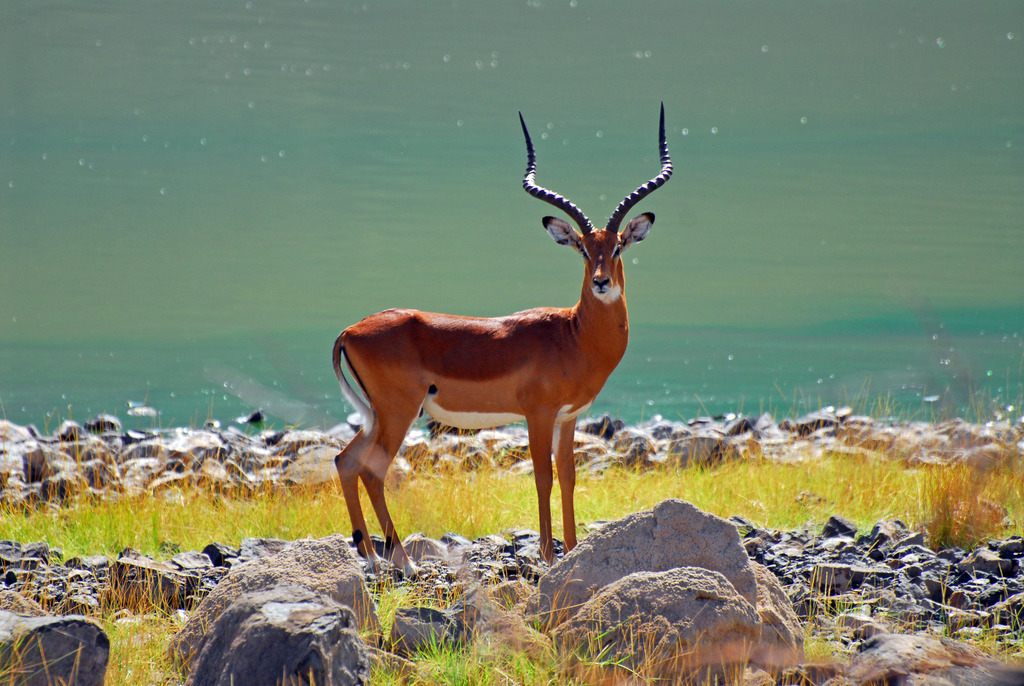
The impala clears about 3 metres high or 10 metres long in a single bound, the best leap of any land mammal. But measured against body size, the tiny meadow spittlebug wins outright: it launches over 100 times its own length, beating the flea. Six real catalog species, ranked by leap.
"Best jumper" is not one contest. An impala clearing a Land Rover is impressive in absolute terms, but an insect a few millimetres long that out-jumps a flea relative to its own body is arguably doing something harder. The six animals below each hold a genuine, documented jump record, from raw distance to reflex speed to the pound-for-pound title that actually belongs to an insect most people have never heard of. All are in the Kaught catalog with their observation-derived rarity tier.
1. Impala, up to 10 m long or 3 m high
Among land mammals, nothing covers ground like an impala in flight. A single escape bound can carry it roughly 10 metres in length or 3 metres in height, launched off powerful hindquarters built for exactly this. Predators that get close enough to trigger the jump often lose the chase in the first stride.
The same leap doubles as a display. Impala perform a stiff-legged, four-footed bounce called stotting, jumping repeatedly for no obvious escape reason, which most biologists read as a fitness signal: "I have energy to burn, don't bother chasing me." In the Kaught catalog the impala is Common, one diamond, reflecting large, frequently observed herds across the region.
2. Northern Lesser Galago, several metres between branches
Also called a bushbaby for its infant-like wailing call, the northern lesser galago is a small nocturnal primate with disproportionately powerful hind legs. A single leap carries it several metres between branches, cleared entirely in the dark and often in dense canopy where a miscalculation means a long fall.
Huge eyes and independently rotating ears do the navigating; the legs do the rest. It is Epic in the Kaught catalog, three diamonds, a wide range across Africa doesn't translate to easy sightings when the animal is strictly nocturnal and airborne between trees half the night.
3. Desert Kangaroo Rat, a reflex jump under a snake strike
This is a jump measured in milliseconds, not metres. When a rattlesnake strikes from ambush, a desert kangaroo rat can clear well over half a metre vertically or sideways before the snake's head arrives, a reflex jump fast enough to turn an ambush ready to be finished into a miss.
High-speed video of real predator encounters shows the reaction happening in a fraction of a second, among the fastest predator-evasion responses recorded in any mammal. Rare in the catalog, two diamonds, this is a nocturnal desert specialist that people rarely encounter outside its dune habitat.
4. Lesser Egyptian Jerboa, the same trick evolved twice
Swap continents from the kangaroo rat above and you find a rodent solving the same problem the same way. The lesser Egyptian jerboa is a bipedal hopper with elongated hind feet and a long tufted tail for balance, able to cover ground fast and change direction mid-leap to shake off a pursuing predator.
It evolved that body plan entirely independently of North America's kangaroo rats, unrelated rodents that converged on an identical solution to life in open desert under similar pressure from ambush predators. Rare in the catalog, two diamonds.
5. Striped Rocket Frog, 2 metres from a 5 cm body
The name is literal. Exceptionally long, muscular hind legs let this roughly 5 cm frog launch itself more than 2 metres in a single low, explosive bound, among the longest jumps relative to body length of any frog. Most frogs hop; the striped rocket frog fires itself across open ground.
It lives in coastal grassland and disturbed ground near water across northern and eastern Australia, common enough in the catalog to earn just one diamond, but rarely appreciated for what its legs are actually capable of until it's mid-leap.
6. Meadow Spittlebug, the real champion
Nothing above actually holds the title. Measured against body size, the best jumper in the animal kingdom is a 6 mm insect best known for the foam ("cuckoo spit") its nymphs hide inside on plant stems. An adult meadow spittlebug launches more than 70 cm high, over 100 times its own body length, beating the flea outright.
The mechanism is a catapult, not muscle alone. Its hind legs pre-load energy into resilin, a rubbery elastic protein, then release it in under a millisecond, producing peak accelerations close to 400 g. It is common and widespread, from Europe through temperate Asia, with introduced populations in North America, one diamond in the Kaught catalog, but almost nobody notices the tiny green insect that quietly outperforms everything else on this list.
Why "best jumper" depends on how you measure it
Line these six up by a single ruler and the ranking falls apart immediately. The impala wins on raw distance. The spittlebug wins relative to body size, by a wide margin. The desert kangaroo rat wins on reaction time, a jump measured in fractions of a second rather than metres. The jerboa and the kangaroo rat are not each other's rivals at all, they are proof that unrelated animals under similar pressure independently invent the same solution.
The pattern echoes the fastest animals in the world, where the record also depends on the medium: air, land or water. For raw power rather than distance, the strongest animals list applies the same logic to force. And for the animals that solved survival by barely moving at all, see the slowest animals in the world.
Best jumpers: frequently asked questions
What animal is the best jumper in the animal kingdom relative to its size?
The meadow spittlebug (Philaenus spumarius). At around 6 mm long it launches itself more than 70 cm into the air, over 100 times its own body length, which beats the flea, the animal most people assume holds this record.
What land mammal jumps the farthest?
The impala (Aepyceros melampus) is among the best-jumping land mammals, clearing roughly 10 metres in length or 3 metres in height in a single bound, an escape leap it also performs as a stiff-legged "stotting" display to signal fitness to predators.
Do fleas jump higher than any other animal?
No. Fleas are excellent jumpers relative to their size, but the meadow spittlebug outperforms them, launching over 100 times its own body length using a catapult mechanism built from the elastic protein resilin.
How far can a kangaroo rat jump to escape a rattlesnake strike?
The desert kangaroo rat (Dipodomys deserti) can clear well over half a metre vertically or sideways in a fraction of a second, a reflex jump fast enough to dodge an ambush strike from a rattlesnake already in motion.
What is the difference between a jerboa and a kangaroo rat?
They are unrelated rodents that independently evolved the same bipedal hopping body plan: long hind legs, a long tail for balance, and small forelimbs. The lesser Egyptian jerboa lives in North African and Arabian deserts; the kangaroo rat lives in North American deserts. It is a textbook case of convergent evolution.
How do galagos (bushbabies) jump so far between trees?
The northern lesser galago has powerful hind legs that launch it several metres between branches in a single leap. Combined with huge eyes and independently rotating ears, it is built for navigating and hunting through the forest canopy entirely in the dark.
Why does the striped rocket frog jump so far for its size?
Its exceptionally long, muscular hind legs let a roughly 5 cm frog cover more than 2 metres in a single bound, among the longest jumps relative to body length of any frog, and the trait its common name is built around.
The next thing you see could be
your first catch.
Kaught is live on the App Store and Google Play. Free to start, and your first catch is one photo away.
Free to start · Live on the App Store and Google Play
Species data, type, rarity tier and measurements, is drawn from the Kaught catalog, built on open biodiversity records from GBIF and iNaturalist. Rarity reflects how often a species is observed in the wild, not its conservation status.