
Evolution story
Why do clownfish change sex? The strange biology behind it
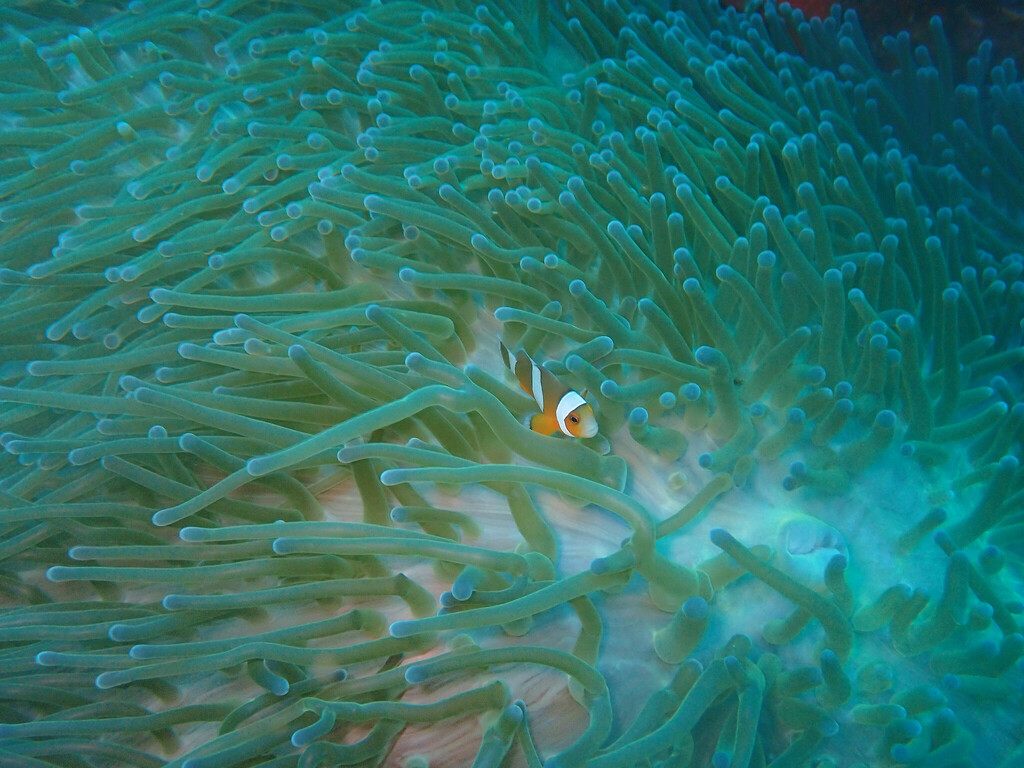
Every clownfish is born male. Inside a host anemone, only the biggest fish breeds as a female, and if she dies, the resident male changes sex to replace her. A separate trick, a mucus coat low in one sugar, lets it live inside the anemone's sting untouched.
Nudge apart a clump of anemone tentacles on almost any Indo-Pacific reef and there is a decent chance something small, orange and unbothered will nudge back. The ocellaris anemonefish is one of the most recognisable fish on the planet: a bright orange body banded in white and edged in black, always found tucked inside the stinging arms of a sea anemone it treats as a permanent home. Its real party trick has nothing to do with its colours. Every single one is born male, and which fish in a group eventually becomes female is decided by rank and circumstance, not by anything fixed at birth.
Every clownfish is born male
Clownfish belong to a small club of animals known as protandrous hermaphrodites: sequential hermaphrodites that start life as one sex and can switch to the other. Every juvenile Amphiprion ocellaris develops as a functional male, carrying testes alongside a strip of undeveloped ovarian tissue that stays dormant unless it is ever called on. A single host anemone typically shelters one small clownfish family: one large, dominant breeding female at the top, one smaller breeding male below her, and a handful of even smaller non-breeding males waiting in a strict size-based queue. The female's presence actively suppresses the growth and development of every fish beneath her, which is what keeps the group so orderly.
How the switch actually happens
Remove the breeding female, whether to a predator or old age, and the group's hierarchy resets within days. Freed from her suppression, the resident breeding male begins the transition into a female: the dormant ovarian tissue in his gonads activates while his testicular tissue regresses. At the same time, the largest of the waiting non-breeding males is promoted into the now-vacant breeding male role, and every smaller fish in the group shuffles up one place in the queue. The trigger is entirely social, not seasonal or age-based, a male can make the switch at almost any point in his adult life provided the vacancy above him opens up.
What changes inside the body
The transformation is not just anatomical, it starts in the brain. Studies comparing gene activity before and during sex change have found the brain responds first, with a rapid shift in gene expression that only later reaches the gonads themselves. That helps explain why the process is not instant: some fish complete the anatomical and behavioural change within weeks, while others stall for a long stretch in an intermediate state, developing ovarian tissue without yet acting fully like a female, or continuing male-typical behaviour despite an already-feminised body. Once the change is complete, though, it does not reverse. A fish that becomes the breeding female stays female for the rest of its life.
Surviving inside a stinging anemone
None of this would matter if the fish could not first survive inside its host. A sea anemone's tentacles are studded with nematocysts, harpoon-like stinging cells that fire automatically on contact with the right chemical trigger, principally a sugar called sialic acid found on the skin of most fish. A clownfish's own mucus coat carries unusually little of that sugar to begin with, and a juvenile reinforces the effect by performing a slow, deliberate acclimation dance, brushing against the tentacles again and again until it is coated in the anemone's own mucus. Chemically disguised as part of the anemone rather than as prey, the nematocysts stay dormant, and the fish moves freely through tentacles that would sting almost anything else on the reef.
What the anemone gets back
The relationship runs both ways. A resident clownfish aggressively chases off fish that would otherwise eat the anemone, butterflyfish especially, and its constant movement through the tentacles keeps water circulating through the colony, preventing the low-oxygen pockets that can build up in still water. The fish's nutrient-rich waste also feeds the microscopic algae living inside the anemone's own tissue, the same kind of photosynthetic partner a coral relies on, giving the anemone a small but steady nutritional return for the room and protection it provides.
Not every clownfish is this picky
Ocellaris anemonefish are relatively selective. In the wild they rely mainly on a single host, the anemone Heteractis magnifica, occasionally settling for one or two close relatives if nothing else is available. Other anemonefish are far more flexible: Clark's anemonefish, the most widely distributed species in the genus, will happily take up residence in around ten different host anemone species across its range. Across the roughly 30 species of anemonefish, host specificity varies enormously, one of the clearest signs that a single evolutionary partnership, one ancestral fish learning to tolerate an anemone's sting, has since branched into dozens of slightly different working relationships.
How rare is the clownfish in Kaught?
In the Kaught catalog the ocellaris anemonefish sits at the Common tier, one diamond out of four, worth pausing on given how famous this fish is. Kaught's rarity is not a measure of fame or conservation status, it is purely a record of how often a species is actually logged in the wild. Ocellaris anemonefish are reported constantly across reefs throughout the tropical Indo-West Pacific, wherever divers, snorkellers and reef walkers turn up with a camera, which is exactly what keeps a species at Common regardless of how recognisable it is.
Three things worth knowing about the ocellaris anemonefish
- Eggs are laid on a cleared patch of rock at the anemone's base, never inside the tentacles themselves, and the breeding male alone fans and guards the clutch until it hatches after four to six days.
- Hatchlings do not settle straight into an anemone. They drift as plankton for one to two weeks before searching the reef for an unoccupied anemone or a foothold in an existing group, the single riskiest stretch of a clownfish's life.
- Despite its fame, an adult tops out at around 11 cm, smaller than most people expect from a fish this instantly recognisable. The same reef holds far larger residents, like the coral reef's other catalog species, from moray eels to mantis shrimp.
Sex change on its own terms is rarer in the animal kingdom than people assume, but it is not unique to this one fish. The ribbon eel changes sex in the same direction, male to female, over the course of its life, while the giant seahorse takes the opposite approach to reproduction entirely and leaves pregnancy to the male. Between the three, a host anemone's tentacles turn out to be one of the more ordinary places on a reef for biology to bend the rules.
Clownfish sex change: frequently asked questions
Why do clownfish change sex?
Every clownfish is born male. Inside a host anemone, only the largest fish breeds as a female and the second-largest breeds as a male. If the female dies or is removed, that male changes sex to replace her, and the largest non-breeding male is promoted to take his place as the new breeding male.
Are all clownfish born male?
Yes. Clownfish are protandrous hermaphrodites, meaning every individual starts life as a male with underdeveloped ovarian tissue alongside functioning testes. Only the single largest, most dominant fish in a group ever completes the change into a fully reproductive female.
Can a clownfish change back from female to male?
No. The sex change from male to female is one-directional in clownfish. Once a fish has completed the transition and taken over as the breeding female, it does not revert to male even if its circumstances change again.
How does a clownfish survive living inside a stinging anemone?
Its mucus coat carries very little of the sugar that triggers an anemone's stinging cells to fire, and young fish reinforce this by gently brushing against the tentacles until they are coated in the anemone's own mucus, chemically disguising themselves as part of the anemone rather than prey.
What does the anemone get out of the relationship?
Protection and nutrition. The clownfish aggressively drives off anemone-eating fish such as butterflyfish, fans water through the tentacles to prevent low-oxygen pockets, and its nutrient-rich waste feeds the algae living inside the anemone's own tissue.
Do all anemonefish use the same host anemone?
No. Some anemonefish, like Clark's anemonefish, will settle in around ten different anemone species. The ocellaris anemonefish is choosier, relying mainly on the anemone Heteractis magnifica and occasionally one or two close relatives.
Why is the clownfish only "Common" in Kaught, despite being so famous?
Kaught's rarity tier measures how often a species is actually recorded in the wild, not how famous it is. The ocellaris anemonefish is reported constantly across Indo-Pacific reefs, which places it at the Common tier: one diamond out of four.
The next thing you see could be
your first catch.
Kaught is live on the App Store and Google Play. Free to start, and your first catch is one photo away.
Free to start · Live on the App Store and Google Play
Species data, type, rarity tier and measurements, is drawn from the Kaught catalog, built on open biodiversity records from GBIF and iNaturalist. Rarity reflects how often a species is observed in the wild, not its conservation status.