
Behaviour explainer
Do praying mantises eat their mates? The science behind the myth
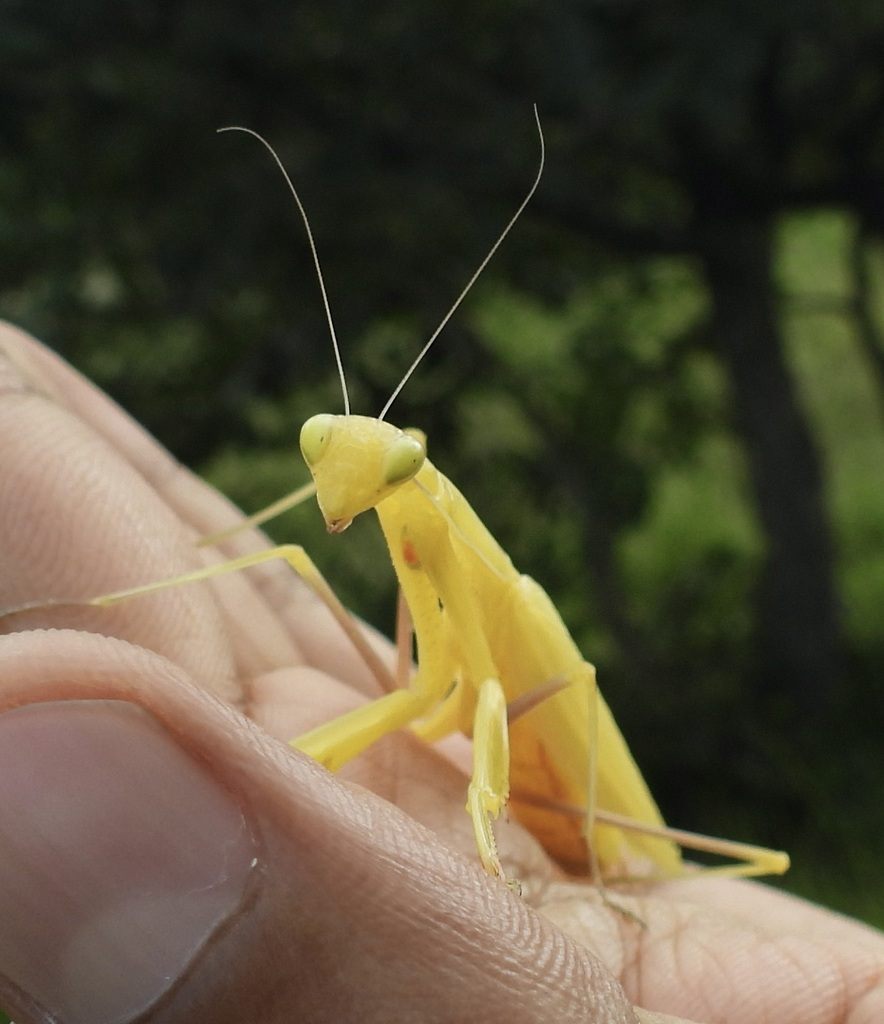
Female praying mantises sometimes eat the male during mating, especially if she's hungry, but it isn't guaranteed. If she does bite off his head, his body keeps mating anyway: decapitation removes a nerve brake, not the drive. Mantises also see in 3D, rare for an insect.
A praying mantis holds its spiked forelegs folded in front of its body, as if in prayer, then unfolds them into one of the fastest predatory strikes in the insect world. It also carries the animal kingdom's most persistent piece of folklore: that the female always eats the male during sex. She sometimes does. What actually happens, how often, and what happens to the male afterward, is stranger and more specific than the myth.
One thing to clear up first: this is not the mantis shrimp. The two share a nickname because both fold a pair of spiked, grasping arms the same way, but a praying mantis is a land insect while the mantis shrimp is an ocean-dwelling crustacean with a punch fast enough to shatter aquarium glass. Past the folded arms, the two are not related at all.
Do praying mantises really eat their mates?
Sexual cannibalism in mantises is real, well documented, and does happen in the European mantis. It is not, however, a guaranteed part of mating. Early lab studies, often mantises confined together in a small cage with limited food, reported cannibalism in a large share of encounters and helped cement the idea that it is close to inevitable. Later research watching mantises court and mate more freely on their own plants found it happens far less often than that, and the single biggest predictor isn't species or ritual, it's hunger: a well-fed female is much less likely to attack her mate than a starved one.
Cannibalism isn't limited to after sex, either. A hungry female will sometimes seize and eat an approaching male before mating even starts, which is exactly why males of many mantis species have evolved a cautious approach: creeping in from behind or the side, freezing at the first sign of aggression, and timing the approach for when a female is least likely to be actively hunting.
Why doesn't losing his head stop him?
When cannibalism does happen during mating, it produces the detail everyone remembers: a male that keeps copulating after the female has bitten off his head. That isn't myth, and the explanation is a genuine, decades-old finding in insect neuroscience. A cluster of nerves near the head, the subesophageal ganglion, normally suppresses the reflex circuits in the abdomen that drive copulatory movement. Removing the head removes that suppression, not the underlying drive, so the abdominal nerve cord, still intact and still able to fire on its own, keeps producing the motion by itself. Researchers first documented this in the 1930s, and it remains one of the clearest examples of decentralised nervous control in any animal: a body that keeps working from local instructions after losing its central command centre.
The strike: catching prey in a twentieth of a second
Outside of mating, a mantis spends most of its life doing one thing extremely well: waiting. It holds its spined, raptorial forelegs folded and still, relies on green or brown camouflage to disappear against a stem or leaf, and tracks passing insects by swivelling its head rather than moving its body. When prey comes within range, the forelegs snap forward and clamp shut in around a twentieth of a second, among the fastest strikes of any predatory insect and too quick for a human eye to follow cleanly. Flies, moths, crickets, aphids and bees make up most of the diet; larger tropical relatives occasionally take small vertebrates, but the European mantis sticks to insect-sized prey.
The only insect confirmed to see in 3D
A mantis's strike depends on judging distance accurately, and that rests on a genuinely rare sense: stereoscopic vision, comparing the slightly different view from each eye to compute depth, the same trick human vision uses. Researchers proved it directly on this exact species in 1983 by fitting European mantises with tiny prisms that shifted what one eye saw relative to the other; the mantises misjudged their strikes by exactly the amount the prism predicted. Decades later, a team built genuinely miniature 3D glasses, coloured filters over each eye, for a mantis and confirmed the same effect. It makes mantises one of the only insect groups on Earth known to use true stereopsis, a sense covered in more depth in seven animals with extreme senses.
A head that turns almost all the way around
A mantis's neck is a slender, highly flexible joint between the head and the mobile, elongated prothorax, and it gives the animal a party trick almost no other insect can match: it can rotate its head roughly 180 degrees to track a threat or a target without turning its body at all. For an ambush predator that survives by staying motionless and camouflaged, that matters enormously. Watching, and being watched, without ever giving away its position, is most of the job. It's a different solution to the same problem the eight eyes of a jumping spider solve by other means.
Are praying mantises dangerous to people?
No. A praying mantis has no venom and cannot deliver a bite that breaks human skin in any meaningful way. Picked up or handled roughly, it may pinch defensively with its spined forelegs, enough to startle but not to hurt, and it may raise its wings and forelegs in a bluffing threat display that looks far more dramatic than anything it can actually do. They are entirely safe to observe up close, and mostly beneficial in a garden, since they eat plenty of insect pests along with the occasional bee.
How rare is the European mantis in Kaught?
In the Kaught catalog the European mantis sits at the Common tier, one diamond out of four. As with every species in Kaught, that isn't a comment on population health: it reflects purely how often the species is actually recorded in the wild. The European mantis is native across southern and central Europe, North Africa and much of Asia, in warm grassland, meadow and scrub habitat, and it has also been established in North America since 1899, when it was first recorded near Rochester, New York; it has since spread across much of the northeastern United States and beyond. Wherever it occurs, it turns up constantly in observation records, which is exactly what keeps it at Common.
Three things worth knowing about the European mantis
- Eggs are laid in a hardened foam case called an ootheca, glued to a stem or wall in autumn; a single case can hold more than a hundred eggs and survives winter intact before nymphs hatch together in late spring.
- Most individuals live only one season: nymphs hatch in spring, mature by mid to late summer, mate in autumn, and adults die off before winter in temperate climates.
- Colour isn't fixed. Individuals hatch green or brown, a difference linked to the background they develop against, so a single meadow can hold mantises tuned to both live grass and dry stems, courtesy of the same arthropod toolkit that gives so many predatory invertebrates an edge most vertebrates can't match.
Praying mantis mating: frequently asked questions
Do praying mantises really eat their mates?
Sometimes, but it isn't automatic or universal. Sexual cannibalism happens more often when the female is hungry, and far more often in cramped lab studies than in field observations of mantises mating freely on plants. Plenty of matings end with both mantises simply walking away.
Why does a decapitated male keep mating?
A nerve centre near the head normally suppresses the reflexes that drive copulatory movement. Removing the head removes that suppression, not the drive itself, so the separate nerve cord in the abdomen keeps producing the motion on its own, a finding first documented in the 1930s.
Can praying mantises really see in 3D?
Yes. Researchers proved it by fitting European mantises with tiny prisms that shifted what each eye saw, throwing off their strike distance by exactly the predicted amount. It makes mantises one of the few insect groups confirmed to judge depth by comparing both eyes at once.
Can a praying mantis turn its head all the way around?
Not a full circle, but close: a uniquely flexible neck joint lets it rotate its head roughly 180 degrees to track prey or a threat without moving its body, something almost no other insect can do.
Are praying mantises dangerous to humans?
No. They have no venom and cannot deliver a bite that breaks human skin in any meaningful way. A handled mantis may pinch defensively with its forelegs, which can startle but doesn't hurt. They are safe to watch up close.
What do praying mantises eat?
Mostly other insects: flies, moths, crickets, aphids and bees, ambushed from a motionless, camouflaged wait and grabbed by spined forelegs in a fraction of a second. Larger tropical relatives occasionally take small vertebrates, but the European mantis sticks to insect prey.
Why is the European mantis "Common" in Kaught?
Kaught's rarity tier reflects how often a species is actually recorded in the wild, not whether it's threatened. The European mantis is abundant and reported constantly across its range, so it sits at the Common tier: one diamond out of four.
The next thing you see could be
your first catch.
Kaught is live on the App Store and Google Play. Free to start, and your first catch is one photo away.
Free to start · Live on the App Store and Google Play
Species data, type, rarity tier and measurements, is drawn from the Kaught catalog, built on open biodiversity records from GBIF and iNaturalist. Rarity reflects how often a species is observed in the wild, not its conservation status.