
Evolution story
Golden Jackal: the wild dog that DNA proved was never really a jackal
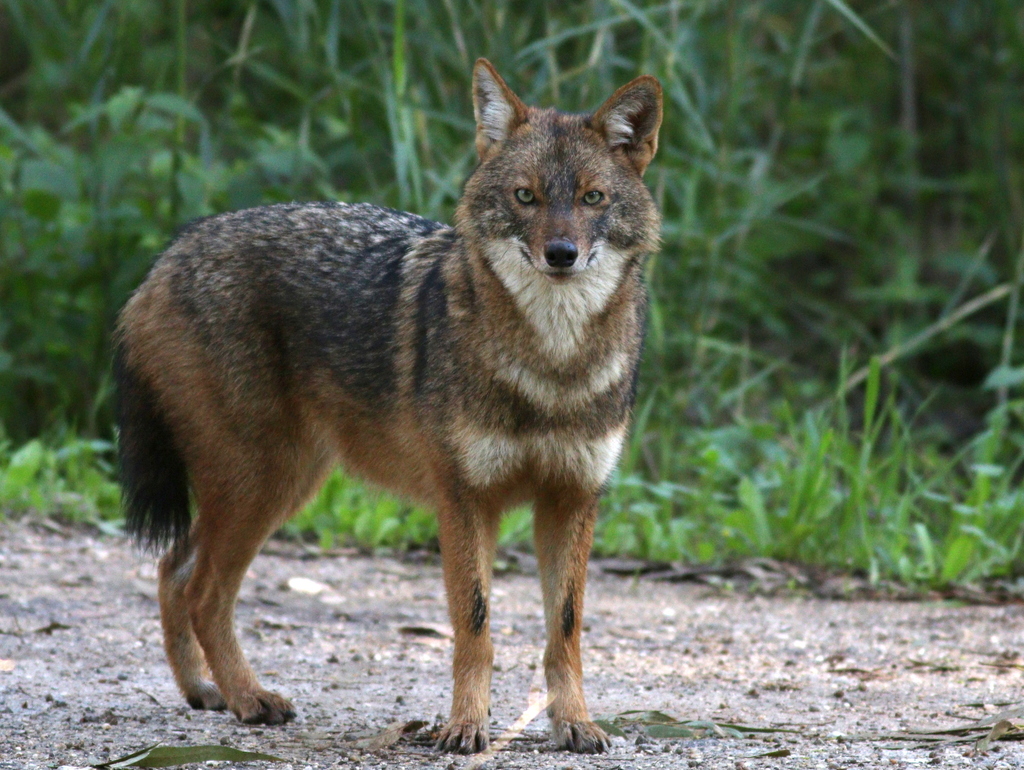
The golden jackal (Canis aureus) is a medium-sized wild canid native to South Asia, the Middle East and the Balkans. Despite its name, it is genetically closer to wolves and coyotes than to African jackals. It is now expanding rapidly into western and northern Europe. Epic tier in the Kaught catalog, three diamonds.
Most people who know the golden jackal assume it is a smaller, scrappier version of a wolf: a scavenger at the margins of the food chain, interchangeable with the black-backed or side-striped jackals of African wildlife documentaries. The genome said otherwise.
The DNA that rewrote the family tree
For most of the twentieth century, the golden jackal sat comfortably in the genus Canis alongside wolves, coyotes and domestic dogs, grouped loosely with the three African jackals on the assumption that small, generalist canids were all roughly the same thing.
In 2015, a comprehensive mitochondrial and nuclear DNA analysis compared golden jackal populations from across Asia and Africa. The result was stark: the "golden jackal" of Africa (Canis anthus, now called the African golden wolf) is not closely related to the Eurasian golden jackal at all. They share less DNA than a golden jackal shares with a wolf.
The Eurasian golden jackal's nearest relatives are wolves (Canis lupus), coyotes (Canis latrans) and domestic dogs (Canis lupus familiaris). It diverged from the wolf lineage roughly 1.9 million years ago, making it a true member of the wolf clade that simply evolved smaller and more generalist.
What the golden jackal looks like
At first glance, a golden jackal reads as a small, lean wolf or a large, long-legged fox. The key field marks:
- Coat: tawny-gold or sandy-brown above, paler below. The back carries a darker saddle of grey and black hairs, more pronounced in winter coat.
- Build: 70–85 cm body length, 35–50 cm at the shoulder. Slender, long-legged and with a pointed muzzle. The tail is shorter than a fox's and carried low.
- Ears: large, upright and close-set, giving the head a distinctly pointed profile. In bright light, slightly translucent at the tips.
- Movement: quick and purposeful, alternating between a fast trot and short bursts of galloping. The gait is looser than a fox's fastidious walk.
The call is the most reliable identifier at distance: a rising, wailing howl, often delivered in chorus by a mated pair. The sound carries several kilometres and is quite different from the bark of a dog or the scream of a fox.
Where golden jackals live, and why the map is growing
The core range stretches from Sri Lanka and the Malay Peninsula through India, the Middle East, the Caucasus, Turkey and the Balkans. This much has been known for decades.
What has changed since the 1980s is the expansion north and west into Europe. Golden jackals first established themselves in Hungary and Austria. By the 2000s they had reached Germany, Switzerland and the Czech Republic. By 2020, confirmed individuals had been documented in the Netherlands, Denmark and southern Sweden. They are not migratory; each generation simply extends the range a little further.
Three factors drive the spread. First, hunting pressure has fallen across much of Europe. Second, wolves suppress jackal populations where the two species overlap, and wolf recovery in some areas has been slower than jackal spread in others. Third, warming winters have opened habitat further north that would once have been too harsh. The golden jackal is one of the fastest-expanding large mammals in European history.
Diet: the wolf clade's generalist
The golden jackal is a genuine omnivore. The menu shifts with season and location: small mammals (voles, hares, rabbits), ground-nesting birds and their eggs, fruit, berries and agricultural crops, insects, fish near water, and carrion wherever it is available. In Asia, jackals follow tigers and leopards to feed on their kills. In Europe, they follow wolves.
Pairs are monogamous and hold a territory together. They hunt small prey solo and cooperate to tackle larger targets. Unlike the African jackals they were once lumped with, golden jackals will occasionally cooperate in small groups when prey is large enough to justify the sharing cost.
Reproduction and social structure
Pairs bond for life or until one partner dies. Breeding occurs once a year, with a litter of three to eight pups born in a den, typically a repurposed fox burrow or a hollow in dense vegetation. Pups from a previous litter sometimes remain as helpers, bringing food and guarding the den against predators. This cooperative breeding behaviour, familiar in wolves and wild dogs, is another trait the golden jackal shares with its wolf clade relatives rather than with its former groupmates, the African jackals.
The jackal and the wolf: a fraught relationship
Where wolves are present, jackals are typically absent or scarce. Wolves kill jackals and compete directly for the same prey and carrion. The expansion of jackals into Europe has followed exactly the gaps in the wolf's recovering range, a pattern so consistent it functions as an indirect indicator of wolf presence. Where wolves return to an area previously occupied by jackals, jackal numbers fall. Where wolves are absent, jackals fill the mesopredator niche with characteristic speed.
This relationship mirrors the dynamic between wolves and coyotes in North America. The coyote, another member of the wolf clade, expanded its range dramatically as wolves were removed, then contracted where wolves were reintroduced. The golden jackal is playing the same role in Europe.
Golden jackal in Kaught
The Kaught catalog places the golden jackal at Epic tier, three diamonds out of four. That reflects real sighting scarcity: jackals are widespread but shy and largely active after dark, so a confirmed field sighting is a genuine find. The type is Mammal (primary) with Apex secondary, accurate for an animal that sits at the top of the food chain in habitats without wolves. The lineage, Mammalia, Carnivora, Canidae, Canis, puts it exactly where the genome says it belongs: in the same genus as the wolf and the coyote.
Golden jackal: frequently asked questions
What is a golden jackal?
The golden jackal (Canis aureus) is a medium-sized wild canid, more closely related to wolves and coyotes than to African jackals. It lives from South Asia through the Middle East to Europe, and its range is expanding north and west. Epic tier in the Kaught catalog, three diamonds.
Where do golden jackals live?
From Sri Lanka and Southeast Asia through India, the Middle East, the Caucasus and the Balkans, and increasingly into central and western Europe. Confirmed individuals have been documented in Germany, France, the Netherlands, Denmark and Sweden in recent decades.
Are golden jackals dangerous to humans?
No. Golden jackals are shy, largely nocturnal and actively avoid contact with people. They may take unprotected small livestock, but attacks on humans are not a documented risk under normal circumstances.
Is the golden jackal really a jackal?
Not in any meaningful genetic sense. DNA analysis confirmed the Eurasian golden jackal shares more ancestry with wolves and coyotes than with the three African jackals. The African "golden jackal" is now reclassified as a separate species, the African golden wolf.
Why is the golden jackal spreading into Europe?
Reduced hunting pressure, the absence of wolves in many areas, and warming winters have all opened new habitat. Jackals fill the mesopredator role left by wolves precisely where wolves are absent, expanding their range at a pace that makes them one of Europe's fastest-spreading large mammals.
How does Kaught classify the golden jackal?
Epic tier, three diamonds out of four. Kaught's rarity reflects how often a species is actually recorded in the wild, not its population size. Jackals are shy and nocturnal, making a clear confirmed sighting genuinely uncommon even where the animals are present.
The next thing you see could be
your first catch.
Kaught is live on the App Store and Google Play. Free to start, and your first catch is one photo away.
Free to start · Live on the App Store and Google Play
Species data, type, rarity tier and measurements, is drawn from the Kaught catalog, built on open biodiversity records from GBIF and iNaturalist. Rarity reflects how often a species is observed in the wild, not its conservation status.