
Adaptation explainer
Why are flamingos pink? The biology of the upside-down filter bill
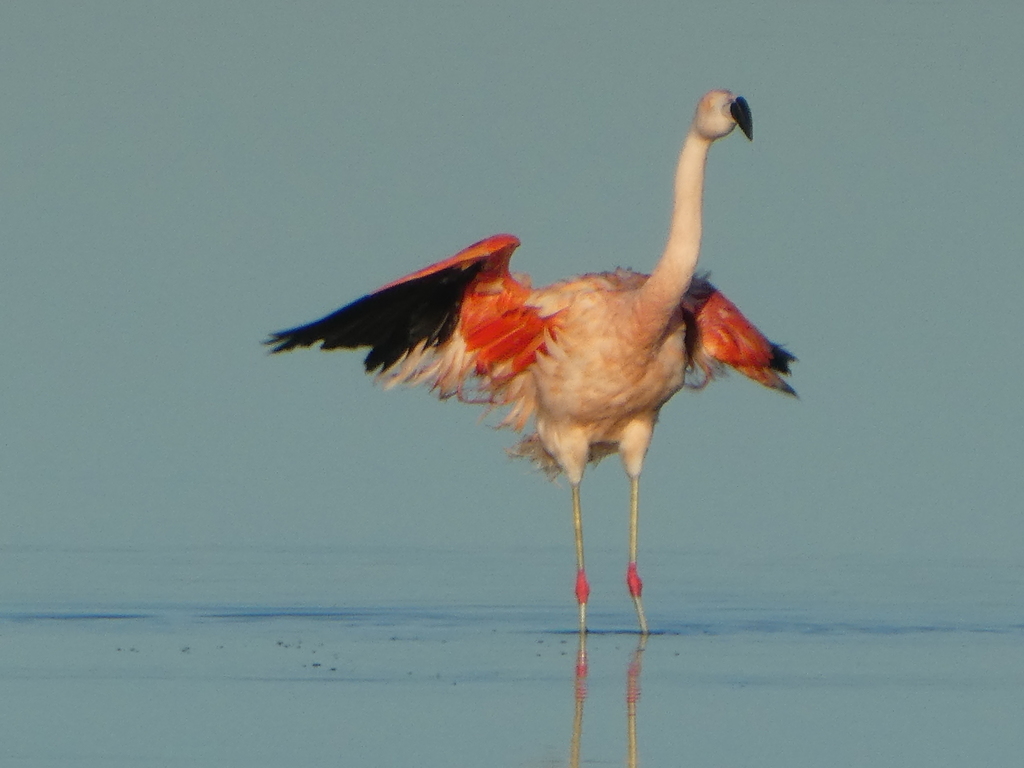
Flamingos are pink because of carotenoid pigments in the algae and invertebrates they eat. Their bodies process these pigments and deposit them in their feathers. A flamingo that stops eating its natural diet fades to cream within weeks. The colour is produced by diet, not genetics.
A flock of flamingos on a high-altitude salt lake in the Andes is one of the more improbable sights in nature: hundreds of pink birds standing in caustic water, heads down, pumping an invisible meal from what looks like nothing. The colour, the posture, the environment, all of it looks wrong. It all makes sense once you understand how the animal works.
The chemistry of pink
Flamingo pink is not a fixed genetic trait. It is the result of a continuous dietary process. The birds eat carotenoid-rich food, principally cyanobacteria (blue-green algae), diatoms, brine shrimp and other small invertebrates that are themselves rich in the orange-red pigments called carotenoids.
In a flamingo's gut, enzymes break the carotenoids down into molecules that the bloodstream transports to the skin and growing feathers, where they are deposited as pigment. The deeper the carotenoid content of the diet, the more saturated the pink. A bird feeding on dense blooms of cyanobacteria develops a vivid coral-pink plumage. The same bird kept on a carotenoid-free diet in captivity goes pale within a single moult cycle. Zoo flamingos are fed carotenoid supplements to maintain their colour.
This dynamic colouring is not just cosmetic. The depth of a flamingo's pink is a direct signal of its condition: a deeply coloured bird is a well-fed bird, which in flamingo society is an attractive mate. Studies of greater flamingos in the Camargue found that birds with more saturated plumage bred earlier and more successfully than paler neighbours.
The most specialised bill in the bird world
The flamingo's bill is a filter pump. Its design is unique among birds.
The bill is bent sharply downward at the middle. When the bird lowers its head and inverts the bill into the water, the bent section means the bill's cutting edge now faces upward. Inside, a large muscular tongue pumps water rapidly in and out, sometimes up to four strokes per second. As water enters through the front of the bill and exits at the sides, it passes through a battery of comb-like structures called lamellae, which fringe the inner surfaces and act as a sieve, trapping the tiny organisms the bird is after.
The bill only works in this inverted position. Flamingos cannot filter-feed upright. This is why they look strange to a first-time observer: the head is held almost upside-down, the bill cutting a slow arc through the shallows while the bird shuffles forward.
Different flamingo species have differently shaped lamellae tuned to different prey sizes. The Chilean Flamingo has medium-depth lamellae, targeting organisms of moderate size. The lesser flamingo, by contrast, has finer lamellae for the smallest algae, while the greater flamingo has coarser ones for larger invertebrates. The six flamingo species share the same basic filter principle but occupy subtly different food niches within the same ecosystem.
The one-leg question
Everyone notices. Flamingos spend a large portion of their time balanced on a single leg, the other tucked into the body. The most supported explanation is thermoregulation. The legs are largely bare of insulating feathers, and standing in cold water or air loses body heat rapidly through the exposed skin. Tucking one leg up reduces the exposed surface area by roughly half.
Measurements back this up: flamingos switch to one-leg standing more frequently when the ambient temperature is low, and the posture is more common when birds are standing in cold water than when resting on warm ground.
A separate study found the posture is also mechanically efficient: the flamingo's leg joints lock into place in a way that requires minimal muscle effort to maintain, making one-leg standing genuinely less tiring than two. The posture is probably maintained for both reasons simultaneously.
Where to find the Chilean Flamingo
The Chilean Flamingo breeds at some of the most extreme addresses in South America. Its core nesting colonies sit on salt lakes and alkaline flats in the high Andes, often above 3,000 m altitude, in environments with water caustic enough to damage human skin. The birds build low mud-cone nests in colonies that can number tens of thousands of individuals, the elevation and the water chemistry together keeping most predators away from the eggs.
Outside the breeding season, birds disperse to estuaries, coastal lagoons and inland wetlands from Peru south to Tierra del Fuego and occasionally into Argentina's Atlantic coast. Their range overlaps with the longest animal migrations, and some flamingo populations move substantial distances between seasons, though they are not long-distance migrants in the way of Arctic-breeding shorebirds.
The Kaught catalog places the Chilean Flamingo at the Epic tier, three diamonds out of four. In its Andean strongholds it can be locally abundant, but those salt lakes are remote and access is restricted; outside those specific habitats the bird is genuinely scarce, and a good sighting of a feeding or breeding colony is a real catch.
How are flamingo chicks coloured?
Chicks hatch in white-grey down with a straight pink bill. The bill gradually develops its distinctive bent shape over the first few weeks, and the chicks begin feeding with their parents on the carotenoid-rich lake food. Pink feathers come in only once the chick begins its juvenile plumage, at around two to three months. Younger birds remain mottled grey-white for a year or two before achieving the full adult colouration. A first-year flamingo standing in a flock looks like a completely different bird.
For another example of dramatic colour production from diet, see our guide to the Bearded Vulture, which actively stains its own feathers with iron-rich mud to achieve its orange colouring.
Why flamingos are pink: frequently asked questions
Why are flamingos pink?
Because of carotenoid pigments in the algae and invertebrates they eat. The body processes these pigments and deposits them in the feathers. A flamingo that stops eating its natural carotenoid-rich diet fades from pink to cream within weeks. The colour is entirely diet-derived, not genetic.
Are flamingos born pink?
No. Chicks hatch covered in white-grey down with a straight bill. They begin developing pink feathers after a few months once they start eating the carotenoid-rich lake diet. First-year flamingos remain mottled grey-white and look nothing like adults.
How do flamingos filter-feed?
The flamingo places its bent bill upside-down in the water and uses a muscular tongue to pump water in and out up to four times per second. Comb-like lamellae on the bill's inner surfaces filter out algae and small invertebrates while water exits through the sides. The upside-down position is essential: the bill works only when inverted.
Why do flamingos stand on one leg?
The leading explanation is thermoregulation: tucking one leg into the body reduces heat loss through the bare, unfeathered legs, particularly in cold water. Flamingos switch to one-leg standing more often at lower temperatures. The posture also requires less active muscle effort than standing on two legs, making it energy-efficient.
Where does the Chilean Flamingo live?
On salt lakes, alkaline lagoons, estuaries and coastal mudflats from Peru and Bolivia south through Chile and Argentina to Tierra del Fuego. It breeds in large colonies on isolated lake islands, often on high Andean salt flats above 3,000 m altitude where the caustic water deters most predators.
How does a flamingo's bill work?
The bill is bent downward at the middle, so when the head is lowered and the bill inverted into the water, the cutting edge faces upward. The large muscular tongue pumps water rapidly in and out. Fine lamellae on the inner bill edges trap tiny organisms while water exits. Different flamingo species have differently sized lamellae, tuned to different prey.
The next thing you see could be
your first catch.
Kaught is live on the App Store and Google Play. Free to start, and your first catch is one photo away.
Free to start · Live on the App Store and Google Play
Species data, type, rarity tier and measurements, is drawn from the Kaught catalog, built on open biodiversity records from GBIF and iNaturalist. Rarity reflects how often a species is observed in the wild, not its conservation status.