
Species spotlight
Sally Lightfoot Crab: the rainbow-shelled crab that grooms iguanas and walks on water
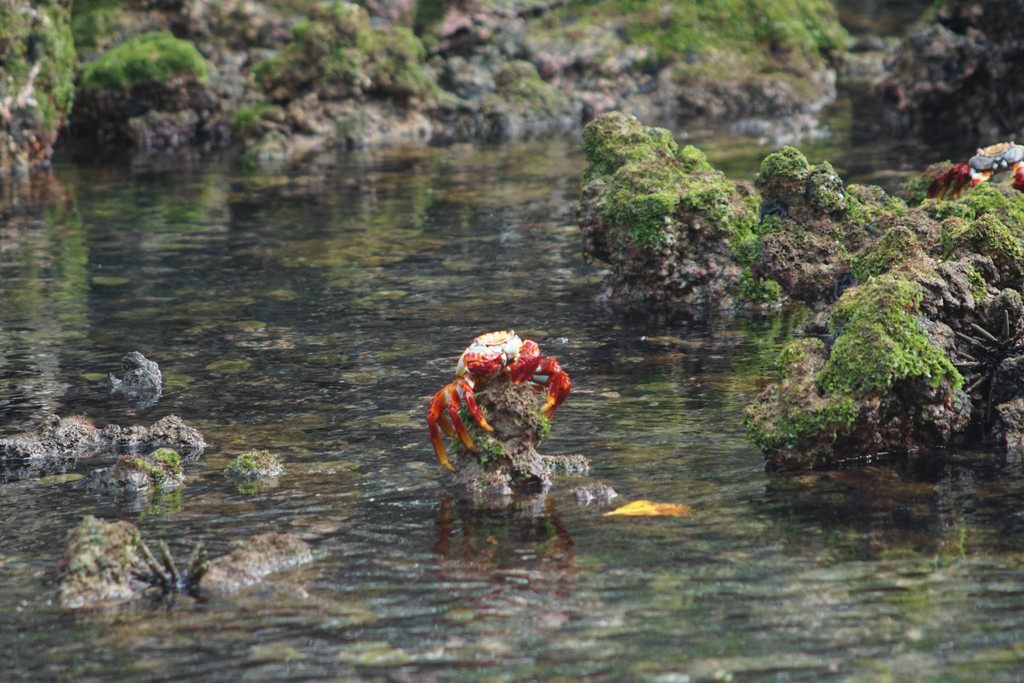
The Sally Lightfoot crab (Grapsus grapsus) is a fast rock crab of the Pacific and Atlantic coasts of the Americas, best known from the Galápagos. Juveniles are black for camouflage; adults flush red, orange, blue and yellow with each molt, and groom ticks and dead skin off marine iguanas.
Stand on almost any rocky shore between Baja California and Chile and you will eventually see one: a flash of red and orange skittering sideways across black volcanic rock, gone before you can point it out. That is the Sally Lightfoot crab, one of the most photographed crustaceans on Earth and, once you know what to look for, one of the easiest to identify.
How to identify a Sally Lightfoot crab
Colour is the giveaway, but it depends entirely on age:
- Adults: a flattened, roughly 8 to 12 cm shell patterned in a mosaic of red, orange, yellow and blue, with pale blue or white eyes and reddish claws. No two individuals look quite the same.
- Juveniles: dark brown to black, matching the lava rock they live on, a strategy shared with plenty of other best camouflaged animals in the world. This is camouflage, not a different species.
- Legs: the front pair carry small, blocky pincers built for scraping algae rather than fighting; the rest are broad and flattened, gripping rock with only the tips touching down.
- Posture: almost always angled to face the sea, ready to bolt.
The common name is not a scientific one. Folklore ties it to a nimble Caribbean dancer named Sally, a nod to how effortlessly the crab crosses wet, uneven rock without ever seeming to slow down. Colour change is not a single event either: an individual molts repeatedly through its life, and each new shell tends to carry a little more pigment than the last, so a wild population shows every stage of the transition at once, from ink-black newcomers to fully patterned veterans.
Where do Sally Lightfoot crabs live?
They occupy the intertidal splash zone, the band of rock that is wet with spray but not permanently submerged, across a huge stretch of the Americas. On the Pacific side that runs from the Gulf of California and the Galápagos Islands, where the species is at its most famous, south to Chile. On the Atlantic side it ranges from Florida to Brazil, with outlying populations on islands further offshore.
Within that range they cluster on exposed, wave-battered rock rather than sand or mud, using their flattened legs to hold a grip that would sweep a less specialised animal straight into the surf.
What do Sally Lightfoot crabs eat, and the marine iguana connection
The bulk of the diet is algae, green and red species grazed directly off wet rock with the small front claws. But Sally Lightfoot crabs are opportunists, not specialists, and will just as readily eat carrion, other invertebrates, and even their own discarded shells after a molt.
The most striking behaviour is a genuine mutualism. In the Galápagos, Sally Lightfoot crabs regularly climb onto basking marine iguanas and sea lions to pick off ticks and flakes of dead skin. The crab gets an easy meal; the reptile or mammal gets groomed for free. It is a small, low-stakes cleaning relationship, but it is one of the more visible examples of interspecies grooming anywhere in the animal kingdom, and a reminder that Kaught's coral reef animals guide is full of similar unexpected partnerships along a shoreline.
How fast is a Sally Lightfoot crab? The "walking on water" escape
Speed is the species' real defining trait. A Sally Lightfoot crab can run in any of four directions without turning its body first, change direction mid-stride, and leap between rocks that are metres apart. Cornered near the waterline, it can even skim briefly across the surface of the water in a rapid hop-skip-and-jump, staying just ahead of a wave or a lunging fish.
That combination of reflexes and agility makes it genuinely difficult for predators, gulls, herons, octopuses and larger fish among them, to catch a healthy adult in open ground. It is also why nature documentary crews return to Galápagos crab colonies again and again: among crustaceans, only a handful of animals, like the compound-eyed mantis shrimp, get anywhere near this kind of reputation for split-second reflexes.
The pressure behind that speed is constant. Adults spend most of daylight hours exposed on bare rock in full view of aerial hunters, with almost nowhere to hide beyond the next gap between boulders, so a slow individual simply does not last long enough to reach adulthood. Every generation is, in effect, filtered by exactly the predators it is trying to outrun.
Is the Sally Lightfoot crab dangerous?
No. It carries no venom, and its front pincers are built for scraping algae, not for defence against something the size of a person. Approached, its overwhelming instinct is to run, not fight. The only real hazard is to the crab itself: in protected areas such as the Galápagos National Park, handling or chasing wildlife is against the rules, so the right way to enjoy one is to watch quietly and let it go about its business.
How rare is the Sally Lightfoot crab in Kaught?
In the Kaught catalog it sits at the Common tier, one diamond out of four. That is a straightforward reflection of how often the species turns up in real sightings, not a judgement about its status: Sally Lightfoot crabs are abundant and conspicuous across their entire range, active in broad daylight on open rock rather than hiding in burrows or emerging only at night, which makes them one of the most reliably recorded crustaceans anywhere they occur, unlike a shore specialist such as the coconut crab, which keeps mostly to cover and a much narrower Indo-Pacific range.
Three things you didn't know about the Sally Lightfoot crab
- Colour is not fixed at hatching. It builds up gradually, brightening a little more with every molt over months and years, so a single population contains a full gradient from newly settled black juveniles to richly patterned adults.
- Females carry a bright orange mass of eggs under the abdomen before releasing planktonic larvae into the open sea, which drift for weeks before returning to settle on rock as tiny, dark, crab-shaped juveniles.
- Related species carry the same "Sally Lightfoot" nickname elsewhere in the world, including one on the coast and islands of West Africa, but Grapsus grapsus itself is found only in the Americas.
Sally Lightfoot crab: frequently asked questions
What does a Sally Lightfoot crab look like?
An adult has a flattened, roughly 8 to 12 cm shell in a mosaic of red, orange, yellow and blue, with pale or blue eyes and reddish claws. Juveniles are dark, almost black, which camouflages them against volcanic rock until they grow older.
Where do Sally Lightfoot crabs live?
On rocky and volcanic shorelines in the splash zone of the Americas: the Pacific coast from the Gulf of California and the Galápagos Islands south to Chile, and the Atlantic coast from Florida to Brazil, plus scattered Atlantic islands.
What do Sally Lightfoot crabs eat?
Mostly algae scraped from wet rocks, but they are opportunistic scavengers that will also eat carrion, other invertebrates and their own shed exoskeletons. Some individuals also pick ticks and dead skin off marine iguanas and sea lions.
Are Sally Lightfoot crabs dangerous to humans?
No. They have no venom and small claws built for grazing, not defence, and their main response to a person nearby is to sprint away. Their speed is what makes them famous, not any threat they pose.
Why do Sally Lightfoot crabs change colour?
Pigment builds up gradually with each molt. A newly hatched crab is black for camouflage on lava rock; as it grows and sheds its shell repeatedly over months and years, the colours brighten into the adult's red, orange, blue and yellow mosaic.
Why is the Sally Lightfoot crab "Common" in Kaught?
Kaught's rarity tier reflects how often a species is actually recorded in the wild, not whether it is threatened. The Sally Lightfoot crab is abundant and conspicuous across its entire range, so it sits at the Common tier: one diamond out of four.
The next thing you see could be
your first catch.
Kaught is live on the App Store and Google Play. Free to start, and your first catch is one photo away.
Free to start · Live on the App Store and Google Play
Species data, type, rarity tier and measurements, is drawn from the Kaught catalog, built on open biodiversity records from GBIF and iNaturalist. Rarity reflects how often a species is observed in the wild, not its conservation status.