
Adaptation explainer
Why do scorpions glow under UV light? Their exoskeleton doubles as a giant eye
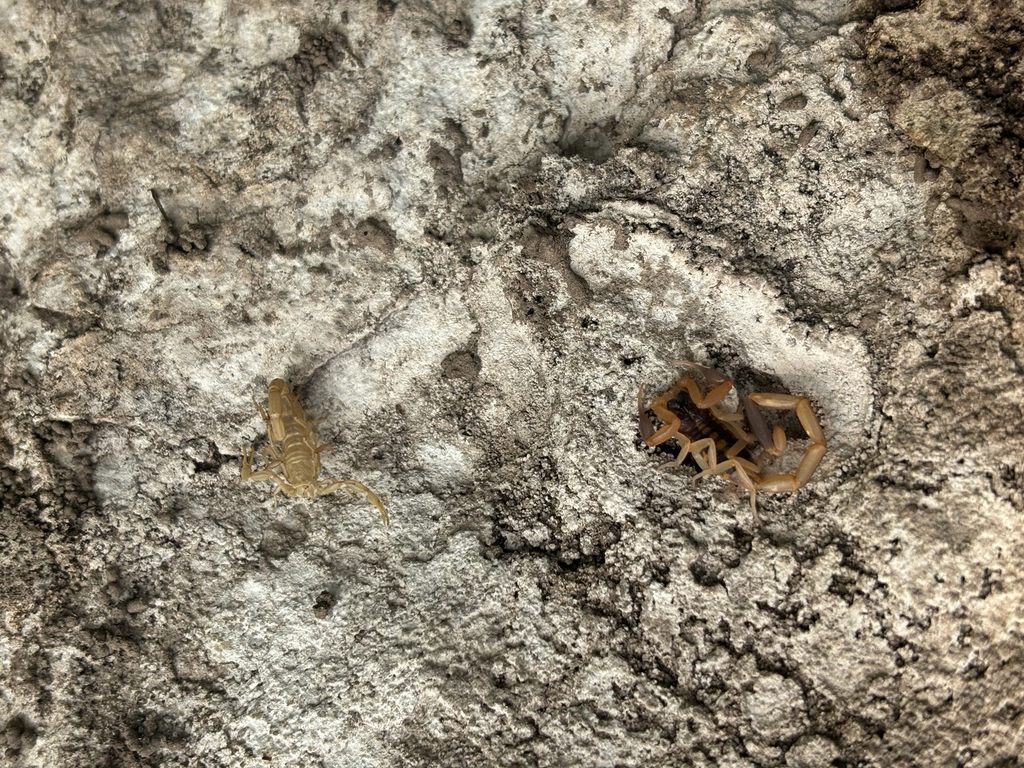
Scorpions glow blue-green under ultraviolet light because a thin outer layer in their exoskeleton absorbs UV and re-emits it as visible light. Almost every scorpion species does it, including the common striped bark scorpion, and one leading theory says the whole body works as a light-sensing organ.
Point an ultraviolet torch at a patch of desert or scrub after dark and, sooner or later, something on the ground answers back: a small, unmistakable smear of blue-green light where nothing was visible a second before. It is a scorpion, and the glow is not a trick of the light. It is built into the animal itself, and almost every scorpion species on Earth does it.
How does a scorpion glow under UV light?
The glow comes from fluorescence, not bioluminescence. A scorpion produces no light of its own; it only glows while ultraviolet light is actively shining on it. A thin coating on the exoskeleton called the hyaline layer contains two known compounds, mainly a molecule called beta-carboline alongside a coumarin (4-methyl-7-hydroxycoumarin), that absorb UV wavelengths, roughly 350 to 400 nanometres, and re-emit that energy as visible light in the blue-green range, around 450 to 500 nanometres.
The effect covers the whole animal at once, which is why a scorpion under a blacklight torch looks like a single glowing outline rather than a few scattered spots. It is the same underlying physics as the structural blue of the common kingfisher or the colour-shifting skin of a panther chameleon: light being manipulated by a physical structure, not painted on with pigment.
Why don't freshly molted scorpions glow?
A scorpion that has just shed its old exoskeleton is pale, soft and, for a while, dark under UV light. The hyaline layer builds up as the new cuticle hardens, a process called sclerotisation, and the fluorescent compounds are laid down as part of that hardening. It typically takes roughly a week after a molt for the layer to mature enough to fluoresce properly, so a soft-bodied juvenile is briefly invisible to a blacklight survey even while adults nearby glow brightly.
Once it forms, the hyaline layer is remarkably tough. It survives in fossilised scorpion cuticle that is tens of millions of years old, long after every other soft tissue has decayed, which is part of how palaeontologists identify ancient scorpion remains in the first place.
Why did scorpion fluorescence evolve? The "giant eye" idea
The chemistry is well understood; the reason it evolved is still debated. The leading hypothesis, put forward by biologist Douglas Gaffin and colleagues, treats the entire fluorescing exoskeleton as a crude, whole-body light sensor. Scorpion eyes are poor at distinguishing UV wavelengths on their own, but a body that converts invisible UV into blue-green light the eyes can register effectively turns the whole animal into what researchers have called a "giant eye."
Under that idea, a scorpion out foraging can use its own glow to judge ambient UV levels, whether from a bright moon or the first light of dawn, and use that reading to decide when conditions are too exposed and it is time to retreat to a crevice. It is one of a handful of theories on the table, alongside ideas about UV protection and prey or mate detection, and researchers have not settled on a single answer. What is well established is the chemistry: the glow is real, consistent and testable, even if its full purpose is not yet.
Is the striped bark scorpion dangerous?
Not seriously, for a healthy adult. The striped bark scorpion delivers a genuinely painful sting: sharp local pain, redness and swelling, and in some cases a tingling sensation likened to a mild electric shock. But it is not classed as medically significant, and serious reactions are rare and generally limited to allergic responses rather than the venom itself.
That is worth spelling out because not every scorpion in its own genus is so forgiving. The Arizona bark scorpion, a close relative, carries venom capable of causing serious illness, especially in children. Field identification matters more than genus alone, so treat any wild scorpion with caution and avoid handling it, even where the resident species is the milder striped bark scorpion.
Where to find one, and how to spot the glow yourself
The striped bark scorpion is common across the south-central United States and northern Mexico, from Texas and Oklahoma through Arkansas, Louisiana, Kansas, Missouri and into New Mexico. By day it shelters under loose bark, rocks and surface debris, in sheds, and around the foundations of old buildings; by night it comes out onto open ground and low vegetation to hunt insects and other small invertebrates.
A UV torch, sold widely as a "blacklight," is the standard tool for finding one after dark. Sweep the beam low across bare ground, rock piles or tree bark near dusk, and a scorpion will stand out as a glowing shape from several metres away, long before you could ever spot it by eye alone. It is the same low-cost technique field biologists use to survey scorpion populations, since the animals are otherwise cryptic and mostly nocturnal.
Three things worth knowing about scorpion fluorescence
- Fluorescence has been recorded in essentially every scorpion family studied, making it one of the most universal traits in the entire order Scorpiones, rather than a quirk of one or two species.
- The hyaline layer is so durable that scorpion fossils tens of millions of years old still fluoresce under UV light, decades or millennia after the animal died.
- The trait shows up alongside other extreme sensory tricks in the animal world, from the sixteen colour receptors of the mantis shrimp to the whiskered star-nosed mole's touch-based hunting, a reminder that plenty of animals perceive light and their surroundings in ways nothing like human vision. It is a theme covered in more depth in seven animals with extreme senses.
Scorpion UV fluorescence: frequently asked questions
Why do scorpions glow under UV light?
A thin coating on their exoskeleton, the hyaline layer, contains compounds (mainly beta-carboline and a coumarin) that absorb ultraviolet light and re-emit it as visible blue-green light. It is fluorescence, not bioluminescence: a scorpion produces no light of its own and only glows while UV is shining on it.
Do all scorpions glow under a blacklight?
Nearly all of them. Fluorescence under UV has been recorded across essentially every scorpion family studied, making it one of the most consistent traits in the entire order Scorpiones, unlike most animal adaptations, which vary widely between species.
Why don't freshly molted scorpions glow?
The fluorescent compounds sit in the hyaline layer, which forms as the new cuticle hardens after a molt. A soft, pale scorpion that has just shed its old exoskeleton has not built that layer yet, so it stays dark under UV light until the cuticle finishes curing, typically within about a week.
Why did scorpion fluorescence evolve?
Nobody has proven it definitively, but the leading theory treats the entire exoskeleton as a crude light sensor. By converting UV into a wavelength the scorpion's own eyes can register, its glowing body may help it judge ambient light levels and know when moonlight or dawn light means it is time to retreat to shelter.
Is the striped bark scorpion dangerous to humans?
Its sting is painful, causing sharp local pain, swelling and sometimes a tingling or electric-shock sensation, but it is not considered medically significant for a healthy adult and is very rarely dangerous. That sets it apart from a few of its relatives in the same genus, such as the Arizona bark scorpion, whose sting can be medically serious.
Why is the striped bark scorpion "Common" in Kaught?
Kaught's rarity tier reflects how often a species is actually recorded in the wild, not whether it is endangered. The striped bark scorpion is abundant and widely reported across the south-central United States, so it sits at the Common tier: one diamond out of four.
The next thing you see could be
your first catch.
Kaught is live on the App Store and Google Play. Free to start, and your first catch is one photo away.
Free to start · Live on the App Store and Google Play
Species data, type, rarity tier and measurements, is drawn from the Kaught catalog, built on open biodiversity records from GBIF and iNaturalist. Rarity reflects how often a species is observed in the wild, not its conservation status.