
Species spotlight
The Lesser False Vampire Bat: the bat that never drinks a drop of blood
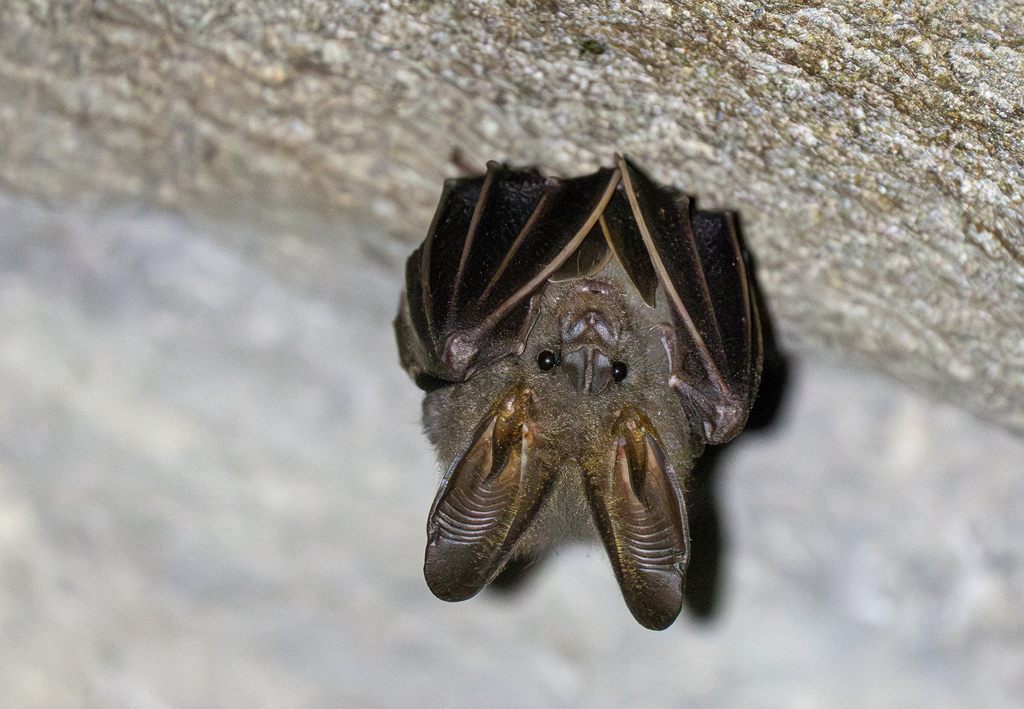
The lesser false vampire bat (Megaderma spasma) is a carnivorous bat from South and Southeast Asia. It hunts moths, grasshoppers and the occasional small vertebrate by sight, hearing and echolocation, snatching prey off leaves and the ground rather than chasing it through open air. Despite the name, it never touches blood.
Most bats you'll ever see are small, twitchy insect-hawkers, gone in a blur before you can focus on them. The lesser false vampire bat is something else entirely: a slow, deliberate hunter with ears nearly the length of its own body, built to pluck a grasshopper off a leaf in total darkness. And despite the name attached to it, it has never once fed on blood. Here's how to recognise one, where it lives, and what that name actually gets wrong.
How to identify a lesser false vampire bat
It's hard to mistake once you've seen the ears:
- Ears: enormous, joined at the base and swept forward over the face, the single most distinctive field mark in the genus.
- Face: a fleshy, spear-shaped noseleaf above the nostrils, used to focus outgoing echolocation calls.
- Body: pale grey to grey-brown fur, forearms around 7 cm and a wingspan up to 30 cm, but no visible tail, unusual among insect-hunting bats.
- In flight: the wing membranes carry yellowish veins that glow amber when backlit, visible if one crosses a torch beam.
It roosts head-down in small, loose clusters, wings wrapped around the body rather than tightly furled.
Where the lesser false vampire bat lives
The species ranges across South and Southeast Asia, from Sri Lanka and India in the west to Indonesia and the Philippines in the east, with populations also in Bangladesh, Bhutan, the Andaman and Nicobar Islands, Malaysia and mainland Southeast Asia. It roosts in caves, rock crevices, hollow trees and, increasingly, buildings, usually in groups of 3 to 30 individuals rather than the vast colonies some bat species form. Lowland forest close to a water source tends to hold the highest numbers, since that combination supports the large grasshoppers and moths it depends on, but a tolerance for roosting in man-made structures means it also turns up in temple ruins, culverts and disused mine tunnels well outside intact forest.
What it eats, and why "vampire" is the wrong word
The name is a 19th-century mix-up. Early naturalists lumped this bat in with the blood-feeding vampire bats of Central and South America (family Phyllostomidae) largely on looks, an oversized noseleaf and ears reading as sinister enough to fit. In reality, the lesser false vampire bat has never fed on blood. It is a carnivore and insectivore: grasshoppers and moths make up most of its diet, picked off tree trunks, walls, leaves and the forest floor. It occasionally takes small vertebrates too, frogs, lizards, mice, small birds and even other bats, though these are the exception rather than the rule.
How it hunts: gleaning instead of the open-air chase
Most bats you've heard of, the common pipistrelle among them, hunt on the wing, using echolocation to intercept flying insects mid-air. The lesser false vampire bat does something closer to a barn owl. It perches, listens and pounces. This is called gleaning: rather than chasing prey through open air, it scans a nearby surface, a leaf, a wall, the ground, for the sound of movement, then flies straight to the source and snatches the target using the membrane stretched between its hind legs. Larger prey is carried back to a favourite perch to eat rather than consumed in flight.
Three senses share the work. Short, low-density, broadband echolocation calls handle general orientation. Oversized ears pick up the faint scuffle a grasshopper makes crossing a leaf. And unusually for a bat, well-developed, forward-facing eyes let it spot movement directly, a rare case of a nocturnal mammal hunting as much by sight as by sound (our piece on animals with extreme senses covers several more that lean on senses beyond vision).
Lesser vs greater false vampire bat
Asia has two Megaderma species, and the names invite confusion. The greater false vampire bat (Megaderma lyra) is the larger of the pair and leans harder into vertebrate prey, taking other bats, birds, frogs and rodents more often than insects. The lesser false vampire bat covered here is smaller, and while it will take a vertebrate opportunistically, insects dominate the menu. In the field, size is the fastest tell: a false vampire bat with a forearm noticeably over 8 cm and a heavier build is more likely M. lyra.
Is the lesser false vampire bat dangerous to humans?
Not in any meaningful sense. It has no interest in people, doesn't feed on blood, and isn't aggressive. Like any wild bat it should never be handled, but a lesser false vampire bat roosting in a barn or outbuilding poses essentially no risk to the people living nearby.
How rare is the lesser false vampire bat in the Kaught catalog?
In the Kaught catalog it sits at the Epic tier, three diamonds out of four. That's a measure of how often the species is actually recorded in the wild, not a statement about its conservation status. It roosts in small, easily overlooked groups tucked into caves and hollow trees across a wide range, so even where it's locally common, a confirmed sighting stays uncommon.
Best time and place to look
Caves, culverts and old buildings across its range make the most reliable daytime roosts: look up near an entrance for a small, tight cluster of bats with their ears folded forward rather than pressed back. At dusk they leave to hunt low over the forest floor and understorey rather than open sky, so a slow, low-flying bat cutting between tree trunks just after sunset is a better candidate than anything chasing insects high overhead. For a wider range of after-dark wildlife, see our guide to nocturnal animals you can actually spot, and for the biosonar most other bat species rely on instead of gleaning, see how bats echolocate.
Three things you didn't know about the lesser false vampire bat
- The genus name Megaderma comes from Greek for "large skin", a nod to its oversized wing and ear membranes, not to its body size.
- It's one of the few bats known to hunt by sight as well as by sound; its eyes are unusually large and forward-facing for a strictly nocturnal mammal.
- A pile of discarded grasshopper legs, wings and beetle cases on the ground below a perch is often the first clue that a roost is nearby.
Lesser false vampire bat: frequently asked questions
Does the lesser false vampire bat drink blood?
No. Despite the name, it is entirely carnivorous and never touches blood. The "vampire" tag is a leftover from a 19th-century mix-up with the unrelated, true blood-feeding bats of the Americas. This species hunts insects and the occasional small vertebrate instead.
What does a lesser false vampire bat eat?
Mostly large insects, especially grasshoppers and moths, snatched off leaves, walls or the forest floor. It occasionally takes small vertebrates too, frogs, lizards, mice, small birds and even other bats, though insects make up most of the diet.
Where does the lesser false vampire bat live?
Across South and Southeast Asia, from Sri Lanka and India to Indonesia and the Philippines. It roosts in small groups of 3 to 30 in caves, tree hollows, rock crevices and buildings, emerging after dark to hunt.
How does it find prey in the dark?
It combines three senses. Short, broadband echolocation calls handle general orientation, oversized ears pick up the sound prey makes moving on a leaf or the ground, and unusually for a bat, well-developed forward-facing eyes let it spot movement directly.
What's the difference between the lesser and greater false vampire bat?
Both belong to the family Megadermatidae, but the greater false vampire bat (Megaderma lyra) is noticeably larger and eats vertebrates, including other bats, far more often. The lesser false vampire bat leans more heavily on insects.
Is the lesser false vampire bat dangerous to humans?
No. It has no interest in people, doesn't feed on blood, and isn't aggressive. Like any wild bat it should never be handled, but it poses no real threat to anyone living near a roost.
How rare is the lesser false vampire bat in the Kaught catalog?
It sits at the Epic tier, three diamonds out of four, reflecting how rarely it's actually recorded in the wild relative to more commonly observed bats. That's a measure of observation frequency, not conservation status.
The next thing you see could be
your first catch.
Kaught is live on the App Store and Google Play. Free to start, and your first catch is one photo away.
Free to start · Live on the App Store and Google Play
Species data, type, rarity tier and measurements, is drawn from the Kaught catalog, built on open biodiversity records from GBIF and iNaturalist. Rarity reflects how often a species is observed in the wild, not its conservation status.