
Habitat guide
What animals live on a coral reef? 6 species ranked by rarity
Coral reefs hold the highest species density of any marine habitat. This guide profiles six reef animals across different roles: a clownfish living in an anemone's stinging tentacles, an eel with a second set of jaws inside its throat, the fastest fish in shallow water, the world's most venomous fish hiding as a rock, an octopus with a unique fixed spot pattern, and a shrimp whose punch creates a cavitation bubble hot enough to flash-stun prey. Each species has a rarity tier in the Kaught catalog derived from real observation frequency.
Coral reefs cover less than 0.1 per cent of the ocean floor but host roughly a quarter of all known marine species. The density of life that figure implies is visible the moment you put on a mask over a healthy reef: every square metre of substrate is colonised, contested and defended. Six species from the Kaught catalog illustrate the range of strategies that make a reef career possible.
1. Spine-cheek Clownfish
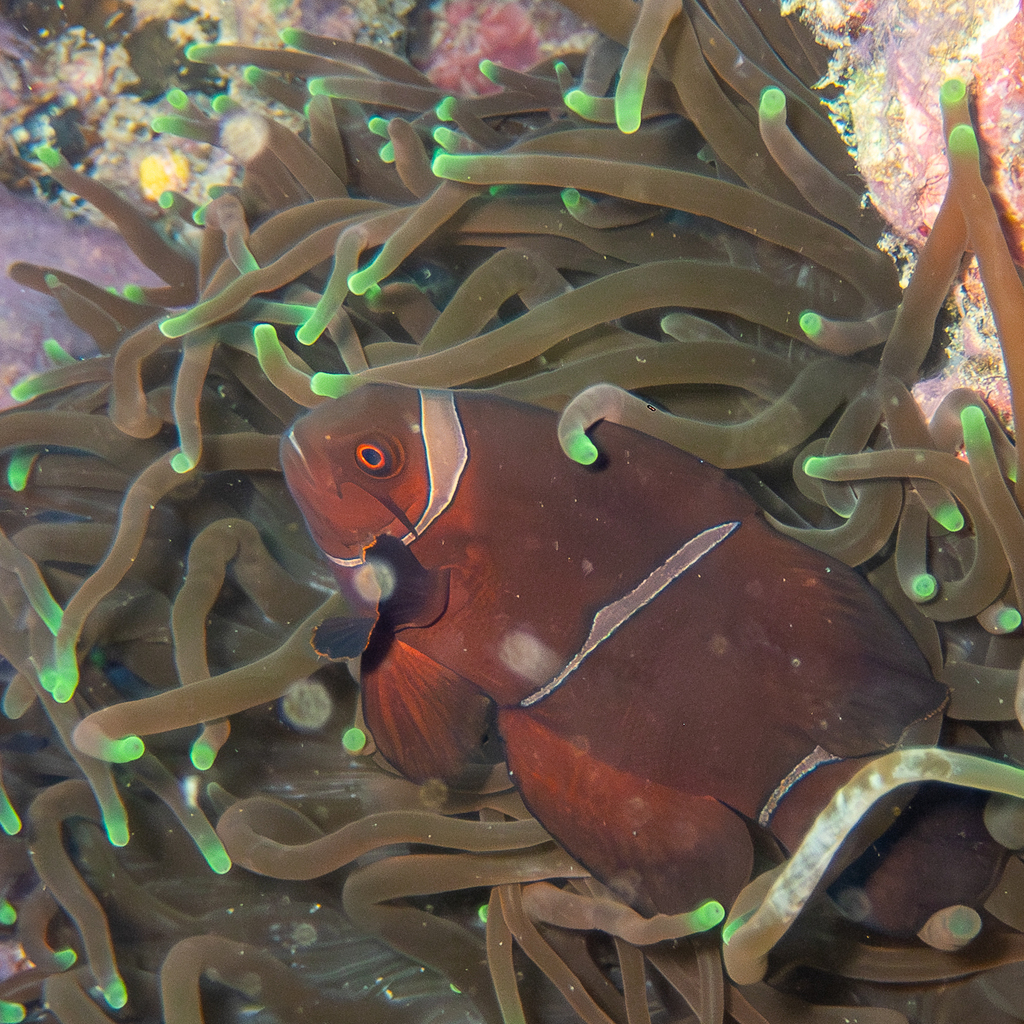
The spine-cheek clownfish is the only member of its genus and takes its name from the prominent spines below each eye, a feature absent in all other clownfish species. In the wild it lives exclusively within the tentacles of the maroon or bubble-tip anemone, protected by a thick mucus coating on its own skin that prevents the anemone's nematocysts from firing.
The mutualism is well-documented: the clownfish chases away butterflyfish that would otherwise eat the anemone's polyps, and the fish's waste provides nitrogen to the anemone's zooxanthellae. Whether the anemone actively benefits from the relationship or is simply indifferent to the fish's presence is still debated, but the fish's dependence is clear. A clownfish removed from its host anemone rarely survives long in open water on a healthy reef.
Spine-cheek clownfish are sequential hermaphrodites. Groups living in a single anemone have one large female, one breeding male, and several smaller non-reproductive males. If the female dies, the breeding male changes sex and becomes female within weeks, and the largest non-reproductive male becomes the new breeding male. The hierarchy exists because the anemone can only support a limited biomass, and this system maximises reproductive output from a fixed territory.
The full wonderpus profile gives context for how another reef animal solves the problem of territory differently, through active camouflage mimicry rather than a fixed host partnership.
2. Laced Moray
The laced moray, sometimes called the honeycomb moray, is one of the largest moray eels in the world, reaching 3 metres in length and 30 kg. Its body is covered in a white or cream base with a dense black spot pattern that resembles a honeycomb or lace, a pattern that breaks up the eel's outline among coral heads and rocky crevices.
Moray eels have a jaw anatomy found nowhere else among vertebrates. After the outer jaws seize prey, a second set of jaws, the pharyngeal jaws, moves forward from the esophagus into the oral cavity, grabs the prey independently, and retracts backward, pulling the meal into the throat. Most fish swallow by creating suction, drawing water and prey backward in a rapid expansion of the mouth cavity. In a narrow, elongated body like a moray's, that suction mechanism does not work efficiently. The pharyngeal jaw system is the evolutionary solution to the same mechanical problem.
The laced moray hunts at night, resting in crevices during the day with only its head visible, mouth opening and closing rhythmically. This movement is not aggression: it is breathing. Moray eels cannot pump water across their gills by closing their mouths as most fish can; the continuous gaping is the only way to circulate water.
3. Great Barracuda
The great barracuda is the largest of the barracuda family, reaching 1.9 metres and 45 kg, and is one of the fastest fish in shallow tropical waters. It accelerates to around 55 km/h in short bursts, using a body designed for rapid straight-line movement: a streamlined torpedo shape, a forked tail for power, and a jaw that extends forward to expose two rows of large, fang-like teeth for seizing fast-moving fish at speed.
Barracuda are known for following divers, a behavior that is exploratory rather than predatory: the fish are attracted to movement and reflective surfaces that resemble the silver flank of a fish. Shiny dive jewelry and watches are sometimes investigated at close range, which produces alarming encounters. Unprovoked attacks on humans are rare and almost all on record involved some provocation or misidentification.
Large great barracuda in tropical reef systems carry a significant risk of ciguatera toxin, which accumulates from dinoflagellate algae at the base of the food chain and concentrates in apex predators. The toxin is not destroyed by cooking. Fish below around 90 cm from cooler inshore waters are generally considered lower-risk, but large individuals from reef systems are widely avoided as food in affected regions for this reason.
4. Reef Stonefish
The reef stonefish is considered the most venomous fish in the world. Thirteen dorsal spines, each connected to a venom gland, pierce any foot or hand that makes contact with the fish. The delivery is entirely passive: the stonefish does not move toward a threat. It relies on camouflage so complete that the fish is essentially indistinguishable from a barnacled rock or a piece of encrusted dead coral on a shallow reef flat. Being stepped on is an occupational hazard of looking so convincingly like the substrate.
The venom causes immediate, severe pain described as among the most intense of any animal envenomation, followed by tissue necrosis, temporary paralysis, and, in untreated cases, cardiovascular effects that can be fatal. Hot water immersion (as hot as can be tolerated) denatures the protein-based venom and significantly reduces pain. An antivenom exists and is held at major hospitals in endemic regions. The most venomous animals guide covers the mechanism in more detail.
The stonefish does not pursue prey either. It waits, motionless, for small fish and crustaceans to swim within range of its mouth, then opens its jaws in under 15 milliseconds, one of the fastest strikes in the animal kingdom, creating a suction that draws the prey in before the prey can react.
5. Wonderpus Octopus
The wonderpus octopus has a fixed, unique spot pattern, an unusual feature in a group of animals defined by their ability to change appearance in real time. In most octopus species the chromatophore patterns are dynamic and variable: the same animal can look completely different from one moment to the next. In the wonderpus, the white circular spots on the arms and the orange-brown base color are stable enough that individual animals can be identified by their spot pattern in the same way humans can be identified by fingerprints. This has made the wonderpus the basis for the first photographic identification database for a wild octopus population.
The wonderpus is also one of the confirmed mimics among octopuses, able to adopt postures and color patterns that resemble lionfish and flatfish in addition to its striking base display. The full biological context of its mimicry behavior is covered in the dedicated species profile. Here it is sufficient to note that the combination of a fixed identifying pattern and an active mimicry repertoire is unusual: most animals with reliable identifying marks are not also accomplished mimics.
The species is found on sandy slopes and rubble fields at the edges of reefs at 3 to 50 metres depth. It is active during the day, which is rare among octopuses, and hunts by corralling small crustaceans with its spread arms against the substrate.
6. Shako Mantis Shrimp
The shako mantis shrimp is a smasher mantis shrimp: its raptorial appendages terminate in a calcified club rather than a spear, and it uses them to break the shells of snails, clams and crabs rather than to impale soft-bodied prey. The strike speed is around 23 metres per second, fast enough that the water in front of the club drops below the vapor pressure of seawater for a fraction of a millisecond, forming a cavitation bubble. That bubble collapses violently as pressure equalizes, generating a shockwave and a flash of light through sonoluminescence. The prey is struck twice: once by the club itself and once by the collapsing cavitation bubble. The club is a natural composite material studied by materials engineers for its crack resistance under repeated high-velocity impact.
Its visual system has 16 types of photoreceptor cells (humans have three) capable of detecting ultraviolet, infrared and polarized light simultaneously. The full profile of this adaptation is in the mantis shrimp guide. In the context of the reef, the vision system likely serves identification of other stomatopods and detection of cryptic prey hidden in coral rubble.
The Legendary rarity tier (four diamonds in the Kaught catalog) reflects how infrequently this species is encountered. It spends almost all its time in a burrow in sandy reef flats, emerging briefly to hunt and fight. A diver or snorkeler on a healthy reef might see dozens of clownfish per dive but never see a mantis shrimp unless looking actively, usually at night, at burrow entrances in sand patches.
Rarity on the reef
Five of these six species sit at the same rarity tier in the Kaught catalog: Epic, three diamonds. The sixth, the mantis shrimp, reaches Legendary. The spread reflects how observation frequency distributes on a reef: clownfish are common to any diver because they sit in open water advertising their location; a stonefish and a moray eel are in the same physical space but require a trained eye or the right light angle to spot. The catalog tier is not a measure of biological impressiveness but of how often wild encounters actually happen, which tends to correlate more with behavior and habitat use than with any other factor.
Coral reef diving records from iNaturalist show a strong detection bias toward species that are bright, mobile and active during the day. Night-active species like the moray eel and the mantis shrimp are substantially under-represented relative to their actual abundance, which is reflected in their Epic and Legendary catalog tiers despite their widespread ranges. The catalog is honest about this: the tiers encode encounter probability, not total population size.
Coral reef animals: frequently asked questions
What animals live on a coral reef?
Coral reefs host the highest density of marine species on Earth, including fish such as clownfish, barracuda, moray eels and stonefish; invertebrates such as mantis shrimp and octopuses; and thousands of smaller invertebrates. The six species in this guide each occupy a different ecological role on the reef.
Are clownfish really symbiotic with sea anemones?
Yes. The spine-cheek clownfish lives exclusively among sea anemone tentacles, protected by mucus that prevents the anemone from stinging it. The clownfish chases away polyp-eating butterflyfish and its waste fertilizes the anemone. The relationship is obligate for the fish, which rarely survives long without a host anemone in the wild.
What makes the moray eel's jaw unusual?
Moray eels have two sets of jaws. The outer jaws hold prey; a second set (pharyngeal jaws) moves forward from the throat, grabs the prey independently and pulls it backward into the esophagus. This mechanism is unique to moray eels among vertebrates, solving the problem of swallowing in a narrow body where suction-based feeding is inefficient.
Why is the reef stonefish so dangerous?
It is the most venomous fish in the world. Its dorsal spines inject venom passively when stepped on or grabbed. The fish's near-perfect camouflage as a rock or encrusted coral head makes it easy to step on in shallow reef flats. The venom causes intense pain, tissue death and, in untreated cases, can be fatal.
What is the rarest animal on a coral reef?
Based on observation frequency in the Kaught catalog, the shako mantis shrimp is the rarest of these six species at Legendary tier (four diamonds). Despite a widespread Indo-Pacific range, it spends most of its time in burrows and is rarely encountered by divers without actively searching.
Can you eat barracuda?
Yes, but large great barracuda from tropical reefs carry significant ciguatera risk. This toxin accumulates up the food chain and concentrates in apex predators; cooking does not destroy it and it causes severe neurological symptoms. Smaller individuals from cooler inshore waters are generally considered lower risk.
The next thing you see could be
your first catch.
Kaught is live on the App Store and Google Play. Free to start, and your first catch is one photo away.
Free to start · Live on the App Store and Google Play
Species data, type, rarity tier and measurements, is drawn from the Kaught catalog, built on open biodiversity records from GBIF and iNaturalist. Rarity reflects how often a species is observed in the wild, not its conservation status.