
Exotic spotlight
Coconut Crab: the world's largest land invertebrate climbs trees and cracks steel
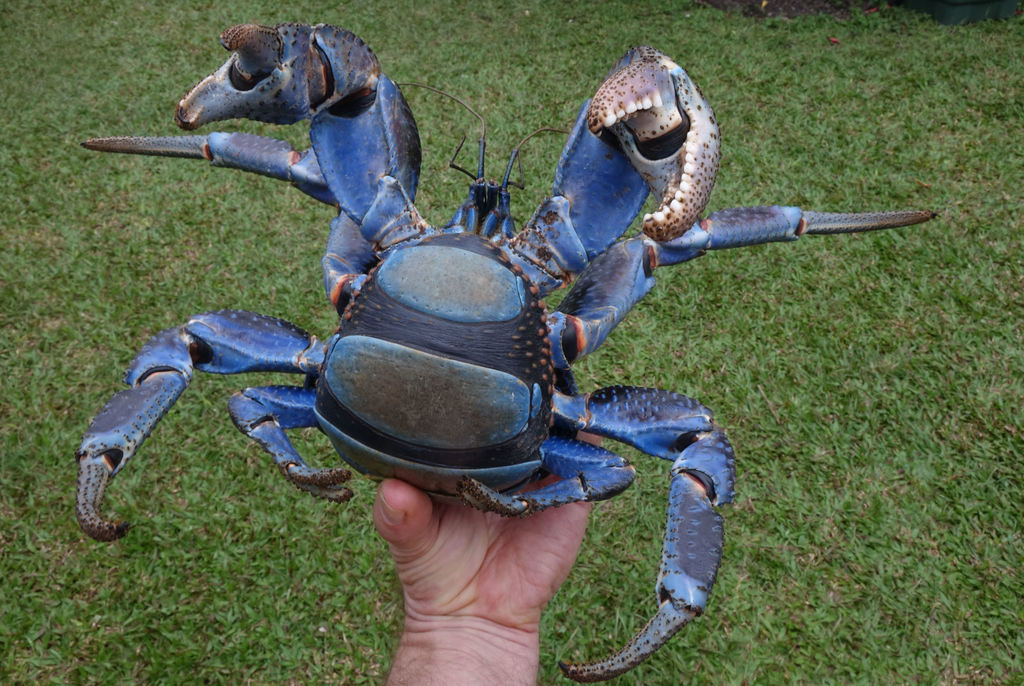
The coconut crab (Birgus latro) is the world's largest land invertebrate: up to 1 m leg span, 4.1 kg, with a claw force of 3,300 N. It climbs palms, cracks coconuts, breathes air, and would drown in the ocean where its larvae were born.
There is an animal living in the Indo-Pacific that spent the first few weeks of its life drifting in the open ocean, came ashore as a thumbnail-sized juvenile, and has not gone back to the water since. Over the next sixty years it grew, moulted and grew again until it became something that looks like a stage prop: a crab the size of a small dog with claws that can crack a coconut, a steel pin or a human finger with equal ease.
The coconut crab is the largest land invertebrate on Earth. Finding one in the wild, particularly in daylight, is unusual enough that Kaught rates it Common based on total population, but in practice the big adults stay hidden. When you do see one, you will not forget it.
How large does a coconut crab get?
A large adult coconut crab has a leg span of up to 1 m and a body weight of up to 4.1 kg. Compare that to the next-largest land crustacean, the robber crab of the same family, which tops out at around 2 kg, or any hermit crab you have seen on a beach, which weighs a few grams. The coconut crab is in a category of its own.
Growth is extremely slow: reaching maximum size takes 40–60 years. The individual you encounter huddled under a coral slab on a remote Pacific atoll is probably older than the ship that brought you there. Across most of their range, coconut crabs are fished heavily and large individuals are now scarce. On uninhabited islands with no hunting pressure, dense populations of big adults still exist.
The claw: a force of 3,300 N
A 2016 study measured the pinching force of coconut crab claws: the largest individuals exerted around 3,300 N, the strongest grip force ever recorded for any crustacean, and proportionally higher relative to body weight than a lion's bite. The researchers noted this comfortably exceeds the force needed to crack a coconut.
The claws are used for climbing, feeding, defence and competition. In confrontations between crabs, claw size is the primary determinant of dominance. Smaller crabs retreat immediately from larger ones. A large crab that grabs a limb will not release it quickly. This is the one clear danger the animal presents to people: slow movement, powerful grip, no intention of letting go.
Compare claw force to other extreme grippers: the mantis shrimp achieves similar peak forces over a much shorter strike, and for a different purpose. The coconut crab is the sustained compression champion. It is also listed among the strongest animals in the world relative to body mass.
A crustacean that cannot swim
The coconut crab's gill chambers have been converted, over evolutionary time, into organs called branchiostegal lungs: spongy, moist tissue that absorbs atmospheric oxygen. The animals must keep these organs damp, which is why they shelter in humid burrows during the day and emerge at night. But immerse an adult in seawater and it drowns within hours.
This creates a striking constraint: the females must return to the sea once a year to release eggs into the surf, and then immediately leave before they are submerged. The larvae hatch in the ocean and drift for 3–4 weeks as free-swimming zooplankton, no different from any other marine crustacean larva. They then settle on the seafloor briefly, adopt a shell like a hermit crab, and migrate onto land. Within a few months, the gills are gone and the animal is fully committed to terrestrial life. It will never return to water again.
What coconut crabs actually eat
The name is partly accurate. Coconut crabs do eat coconuts, using their claws to strip the husk and prise open the shell, sometimes rotating a coconut in a precise sequence of punctures. But they are opportunistic omnivores. They eat fallen fruit, carrion, other crabs, bird eggs and chicks, and will scavenge almost anything high in protein. Their sense of smell is acute, more similar in structure to an insect's antennae than to the chemical receptors of marine crustaceans, allowing them to detect food from tens of metres away.
They are also strong climbers. Coconut crabs regularly scale palm trunks to reach fruit, grip the stem of a coconut until it falls, then descend to process it at ground level. The climbing ability, combined with their size, has led to occasional dramatic encounters with seabird colonies: coconut crabs have been documented killing and eating nesting boobies and frigatebirds.
Where to find one
Coconut crabs occupy tropical and subtropical islands from the Seychelles and eastern Africa through the Indian Ocean to Polynesia. They are absent from continental mainland coastlines. On inhabited islands they are heavily hunted and mostly found as small juveniles; on remote, uninhabited atolls, they can be abundant and reach their maximum size.
The best time to look is at night, in humid forest or at the edge of beach vegetation. During the day most adults shelter in burrows or under coral rubble. Tracks in sand, consisting of five pairs of leg prints with a central drag mark from the abdomen, are often visible in the morning. See also: the slowest animals in the world, which includes several long-lived island specialists that share coconut crab habitat.
Coconut crab: frequently asked questions
How big is a coconut crab?
Up to 1 m leg span and 4.1 kg body weight, making it the largest land-dwelling invertebrate on Earth. Reaching full size takes 40–60 years; most individuals encountered near human settlements are much smaller due to hunting pressure.
Can a coconut crab really crack a coconut?
Yes. Claw force reaches approximately 3,300 N in large individuals, the strongest grip ever recorded for a crustacean. This exceeds the force needed to crack a coconut. They strip the husk by rotating the coconut and striking repeatedly, then prise open the shell with their claws.
Where do coconut crabs live?
Across tropical and subtropical islands in the Indo-Pacific, from the Seychelles through the Indian Ocean to Polynesia. They require humid forest with access to sandy or rocky beach, and are most abundant on remote uninhabited islands where they are not hunted.
Can coconut crabs breathe underwater?
No. Adults breathe air through branchiostegal lungs and will drown if kept submerged for more than a few hours. Despite this, females must briefly enter the surf to release larvae, then leave immediately. Larvae spend 3–4 weeks in the ocean before coming ashore permanently.
How long do coconut crabs live?
Thought to reach 40–60 years, making them one of the longest-lived invertebrates. The largest individuals you can find on remote atolls are likely older than most people you know.
The next thing you see could be
your first catch.
Kaught is live on the App Store and Google Play. Free to start, and your first catch is one photo away.
Free to start · Live on the App Store and Google Play
Species data, type, rarity tier and measurements are drawn from the Kaught catalog, built on open biodiversity records from GBIF and iNaturalist. Rarity reflects how often a species is observed in the wild, not its conservation status.