
Superlative
Best camouflaged animals in the world: 7 masters of disguise
The best animal camouflage ranges from a moth that matches soot-stained bark to an octopus that changes colour and skin texture in under a second. This ranking covers seven species and seven types, from simple background-matching to full shape-shifting mastery, each grounded in the Kaught catalog.
Camouflage is not one trick. Some animals just happen to be the right colour for where they live and hold still. Others actively rebuild their disguise every day, change it by the second, or wear someone else's body as a costume. Here are seven of the best examples across seven different types, ranked from the simplest mechanism to the most sophisticated.
What actually counts as camouflage?
Biologists split animal camouflage into a few broad strategies: background matching (being the same colour as your surroundings), disruptive colouration (patterns that break up your outline rather than match a colour), seasonal change (swapping the whole coat or plumage on a schedule), active colour change (adjusting pigment cells in real time), and decoration (physically attaching camouflage material to your body). The seven species below cover every one of those strategies, and the Kaught catalog tracks each as its own primary type, so the same disguise mechanism shows up across mammals, birds, fish, insects, amphibians, molluscs and crustaceans independently.
1. Peppered Moth
The peppered moth is the simplest strategy on this list: be the same colour as the surface you rest on, and do not move. By day it presses flat against tree bark and relies entirely on its wing pattern to vanish, a pale, speckled form that matches lichen-covered bark almost perfectly.
It is also the best-documented live case of natural selection acting on camouflage. During Britain's industrial era, soot blackened tree trunks across whole regions, and a dark wing form (once rare) became the common one almost overnight because birds picked off the pale moths that now stood out. When air pollution controls let lichen recover, the pale form became common again. Nobody designed that shift. Birds hunting by sight did it, one moth at a time.
2. Common Leaf-litter Frog
Take background matching and add texture, and you get the common leaf-litter frog: a small, mottled brown and tan amphibian of the Central American forest floor whose skin pattern breaks up its outline against dead leaves so completely that most people hear its call long before they ever see it sitting still.
It is also a direct developer, one of a large family of frogs whose eggs skip the tadpole stage entirely and hatch straight into tiny, fully formed froglets in the leaf litter itself. No pond, no larval stage exposed in open water, just camouflage from the moment of hatching.
3. Rock Ptarmigan
Static camouflage only works if the background stays the same colour. The rock ptarmigan's answer to a landscape that turns from bare rock to deep snow and back is to moult three separate plumages a year: mottled brown-grey through summer, a patchy transitional coat in autumn, and pure white through winter. Even its legs and feet are feathered to the claws, the trait that gives the whole grouse family its name.
Few birds bother with three distinct moults in a single year. For a ground-nesting bird with almost nowhere to hide on open tundra, it is close to the only defence it has.
4. Arctic Fox
The arctic fox solves the same problem as the ptarmigan, on the same tundra, by the same method: a full seasonal coat change, brownish-grey in summer and pure white in winter. Neither animal borrowed the trick from the other. A predator and its prey arrived at an identical solution to an identical landscape, entirely independently, which is what makes the pairing worth noticing.
The fox's winter coat is not just camouflage. It is also the warmest fur measured in any mammal, insulating against temperatures below minus 50 degrees Celsius, so the same investment in dense white fur pays for concealment and survival at once.
5. Pacific Peacock Flounder
A flounder starts life like any other fish, upright with one eye on each side of its head. As it matures, one eye migrates across the skull to sit beside the other, and the fish settles permanently onto its side on the seafloor. That strange rebuild is what makes its camouflage possible: lying flat, both eyes scanning the substrate, it can shift its skin pattern to match a new patch of sand or rubble in under a second, one of the fastest colour-change responses measured in any fish.
Unlike the seasonal moults above, this is active, moment-to-moment control: the same fish can look completely different twenty metres apart, matching whatever it happens to be resting on.
6. Graceful Decorator Crab
Every animal so far camouflages with its own body. The graceful decorator crab camouflages with everyone else's. It snips small pieces of sponge, algae and hydroids and hooks them onto specialised bristles covering its shell and legs, building a living costume from whatever grows nearby, and replaces the whole thing piece by piece as it grows and moults.
Some individuals go further and deliberately attach stinging or toxic organisms to their shell, so the disguise doubles as a defence: anything that gets close enough to notice the crab underneath gets stung for the trouble.
7. Day Octopus
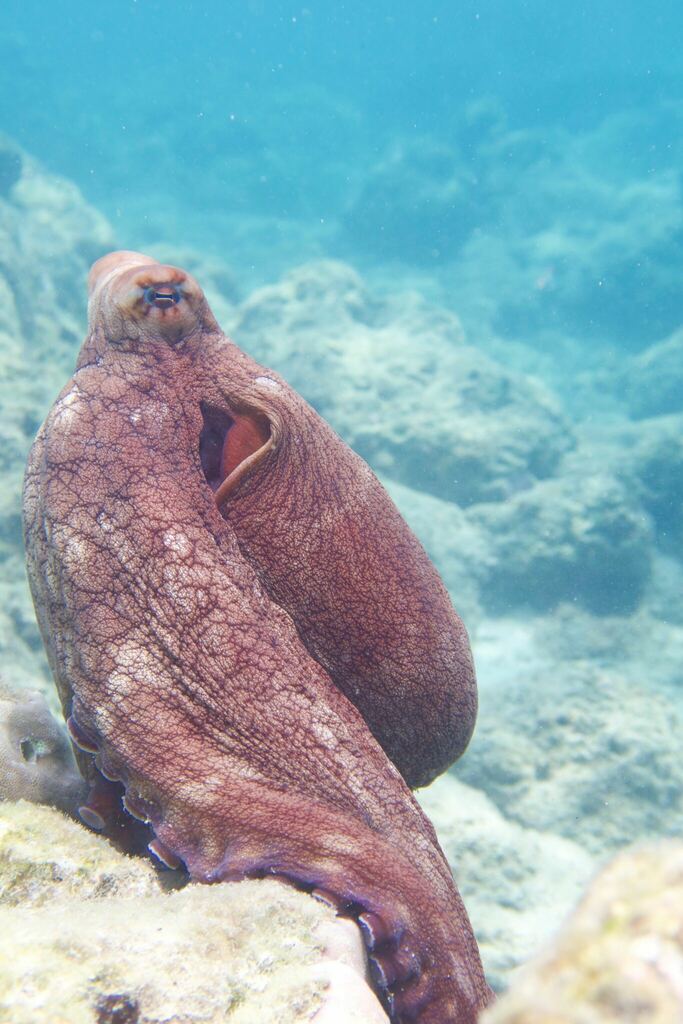
The day octopus does everything on this list at once, and does it faster. Pigment sacs in its skin shift its colour, deeper cells add iridescence and shine, and muscles beneath the skin raise or flatten small bumps called papillae to copy the texture of coral, rock or algae, all in well under a second and all under direct control from the brain.
What makes it stranger is that the day octopus is colour-blind. It has no cone cells to distinguish hue, yet it reliably matches the colour of whatever it is sitting on. Researchers suspect light-sensitive proteins in the skin itself may let the animal sense colour without ever routing that information through its eyes, though exactly how the picture reaches the pigment cells is still an open question. It is also unusual for hunting by day rather than at night, using that camouflage to stalk crabs and small fish across open reef instead of relying on darkness for cover.
Why camouflage varies so much between species
The gap between a peppered moth pressed against bark and an octopus rewriting its own skin in real time comes down to what each animal is defending against, and how often. A moth only needs to fool a bird glancing at a tree trunk. An octopus hunting in the open by day, watched constantly by moray eels and reef sharks, needs a disguise that updates every time it moves. Camouflage complexity tends to track exactly how exposed and how mobile an animal actually is. For a completely different route to the same problem, one built around mimicking a single object rather than blending into a whole background, see how the leafy seadragon evolved to look exactly like floating seaweed, or how chameleons change colour using physics rather than pigment.
Camouflage also is not always about hiding from a predator. The warty anglerfish disappears into the reef so it can ambush prey, and the wonderpus octopus takes disguise a step further, mimicking the shape and movement of venomous animals rather than just their colour.
How rare are these animals in the Kaught catalog?
The seven species here span three of Kaught's four rarity tiers: Common (the peppered moth and the decorator crab), Rare (the leaf-litter frog, ptarmigan, arctic fox and day octopus) and Epic (the peacock flounder). As always, that tier reflects how often a species is actually logged in real sightings, not conservation status. A good disguise cuts both ways here: an animal built to be missed by predators is, almost by definition, also built to be missed by anyone trying to record it, which is part of why several of the best-camouflaged species on Earth sit above the Common tier.
Best camouflaged animals: frequently asked questions
What is the best camouflaged animal in the world?
The day octopus is the strongest all-round candidate. It changes both skin colour and skin texture, raising bumps to mimic coral or rock, in well under a second, despite having no colour vision of its own.
How does a peppered moth use camouflage?
It presses flat against bark by day and relies entirely on its wing pattern to disappear. A pale speckled form matches lichen-covered bark and a dark form matches soot-darkened bark, a textbook live example of natural selection driven by bird predation.
Why do arctic foxes and rock ptarmigans both turn white in winter?
Both species evolved seasonal camouflage independently to match Arctic snow cover. The fox switches its whole coat colour twice a year, while the ptarmigan moults three separate plumages, an example of two unrelated animals converging on the same solution to the same problem.
How fast can a flounder change colour?
A Pacific peacock flounder can shift its skin pattern to match a new patch of seafloor in under a second, one of the fastest camouflage responses measured in any fish, achieved while lying flat with both eyes on one side of its head.
Do decorator crabs really wear their camouflage?
Yes. A graceful decorator crab snips pieces of sponge, algae and hydroids and hooks them onto bristles covering its shell, rebuilding the disguise as it grows. Some individuals attach stinging organisms too, turning the camouflage into a defence as well.
Can an octopus see the colours it copies?
No. Octopuses are colour-blind, yet a day octopus reliably matches the hue of its background. Researchers think light-sensitive proteins in the skin itself may let the animal sense colour without ever routing that information through the eyes, though the full mechanism is still being studied.
How rare are these seven animals in the Kaught catalog?
They range from Common to Epic. Kaught's rarity tier measures how often a species is actually recorded in the wild, not conservation status, so a good disguise that fools both predators and observers can itself push a species toward a higher tier.
The next thing you see could be
your first catch.
Kaught is live on the App Store and Google Play. Free to start, and your first catch is one photo away.
Free to start · Live on the App Store and Google Play
Species data, type, rarity tier and measurements, is drawn from the Kaught catalog, built on open biodiversity records from GBIF and iNaturalist. Rarity reflects how often a species is observed in the wild, not its conservation status.