
Adaptation explainer
Osprey: the anatomy behind a perfect fishing dive
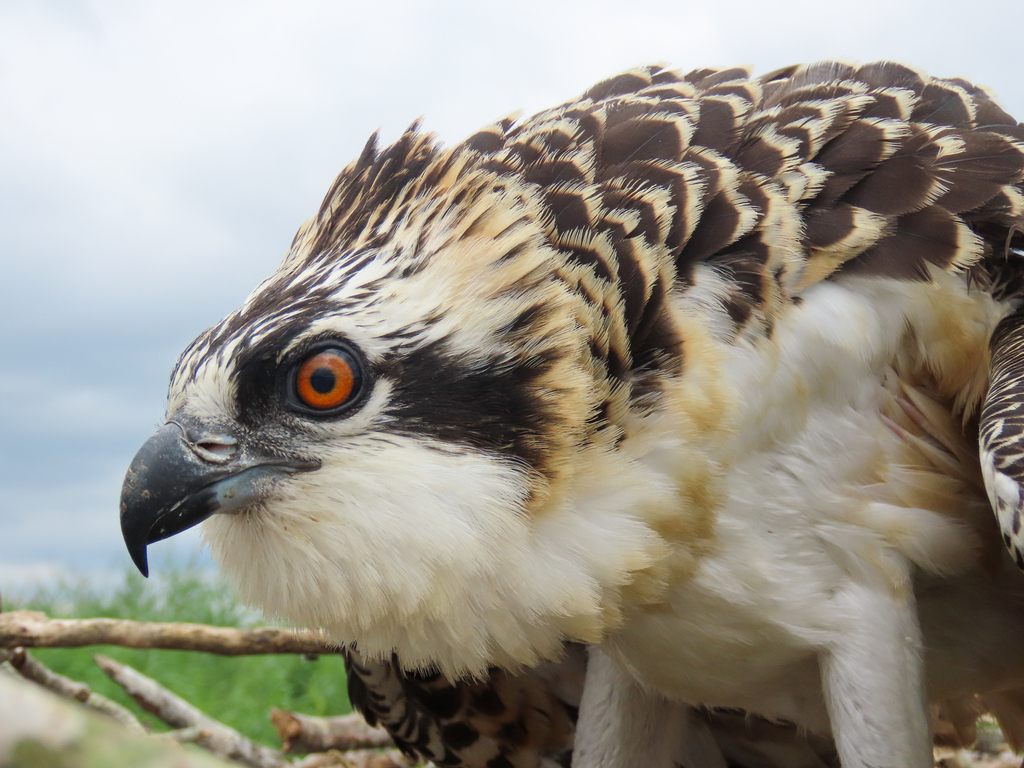
The osprey (Pandion haliaetus) is the only raptor placed in its own family and the only bird of prey that catches fish by plunge-diving feet-first from open water. Barbed toe pads, a reversible outer toe and self-sealing nostrils make every strike remarkably effective.
The osprey hunts fish in a way no other bird quite manages: from altitude, in a vertical drop, feet first, into open water. It succeeds in more than seven out of ten attempts. Understanding how ospreys catch fish means understanding a body that has been shaped by millions of years to do almost nothing else.
A raptor in a family of one
Most raptors belong to one of two enormous families: Accipitridae (eagles, hawks, kites, harriers) or Falconidae (falcons). The osprey belongs to neither. It occupies its own family, Pandionidae, of which it is the only living member. No other bird is more closely related to it than a distant hawk.
This matters because every specialisation on an osprey's body has been selected for one purpose: catching live fish from open water. Its anatomy has diverged so far from a generic raptor that taxonomists could not plausibly fit it anywhere else.
It also means the osprey is one of the most cosmopolitan birds alive. It breeds on every continent except Antarctica, from Alaska and Scotland to South Africa and Australia, and many populations migrate thousands of kilometres between breeding and wintering grounds each year. A bird seen hunting a river in Scotland in summer may have spent winter on a West African lake.
How do ospreys catch fish: the dive, step by step
The sequence is fast enough that a casual observer misses most of it.
- Locate. The osprey soars or hovers at 10 to 30 metres above the water, tilting its head down. Its eyes are positioned slightly forward, giving it the binocular depth perception it needs to judge the exact depth and position of the fish below the surface.
- Commit. It folds its wings and drops in a near-vertical dive, reaching speeds of up to 130 km/h. Crucially, its nostrils close at this point: specialised valves seal the airways to keep water out on impact.
- Strike. Feet hit the water first, talons spread wide. The strike can drive the osprey below the surface by half a metre. It grips the fish and is airborne again in seconds.
- Rotate. Once in the air, the osprey almost always repositions the fish head-first into the wind before flying. The adjustment is deliberate and consistent: a head-first fish cuts the air cleanly, reducing drag and saving energy over a long flight to the nest or a perch.
The whole sequence, from the initial hover to the first wingbeat out of the water, typically takes less than ten seconds.
The anatomy that makes it work
Four structural features separate the osprey's foot from every other raptor's.
Barbed spicules on the toe pads
The underside of each toe is covered in dense, microscopic spines called spicules. Under a magnifying glass they look like tiny hooks. On a wet, thrashing fish they act like grip tape, preventing the prey from sliding free during the first critical moments of a strike. No other raptor has them to this degree.
A reversible outer toe
Most birds of prey hold prey with three toes forward and one back. The osprey's outer toe can rotate to face backwards on command, giving it a two-and-two grip: two toes in front of the fish, two behind, with the talons meeting in the middle. This is sometimes called zygodactyly, the same toe arrangement found in parrots and woodpeckers, though in the osprey it evolved independently and for a completely different purpose.
The grip this produces is significantly stronger than the three-one arrangement and works especially well on round, slippery fish.
Self-sealing nostrils
Plunging bill-first into water at high speed would flood most birds' airways. The osprey has closeable nostril valves that seal on impact, keeping the respiratory tract dry even when the bird drives through the surface at full speed. Eagle and hawk nostrils have no equivalent mechanism.
Waterproof, oily plumage
The osprey's plumage is denser and more water-resistant than a typical raptor's, produced by an active preen gland. It sheds water rapidly, so the bird can lift off without the weight of a saturated coat slowing the initial ascent. Even so, a successful dive often ends with a dramatic full-body shake, scattering water in all directions before the osprey powers upward.
What ospreys actually eat
Fish account for more than 99 percent of an osprey's diet. The species shows no strong preference for one fish family, instead taking whatever is near the surface at the right depth and size: trout, roach, bream, pike, mullet, flounder and perch all feature in dietary studies across different regions. The target is usually 150 to 500 grams, a weight the bird can manage without struggling to leave the water.
On rare occasions an osprey will take a frog, a water bird or a small mammal, but this is opportunistic rather than typical. In the Kaught dual-type system the osprey is catalogued as Bird / Wetland, which captures this dependency precisely: it is a bird that cannot function without productive water nearby.
Where and when to spot an osprey
The osprey is unusually easy to observe given how specialised it is. It hunts in open conditions, from a visible height, over open water. The key field marks:
- Silhouette in flight: long, kinked wings that give a distinctive M-shape or gull-like profile from below. No other large raptor looks quite the same overhead.
- Underparts: white body and wing linings with a darker carpal patch at each wrist. The head is white with a broad brown eye-stripe running through the eye to the nape.
- Behaviour: a hovering shape above open water that suddenly drops in a near-vertical dive is almost certainly an osprey. Other hunting raptors either quarry low across the ground or stoop from a glide, not from a stationary hover over water.
The best seasons depend on location. In temperate Europe and North America, ospreys return to breeding lakes and rivers from March onward and can be watched at the nest through summer. In tropical Africa and southern Asia, migrant individuals are present through the northern winter. Coastlines and large inland reservoirs hold non-breeding birds year-round in some regions.
How common is the osprey in the Kaught catalog?
The osprey sits at the Common tier, one diamond out of four. This reflects actual observation frequency: ospreys are regularly recorded across a huge geographic range, and iNaturalist holds well over 200,000 verified observations. It is not a bird you need to travel to find; a productive lake or estuary in the right season will often produce one.
That said, a hunting dive is an event that requires patience and positioning. If you know where to stand and when to look, the osprey is one of the most reliably dramatic hunters in the raptor world. The peregrine falcon is faster in a stoop, and the bald eagle takes fish too, but neither has built its entire body around the act the way the osprey has.
Osprey: frequently asked questions
How do ospreys catch fish?
The osprey spots prey from 10 to 30 metres up, hovers briefly, then plunges feet-first at up to 130 km/h. Barbed spicules on the toe pads grip the fish, self-sealing nostrils block water on impact, and oily plumage sheds water the moment it surfaces.
Why are osprey feet different from other raptors?
The osprey has a reversible outer toe for a two-and-two grip on slippery fish, dense barbed spicules on the toe pads to prevent slipping, and exceptionally long curved talons. No other raptor has all three adaptations combined.
Do ospreys eat anything other than fish?
Rarely. Fish make up more than 99 percent of the osprey's diet. On isolated occasions they take small mammals, frogs or water birds, but the osprey is one of the most diet-specialised raptors on Earth.
How do ospreys carry fish without dropping them?
Once airborne, the osprey almost always rotates the fish head-first into the wind, reducing drag. This is an active, consistent adjustment, not accidental. The reversible outer toe lets it lock the fish in place for the entire flight.
Where can I spot an osprey?
Look over large lakes, rivers, estuaries and coastlines. The osprey breeds on every continent except Antarctica. A large raptor hovering above open water with a kinked-wing, gull-like silhouette before plunging is almost certainly an osprey.
Are ospreys rare?
In the Kaught catalog the osprey is Common tier, reflecting how regularly it is recorded worldwide. It is genuinely widespread. A productive lake or estuary in the right season will usually produce one, making it one of the more accessible large raptors to observe.
Is the osprey related to eagles or hawks?
The osprey belongs to its own family, Pandionidae, separate from eagles, hawks and falcons. It is the sole member of that family worldwide and the only raptor classified as a global fish-hunting specialist.
The next thing you see could be
your first catch.
Kaught is live on the App Store and Google Play. Free to start, and your first catch is one photo away.
Free to start · Live on the App Store and Google Play
Species data, type, rarity tier and measurements, is drawn from the Kaught catalog, built on open biodiversity records from GBIF and iNaturalist. Rarity reflects how often a species is observed in the wild, not its conservation status.