
Adaptation explainer
How barn owls hunt in total darkness: the biology of the world's most accurate ear
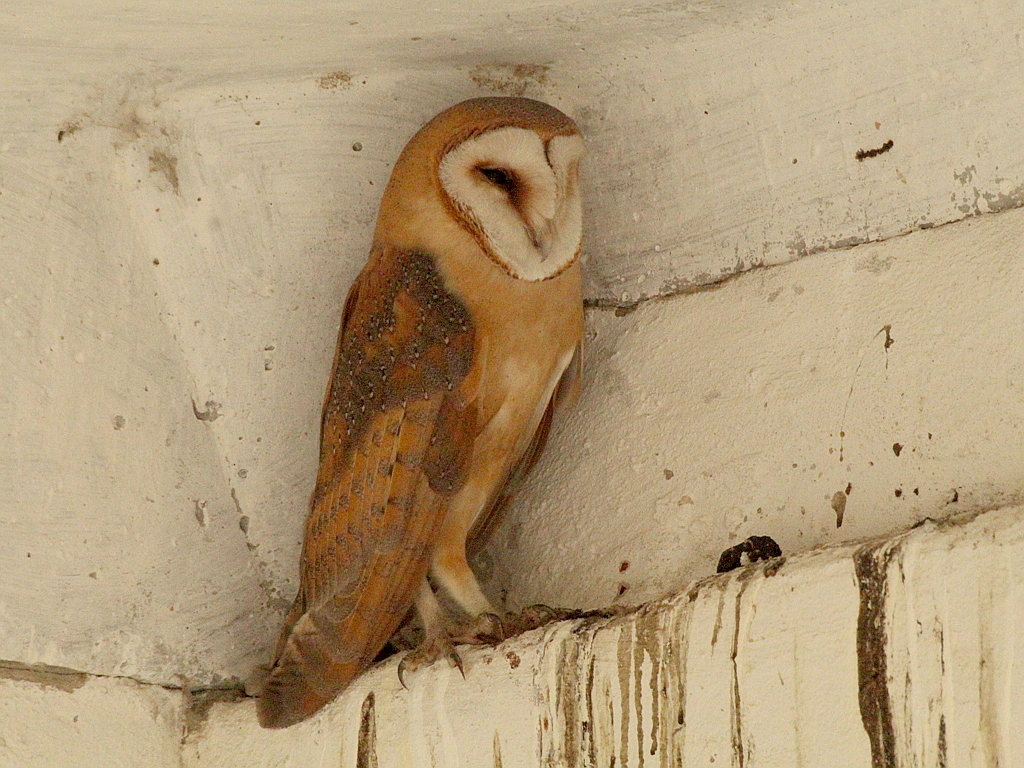
The western barn owl (Tyto alba) hunts in complete darkness by sound alone. Its left ear sits higher on the skull than its right, creating a tiny timing difference that lets its brain calculate a mouse's exact position in three dimensions. The heart-shaped facial disc amplifies and focuses sound toward those ears. Silent feathers mean it can hear its prey while flying.
Most predators rely primarily on sight. The barn owl has taken a different route entirely. Over millions of years its auditory system has been refined to a level of precision that still surprises researchers who study it, an ear so accurate it can track a mouse moving under a layer of snow in pitch darkness without seeing it once.
The problem: hunting without light
Prey animals that are active at night have one significant advantage: darkness hides them. A typical raptor loses much of its hunting effectiveness in low light and can do almost nothing in true darkness. The barn owl solved this problem not by improving its vision further (though its eyes are excellent in low light) but by routing its primary hunting sense through hearing.
The challenge with sound-based hunting is that ears alone cannot easily determine the elevation of a sound source. Two ears placed symmetrically on either side of the head can triangulate horizontal direction well, but struggle to resolve whether a sound is coming from above or below. Barn owls solved this with an elegant anatomical asymmetry.
Asymmetric ears: the key to 3D hearing
The barn owl's left ear sits noticeably higher on the skull than its right. This is not a coincidence or an injury: it is a fixed, genetically determined feature of the species. The asymmetry means that a sound from directly below the bird arrives at the right ear a few microseconds earlier than the left, and a sound from above arrives slightly earlier at the left ear.
The owl's brain is wired to process these timing differences with extraordinary precision. It integrates the horizontal timing difference (which ear receives the sound first) with the vertical timing difference (which ear is higher or lower relative to the sound source) to compute a three-dimensional location for the noise. The resulting map is accurate to within one degree in both axes. A barn owl hunting in total darkness can follow a mouse through grass, adjust its flight path as the mouse changes direction, and strike with its talons to within millimetres, guided entirely by the rustle of dry grass under tiny feet.
The facial disc: a living satellite dish
Look at a barn owl face-on and the most obvious feature is the heart-shaped pale disc formed by a dense ring of stiff, curved feathers. This is not decoration. It functions as a parabolic reflector, concentrating sound from a wide angle and channelling it toward the ear openings, which are hidden beneath the disc feathers on either side of the face.
The owl can adjust the disc by contracting the facial muscles, changing its curvature and therefore its acoustic focus. When a barn owl tilts its head during a hunt, it is not just looking, it is steering the dish. Different tilt angles amplify different frequency ranges and different directions, allowing the bird to sweep for sounds in a similar way a radio telescope sweeps for signals.
The ear openings themselves are covered by a mobile flap of skin and feathers that the owl can raise or lower. Raising the flap improves high-frequency sensitivity from above; lowering it shifts sensitivity downward. The barn owl is essentially operating a precision stereo microphone array in real time as it hunts.
Silent flight: hearing prey while moving
A bird in flight is a noisy machine. Turbulent airflow over the leading edges of the wings produces a hissing sound. The trailing edge generates a vortex sound as the wing sheds air. Both of these would drown out the rustle of a mouse below, making acoustic hunting impossible while actually moving.
Barn owl feathers have two structural modifications that eliminate this noise. The leading edge of each primary feather is serrated like a fine comb, breaking up the large turbulent vortices into many tiny ones that generate sound at frequencies above the owl's own hearing range. The trailing edge and upper surface of the flight feathers are covered in a dense, velvety pile of fine barbules, which absorbs the remaining sound. The result is a bird that can fly at speed in near-silence, quiet enough that the mouse below cannot hear it coming, and quiet enough that the owl can hear the mouse while flying directly toward it.
This combination of a directional facial disc, asymmetric ear placement and silent wings makes the barn owl a different kind of predator from any of the larger, vision-dependent raptors such as the eagle owl or the wedge-tailed eagle. Those birds dominate in twilight or daylight. The barn owl owns the darkness entirely.
How to find a barn owl
Barn owls are most often seen at dusk, quartering low over rough grassland or marsh edges on a slow, buoyant flight that looks almost weightless. They float rather than flap, gliding with wings held in a shallow V and tilting constantly as the facial disc sweeps the ground below.
The call is not the resonant hoot of tawny owls. Barn owls produce a long, drawn-out screech, sometimes described as a slow tearing sound. Old barn buildings, church towers and hollow trees near open farmland are the roost and nest sites to look for. In the Kaught catalog, barn owls carry the Nocturnal secondary type alongside their Epic rarity, reflecting how rarely a clear sighting occurs despite the species being widespread across six continents.
Compare the barn owl's passive, sound-driven hunting with the echolocation-based active sonar of bats, covered in the bat echolocation guide. Bats broadcast sound and interpret the returning echo. Barn owls receive only the sounds their prey makes. Both are solutions to the same problem of hunting without light, but they evolved completely independently and operate on entirely different principles.
Three things that make the barn owl unusual
- Laboratory experiments have confirmed that barn owls can strike prey accurately with zero light, navigating and killing by hearing alone, not just in low light.
- The asymmetry between the two ears is permanent and structural; it cannot be seen from outside because the ear openings are hidden, but it is present in every individual of the species.
- A barn owl hunts the same fields night after night, building a detailed acoustic map of the exact location of every grass tussock, fence post and rabbit hole in its territory, so it recognises unusual sounds as potential prey against a familiar background.
Barn owl hunting: frequently asked questions
How do barn owls hunt in the dark?
Barn owls locate prey by sound alone. Their heart-shaped facial disc funnels sound to asymmetrically placed ears: the left ear sits higher than the right, creating a timing difference the brain uses to pinpoint prey in three dimensions to within one degree, in complete darkness.
Can barn owls see in total darkness?
No. Their vision is excellent in low light, but hunting in total darkness relies on hearing. Laboratory experiments with all light removed confirm they strike prey accurately using sound alone.
Why is a barn owl's face heart-shaped?
The heart-shaped facial disc is a ring of stiff feathers that acts as a parabolic reflector, channelling sound toward the ear openings. The owl can adjust the disc shape using facial muscles, changing which frequencies are amplified and from which direction.
How quiet is a barn owl in flight?
Near-silent. The leading edges of the primary feathers are serrated, breaking turbulence into inaudible high-frequency noise. The upper surface of the wing feathers is velvety and absorbs remaining sound. A barn owl can fly at speed while still hearing a mouse below it.
Where do barn owls live?
Barn owls are found on every continent except Antarctica, one of the most widespread birds on Earth. They favour open farmland, grassland, marshes and woodland edges, roosting in barns, church towers and hollow trees wherever old structures or large trees are available.
Why is the barn owl Epic tier in Kaught?
Kaught's tier reflects observation frequency, not population size. Barn owls are widespread but strictly nocturnal and roost in concealed locations by day. A clear field sighting is genuinely uncommon, placing them at Epic: three diamonds out of four.
The next thing you see could be
your first catch.
Kaught is live on the App Store and Google Play. Free to start, and your first catch is one photo away.
Free to start · Live on the App Store and Google Play
Species data, type, rarity tier and measurements is drawn from the Kaught catalog, built on open biodiversity records from GBIF and iNaturalist. Rarity reflects how often a species is observed in the wild, not its conservation status.