
Adaptation explainer
How do hummingbirds hover? The wing mechanics that make it possible
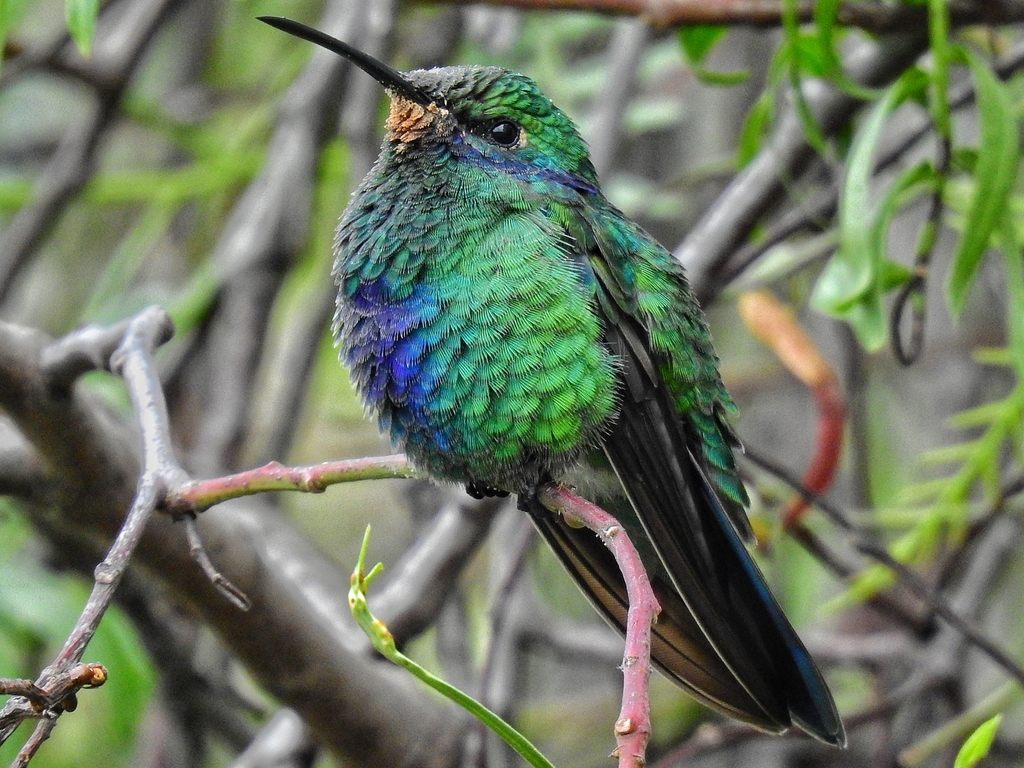
Hummingbirds hover by rotating their shoulder joint through a full sphere and tracing a figure-8 path with each wing. That produces lift on both the forward and backward stroke, so the bird stays stationary with no need to move forward at all. No other bird can do this.
Watch a hummingbird at a flower and what you see defies easy explanation: the bird hangs in space as if pinned there, body perfectly still while the wings are a blur on either side. It can hold that position for minutes, drift sideways, reverse and then accelerate forward, all without turning around. Every other flying bird needs forward speed to stay aloft. Hummingbirds have found a different solution, one that took 22 million years of evolution to refine and is still not fully replicated by any human-built flying machine.
The shoulder joint that no other bird has
Most birds have a shoulder joint that lets the wing move up and down, forward and back to a limited degree. The hummingbird's is effectively a ball-and-socket: the humerus (upper arm bone) rotates freely in almost every direction. This single anatomical difference unlocks everything else.
Because the shoulder can rotate through a full sphere, the wing tip traces a shallow figure-8 path rather than a simple up-down arc. The leading edge stays angled correctly into the airflow during both the forward swing and the backward swing. Lift is therefore generated in both halves of each beat, not just on the downstroke as in a conventional flapping bird.
The result is symmetrical upward force with zero net horizontal push, which is precisely the definition of a hover.
How many beats per second?
The wingbeat frequency is what produces the hum. Larger hummingbirds beat at around 10-15 times per second. Medium-sized species like the Ruby-throated Hummingbird reach roughly 53 beats per second during hover. The smallest, the Bee Hummingbird of Cuba (the lightest bird on Earth at under 2 g), has been measured at around 80 beats per second during competitive display.
The Sparkling Violetear, the species on the Kaught card above, beats at around 7-8 metres per second of wing-tip speed and is one of the larger Andean hummingbirds, sitting closer to the 8-10 beats per second end of the scale at rest but ramping up to around 26 beats per second during hover. That is still far faster than any other bird of comparable size.
At those frequencies the wing muscles must contract and relax faster than voluntary muscle fibres can fire. Hummingbirds (and a few other rapid fliers) use a special class of asynchronous muscle: the fibres respond to mechanical stretch, not to a nerve impulse per contraction. The nervous system sets the tone; the muscle oscillates on its own.
The cost of hovering
Hovering is the most energetically expensive form of flight. Gram for gram, a hovering hummingbird burns energy at a rate roughly ten times higher than a human running at full sprint.
To fuel this, the heart must deliver oxygenated blood extraordinarily fast. Anna's Hummingbird holds the recorded maximum for any vertebrate: 1,260 beats per minute during sustained hover. At rest the same bird's heart drops to around 500 bpm. During overnight torpor, with body temperature falling to near-ambient and every metabolic process dialled back, the rate can fall as low as 50 bpm.
The fuel is nectar, almost pure sucrose. A hummingbird visits between 1,000 and 2,000 flowers per day and consumes roughly half its body weight in nectar. It also eats insects and spiders for protein, often picking them directly from spider webs or snatching them mid-air while hovering.
How hummingbirds fly backwards
Flying backwards sounds like a trick, but it follows directly from the same mechanics. By tilting the entire stroke plane rearward and rotating the shoulder so that the upstroke generates more backward thrust than forward, the bird pushes itself backwards without turning around. It is the same figure-8 wingbeat, just the angle altered.
Hummingbirds are the only birds confirmed to fly backwards under their own power in free flight. Several other bird species back up short distances using the forces generated by wing-spreading, but that is not true backwards flight.
The fuel stops: UV vision and flower choice
Hovering in front of the right flower is as important as hovering at all. Hummingbirds see well into the ultraviolet part of the spectrum, a range invisible to us. Many of the flowers they pollinate reflect UV patterns that act as landing guides, visible to the bird but not to most competing insects. The classic "hummingbird red" is partly a signal that reads "no bee door", since many bee species see red poorly while UV is strong in the same bloom.
The Sparkling Violetear is a bold, aggressive nectar feeder that will displace larger hummingbirds from flowering trees. It has adapted well to high-altitude gardens in Andean cities, including central Quito at 2,850 m above sea level, where it feeds from introduced ornamental flowers within earshot of city traffic. In the Kaught catalog it sits at the Rare tier, two diamonds out of four: present across the Andes but not easy to clock in the wild, with around 9,500 iNaturalist observations globally.
Why no other bird can do this
Other birds have experimented with some parts of this package. Kestrels hover in a headwind by pitching their body nose-up and using the airflow to stay aloft, a kind of dynamic hovering that requires a breeze. Ospreys do something similar above rivers, but they are built for a plunge-dive, not sustained station-keeping. Both need moving air and cannot sustain the position in calm conditions.
The hummingbird's combination of the ball-socket shoulder, asynchronous flight muscle, and figure-8 stroke is a package that evolved once, exclusively in the Trochilidae. There are about 360 species in the family, all confined to the Americas, all sharing this same fundamental mechanics. None of their closest relatives, the swifts (family Apodidae), can hover: they are speed specialists, not hover specialists, despite sharing the same order (Apodiformes).
Engineers studying micro air vehicles have been trying to replicate this for decades. The closest attempts, tiny robotic insects and drone prototypes, can hover, but only within narrow wind-speed tolerances and at nowhere near the energy efficiency of the real thing. The hummingbird remains, for now, the benchmark.
If you are near a flowering garden or highland forest edge in the Americas, the best moment to watch hovering mechanics is when a hummingbird returns to the same flower repeatedly: it will approach from the same angle each time, hold position for two to four seconds, and leave in the direction it arrived from. That repeat pattern is not random; it reflects the bird's knowledge of which flowers have already been drained and which have had time to refill.
See one in the Kaught catalog to compare its Rare tier with more common birds. For more on extreme bird adaptations, see how barn owls locate prey in total darkness using asymmetric ear placement, or how animals with extreme senses have evolved perception systems that operate beyond the range of human experience.
Hummingbird hovering: frequently asked questions
How do hummingbirds hover?
Hummingbirds hover by rotating their shoulder joint in a full circle and sweeping the wing in a figure-8 path. This generates lift on both the forward and backward stroke, so the bird stays airborne without needing to move forward at all.
How many times does a hummingbird flap its wings per second?
Between 10 and 80 times per second depending on the species. The Ruby-throated Hummingbird beats at around 53 times per second during hover; the tiny Bee Hummingbird reaches roughly 80 beats per second during competitive display.
Can any other bird hover like a hummingbird?
No. Hummingbirds are the only birds that sustain a true stationary hover and fly in every direction including backwards. Kestrels and ospreys can slow to a near-hover in a headwind, but they require moving air to do so.
How do hummingbirds fly backwards?
They tilt the figure-8 stroke plane rearward and angle the wing so the upstroke generates more thrust than the downstroke, pushing themselves backwards without turning around. No other bird can do this in still air.
What does a hummingbird heart rate reach during hovering?
Anna's Hummingbird has been recorded at 1,260 beats per minute during sustained hover. At rest it drops to around 500 bpm, and during overnight torpor it falls as low as 50 bpm, the heart barely ticking.
Why do hummingbirds need to eat so much?
Hovering burns more energy per unit mass than almost any other animal activity. A hummingbird must visit 1,000 to 2,000 flowers per day, consuming roughly half its body weight in nectar just to keep its metabolism running.
How rare is the Sparkling Violetear in Kaught?
In the Kaught catalog the Sparkling Violetear sits at the Rare tier, two diamonds out of four. Kaught's rarity reflects how often a species is recorded in the wild, not its conservation status.
The next thing you see could be
your first catch.
Kaught is live on the App Store and Google Play. Free to start, and your first catch is one photo away.
Free to start · Live on the App Store and Google Play
Species data, type, rarity tier and measurements, is drawn from the Kaught catalog, built on open biodiversity records from GBIF and iNaturalist. Rarity reflects how often a species is observed in the wild, not its conservation status.