
Exotic spotlight
Fen Raft Spider: the arachnid that hunts on the water and beneath it
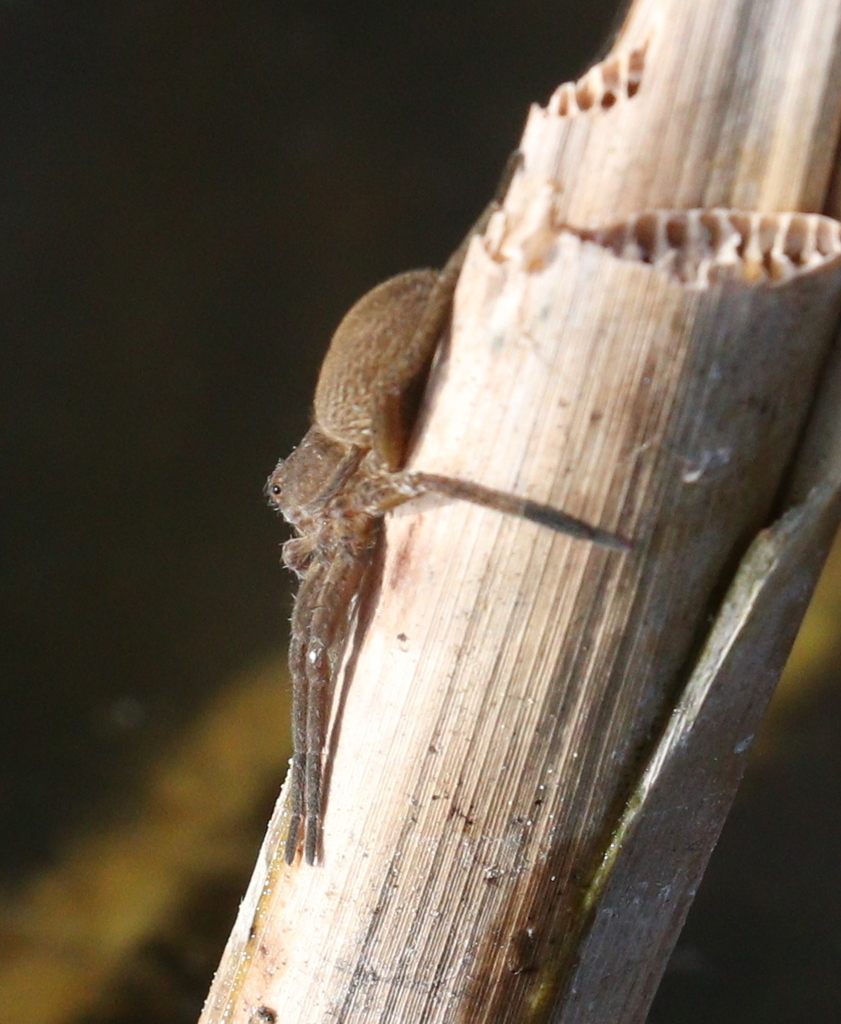
The fen raft spider (Dolomedes plantarius) is one of Europe's largest and rarest spiders. It rests its front legs on the water to feel vibrations, then rows, gallops or dives underwater to seize prey, sometimes catching small fish and tadpoles. It survives at only a handful of protected wetlands.
Most spiders keep well away from open water. The fen raft spider builds its entire life around it: hunting across the surface, diving beneath it, and raising its young at the water's edge. It is also one of the rarest and most closely monitored invertebrates in Europe, confined for decades to a small number of undisturbed wetlands. Here's how to recognise one, where to find it, and what that surface-walking, water-diving hunt actually looks like.
How to identify a fen raft spider
Size alone sets it apart from almost anything else you'll find at a pond margin:
- Body: rich brown to near-black, with a distinctive cream or white stripe running down each side of the abdomen and the front body segment, the single most reliable field mark.
- Size: females reach a body length of up to 23 mm, one of the largest spiders you'll encounter in Europe, with a leg span of roughly 7 cm including the legs. Males are noticeably smaller.
- Posture: usually found resting head-down on waterside vegetation or a reed stem, front legs extended onto the water film rather than tucked in.
- Timing: adults are easiest to find from late spring through late summer, when they mature, mate and, for females, carry an egg sac in their jaws.
It belongs to the genus Dolomedes, the fishing or nursery-web spiders, a small group built almost entirely around semi-aquatic hunting rather than the web-spinning most people associate with spiders.
Where the fen raft spider lives
The species ranges across northern and central Europe, but it is fussy about water quality: it needs unpolluted, base-rich (neutral to alkaline) water, open fen, grazing-marsh ditches and canals with dense marginal vegetation to hunt from. Acidic, nutrient-poor or heavily managed waterways don't hold it.
In Britain that need has squeezed it into a short list of sites: Redgrave and Lopham Fen on the Norfolk/Suffolk border, the Pevensey Levels in Sussex, and Crymlyn Bog and the Tennant Canal near Swansea in South Wales. A reintroduction programme run by Natural England and Suffolk Wildlife Trust, begun in 2010 with captive-bred spiderlings released into the Waveney Valley, has since added new dyke systems in the Norfolk and Suffolk Broads to that list, alongside genuine population growth at the original sites.
How a fen raft spider hunts, on the water and below it
The hunt starts with stillness. A fen raft spider anchors its back legs on waterside vegetation and rests its front legs directly on the water's surface film, using them the way a fisherman reads a line: any ripple caused by a struggling insect, a pond skater or a passing tadpole is felt instantly as a vibration.
Once it locks onto a target, it moves fast. It can row itself across the surface using its second and third pairs of legs, or switch to a high-stepping gallop that lets it accelerate roughly fivefold, reaching speeds of about 0.75 metres per second, fast enough to close on active prey before it escapes.
What makes the fen raft spider unusual among spiders is what it does next. Dense, water-repellent hairs cover its body and legs, trapping a thin layer of air against the surface. That trapped air lets it dive completely underwater in pursuit of prey and breathe briefly while submerged; a diving spider takes on a silvery sheen from the air held against its body. Most of the diet is other invertebrates (small spiders, dragonfly larvae, pond skaters), but a fen raft spider will readily take tadpoles and small fish several times its own size, an ambush few land-hunting spiders can match.
Is the fen raft spider dangerous?
Not to people. It is venomous in the sense that it uses venom to subdue prey, but bites to humans are extremely rare and only happen if the spider is handled or trapped against skin. When they do occur, the effect is compared to a bee sting: brief, localised discomfort with no lasting harm. A fen raft spider's default response to a large approaching animal is to flee, rowing away across the water or diving beneath it rather than standing its ground.
Fen raft spider vs the common raft spider
Britain has two Dolomedes species, and the names invite confusion. The common raft spider (Dolomedes fimbriatus) looks similar, with the same pale side-stripes, but it is far more widespread and sticks to acidic bog and heathland pools. The fen raft spider covered here is the scarcer of the two and is tied specifically to neutral-to-alkaline fen water. In practice, habitat is the fastest way to tell them apart in the field: a spider on a lowland fen ditch or grazing-marsh dyke is far more likely to be D. plantarius, while one on an acidic heathland pool is almost certainly D. fimbriatus.
Legal protection and a slow comeback
In the UK the fen raft spider holds Schedule 5 protection under the Wildlife and Countryside Act 1981, the highest level of legal protection available to an invertebrate. It is an offence to kill, injure, disturb, sell or possess one, or to damage the habitat it depends on. That legal status sits alongside two decades of active habitat management, captive breeding and reintroduction, and recent surveys of the Norfolk and Suffolk Broads population now estimate several thousand adult females present, a marked recovery from a species once confirmed at essentially a single UK location.
How rare is the fen raft spider in the Kaught catalog?
In the Kaught catalog the fen raft spider sits at the Epic tier, three diamonds out of four. As always, that's a measure of how often the species is actually recorded in the wild, not a statement about conservation status. A handful of protected sites and a habit of vanishing into thick reed and sedge margins means most visits to suitable wetlands, even the right wetlands, still turn up nothing.
For a look at how other ambush hunters solve the same problem from open water, see how herons hunt by standing perfectly still. And for more on the surface-vibration sense that makes the fen raft spider's hunt possible, our piece on animals with extreme senses covers several unrelated species that read the world through touch rather than sight.
Best time and place to look
Visit a known reserve on a warm, still morning between June and August, when adults are mature and most active. Walk slowly along fen ditches and dykes, scanning the waterline itself rather than the open water: look for a large, dark, stripe-sided spider resting with its front legs just touching the surface film among reed and sedge stems. Approach quietly. A fen raft spider that senses vibration through the ground or the water will dive or scatter long before you get close enough for a clear look.
Not every large water-loving spider you find will be this one. Most spiders rely on silk rather than water to catch a meal, and Britain holds several other large, striking species, including the jumping spiders that hunt by sight rather than vibration. The fen raft spider is the only one of them that will dive underwater to finish the job.
Fen raft spider: frequently asked questions
What does a fen raft spider look like?
A large, dark brown to almost black spider with a cream or white stripe running down each side of its body. Females reach a body length of up to 23 mm with a leg span of about 7 cm; males are noticeably smaller.
Where can you find a fen raft spider?
On unpolluted, base-rich fen ditches, grazing-marsh dykes and canals across northern and central Europe. In Britain it survives at only a handful of reserves, including Redgrave and Lopham Fen, Pevensey Levels, Crymlyn Bog and parts of the Norfolk and Suffolk Broads.
Is the fen raft spider dangerous to humans?
No. It is harmless to people and rarely bites unless handled roughly. A bite has been compared to a bee sting, mildly uncomfortable but not medically significant, and the spider's instinct is to flee across or under the water rather than confront anything as large as a person.
How is the fen raft spider different from the common raft spider?
Both Dolomedes species in Britain look similar and share the pale side-stripes, but the fen raft spider is the rarer of the two and needs neutral to alkaline fen water. The common raft spider (Dolomedes fimbriatus) is more widespread and sticks to acidic bog and heathland pools.
How does a fen raft spider hunt underwater?
Water-repellent hairs trap a thin film of air over its body, letting it dive beneath the surface in pursuit of prey and breathe briefly while submerged. On the surface it detects vibrations through its legs, then rows, gallops or lunges to seize whatever caused the ripple.
Is the fen raft spider protected by law?
Yes. In the UK it holds Schedule 5 protection under the Wildlife and Countryside Act 1981, the highest legal protection available to an invertebrate. It is an offence to kill, injure, disturb, sell or possess one, or to damage the habitat it depends on.
How rare is the fen raft spider in the Kaught catalog?
It sits at the Epic tier, three diamonds out of four. That reflects how rarely it is actually recorded in the wild, not its conservation status: it survives at only a few sites, so most people who go looking for one never see one at all.
The next thing you see could be
your first catch.
Kaught is live on the App Store and Google Play. Free to start, and your first catch is one photo away.
Free to start · Live on the App Store and Google Play
Species data, type, rarity tier and measurements, is drawn from the Kaught catalog, built on open biodiversity records from GBIF and iNaturalist. Rarity reflects how often a species is observed in the wild, not its conservation status.