
Exotic spotlight
Northern Right Whale Dolphin: the Dolphin With No Fin at All
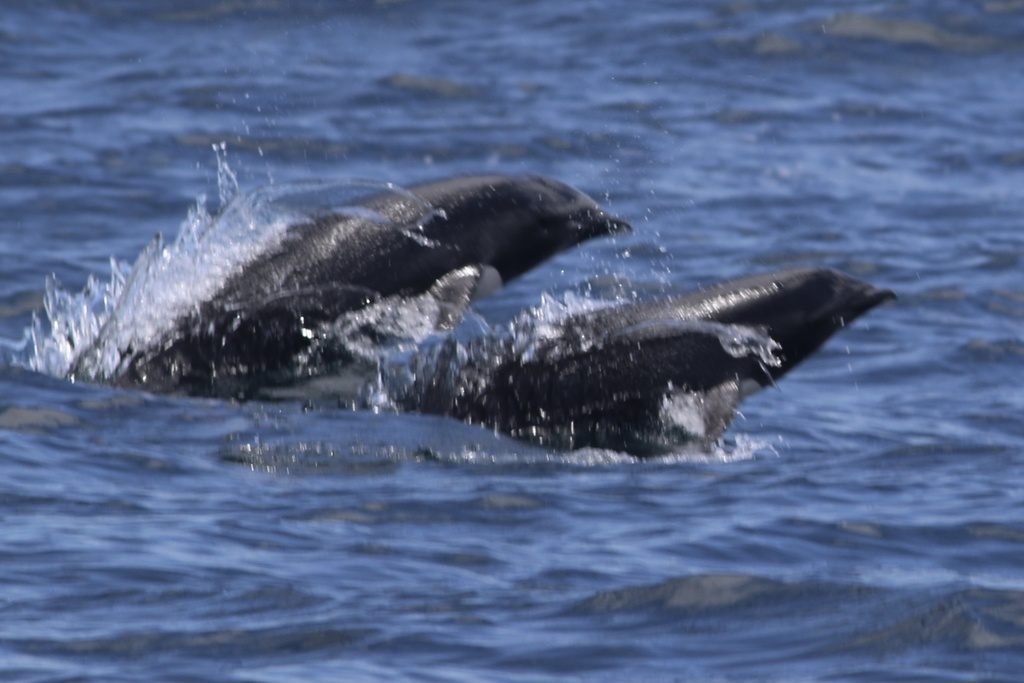
The northern right whale dolphin (Lissodelphis borealis) is one of only two dolphin species with no dorsal fin at all. It lives far offshore in the cold North Pacific, travels in large leaping pods, and is rarely ever seen. Harmless to people, and Epic tier in the Kaught catalog.
Most dolphins are easy to pick out of the water by a single feature: the dark blade of a dorsal fin cutting the surface. The northern right whale dolphin has none. Its back runs smooth and unbroken from blowhole to tail, a trait shared by only one other dolphin on the planet, and it lives so far offshore in the cold North Pacific that most people who spend a lifetime near the ocean will never see one.
What is a northern right whale dolphin?
It is a slender, torpedo-shaped dolphin, glossy black on top with a white throat and belly stripe that widens across the chest and tapers to a thin line near the tail. Males grow to about 3.1 m, females a touch smaller at 2.3 to 2.6 m, and both weigh somewhere between 60 and 100 kg. Strip away the dorsal fin every other dolphin has and what is left looks almost like a long, dark eel skimming the surface, which is exactly how boat crews in the open North Pacific usually first spot one.
The only dolphin with no fin on its back
There are dozens of dolphin species in the world's oceans, and all but two carry a dorsal fin or at least a low ridge. The northern right whale dolphin is one of the exceptions. The other is its near-identical counterpart in the Southern Hemisphere, the southern right whale dolphin, found nowhere near it. Both get their name from a resemblance to right whales, the large baleen whales that are likewise completely smooth along the back, having lost the fin somewhere in their own separate evolutionary history. In a dolphin built for speed, that missing fin does not seem to cost it anything.
Where it lives: deep, cold and far offshore
This is a species of the open ocean, not the coast. It keeps to deep, cold water across the North Pacific, roughly between 34°N and 55°N, favouring sea temperatures around 8 to 19°C. It occasionally pushes further south during cold-water years, but a sighting anywhere near a beach is unusual. Because it keeps to deep water and rarely approaches boats, strandings are uncommon and most of what's known about the species comes from fishery and survey data rather than close observation, so it remains one of the more poorly studied dolphins relative to the coastal species people encounter every day. Its 200 m feeding dives are modest next to the true specialists in the deepest-diving animals ranking, but still far beyond what any coastal dolphin needs to manage.
How it swims: pods that skip instead of breach
Where many dolphins breach clear of the water, a travelling pod of northern right whale dolphins tends to skim it instead, surfacing in long, low leaps that can cover up to 7 metres before dropping back under. Cruising speed averages around 26 km/h, with bursts of 30 to 40 km/h when the pod is moving fast. Group sizes typically run from a few dozen to a couple hundred, occasionally far larger, and they are notably sociable, often travelling mixed in with Pacific white-sided dolphins and sometimes alongside Dall's porpoises, Risso's dolphins, pilot whales, humpback whales, sperm whales or Baird's beaked whales, much like the pod hunts of its orca cousins further up the North Pacific food chain.
What it eats, and how it talks
It hunts small fish and squid, diving to around 200 m for lanternfish, Pacific hake and saury, gripped by a row of 80 to 95 narrow, conical teeth built for holding slippery prey rather than chewing it. One more thing sets it apart from most of its relatives: it does not whistle. Where bottlenose dolphins use signature whistles, among the sharpest hearing in the animal kingdom, to keep track of each other, the northern right whale dolphin communicates with clicks and burst-pulse sounds instead, a quieter, less-studied vocabulary that may serve the same purpose underwater. It's a different acoustic toolkit again from the dense, directional clicks of a narwhal working the ice edge further north.
Family life in the open ocean
Even the basics of its life cycle took decades to pin down, simply because so few researchers ever get close to a pod. Females reach sexual maturity around 9.7 to 10.4 years old, males a little later at roughly 9.9 to 10.1 years. Pregnancy runs about 12 months, with most calves born in July and August, and a mother typically waits at least two years before calving again. None of it looks unusual for a dolphin of this size, but almost everything researchers know about it comes from strandings, fishery bycatch records and the occasional lucky encounter at sea, rather than the years of close, repeated observation that shaped what's known about coastal species like the bottlenose dolphin.
Is the northern right whale dolphin dangerous?
Not to people. It is a wild, wary dolphin with no record of aggression toward humans, and its offshore range means close encounters are rare in the first place. The real challenge with this species has never been safety, it's simply finding one.
How rare is the northern right whale dolphin?
In the Kaught catalog it sits at Epic, three diamonds out of four. That reflects how often the species is actually recorded in the wild, not any statement about its status. A dolphin that keeps to deep, cold water hundreds of kilometres offshore, avoids boats, and rarely strands on a beach is, by definition, a hard one to log a confirmed sighting of, no matter how large its travelling pods get.
Three things you didn't know about the northern right whale dolphin
- Its brain-to-body ratio is among the highest ever measured in any animal, second only to humans by some estimates, in a species almost nobody has ever watched up close.
- A travelling pod can number in the hundreds, occasionally far more, all skipping across the surface together in near-unison rather than breaching individually.
- It shares its finless back with exactly one other dolphin on Earth, the southern right whale dolphin, and the two never meet: one stays north of the equator, the other south.
Northern right whale dolphin: frequently asked questions
What does a northern right whale dolphin look like?
A slender, torpedo-shaped dolphin with a glossy black back, a white underside and throat, and no dorsal fin or ridge anywhere along its back. Males reach about 3.1 m and females 2.3–2.6 m, weighing roughly 60–100 kg.
Why does the northern right whale dolphin have no dorsal fin?
It is one of only two dolphin species on Earth built this way, the other being its southern-hemisphere counterpart. Its name and finless back come from a resemblance to right whales, large baleen whales that are also smooth-backed.
Where do northern right whale dolphins live?
In cold, deep offshore waters of the North Pacific, roughly between 34°N and 55°N, favouring sea temperatures around 8–19°C. They rarely enter coastal waters or approach boats, which is why sightings are so uncommon.
How fast can a northern right whale dolphin swim?
It cruises at roughly 26 km/h and can burst to 30–40 km/h. Travelling pods appear to skip across the surface in long, low leaps, sometimes covering up to 7 metres in a single leap.
Are northern right whale dolphins dangerous to humans?
No. They are wild, wary dolphins with no record of aggression toward people. Their deep offshore range and tendency to avoid boats means most people will never encounter one up close at all.
What do northern right whale dolphins eat?
Mostly small fish and squid, including lanternfish, Pacific hake and saury, caught on dives to around 200 m. They carry 80 to 95 sharp conical teeth suited to gripping slippery prey rather than chewing it.
Why is the northern right whale dolphin "Epic" in Kaught?
Kaught's rarity tiers track how often a species is actually recorded in the wild, not conservation status. This dolphin lives far offshore, avoids boats and rarely strands, so confirmed sightings are genuinely scarce, placing it at Epic, three diamonds out of four.
The next thing you see could be
your first catch.
Kaught is live on the App Store and Google Play. Free to start, and your first catch is one photo away.
Free to start · Live on the App Store and Google Play
Species data, type, rarity tier and measurements, is drawn from the Kaught catalog, built on open biodiversity records from GBIF and iNaturalist. Rarity reflects how often a species is observed in the wild, not its conservation status.