
Legendary spotlight
Orca: the apex predator at the top of every ocean food chain
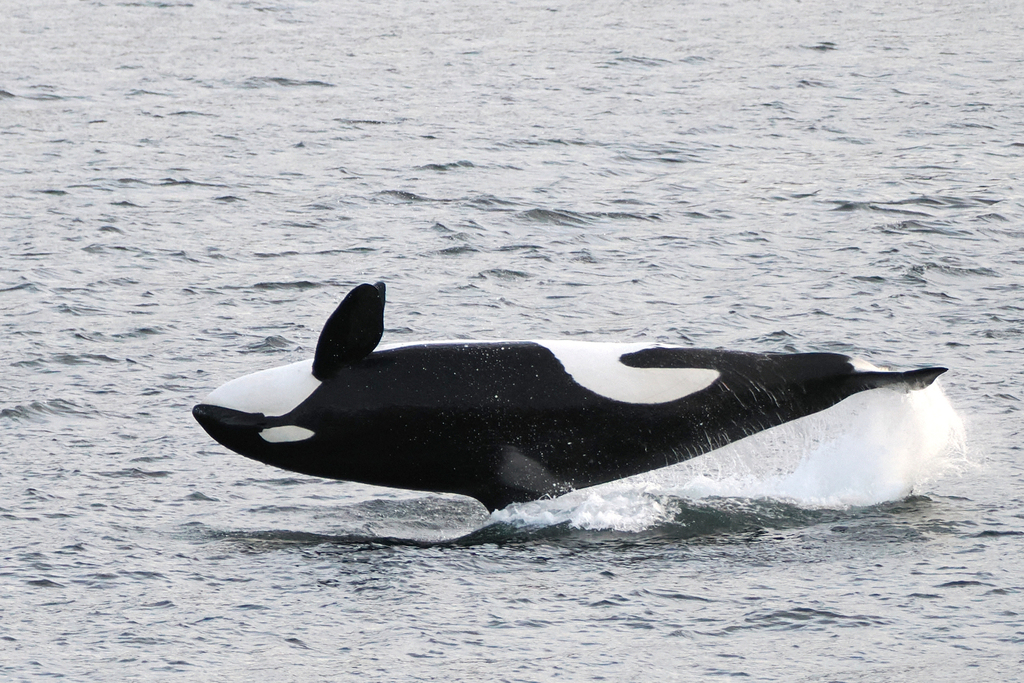
The orca (Orcinus orca) is the largest member of the dolphin family and the apex predator of every ocean on Earth. Black back, white eye patch, up to 8 m long. It hunts in family groups using techniques passed down through generations, making it one of the most culturally complex animals alive.
The orca sits at the very top of the ocean food chain. Nothing hunts it. Its prey list spans fish, squid, sharks, sea lions, dolphins, and occasionally great whales many times its own size. It has a dorsal fin that can reach 1.8 m, a brain that forms lasting social bonds across decades, and a vocabulary specific to its family group. Here is what to look for if you are lucky enough to see one.
How to identify an orca
The field marks are clear and unmistakable at any range:
- Colouration: jet black on the back, brilliant white on the belly and flanks, with a distinctive white oval patch just above and behind the eye.
- Saddle patch: a grey or white mark on the back just behind the dorsal fin. Shape varies between individuals and populations.
- Dorsal fin: tall and pointed. Males develop fins up to 1.8 m, which stand perfectly upright. Female fins are smaller and slightly curved, similar in proportion to other large dolphins.
- Size: an adult male is unmistakably large, longer and heavier than any other dolphin and clearly distinct from any shark fin by the rounded tip, vertical surfacing motion, and the blow.
At the surface an orca exhales a low bushy blow (1–2 m) visible from distance in cooler air, then rolls forward to show the dorsal fin and the back before submerging. It often surfaces multiple times in sequence before a longer dive.
Where orcas live and where to find one
Orcas are the most cosmopolitan cetacean on Earth, recorded in every ocean from the tropics to the polar ice. But the realistic places to find them from shore or on a dedicated boat trip are specific:
- Pacific Northwest (Canada and Washington state): resident fish-eating populations concentrate in summer around San Juan Island and Johnstone Strait.
- Norway and Iceland: large herring-following groups move into coastal fjords in winter, sometimes in pods of several hundred.
- New Zealand (Hauraki Gulf): regular sightings year-round.
- Antarctica: pack-ice ecotypes are frequently photographed around the continent's coast in summer.
- Strait of Gibraltar: a small, much-studied population hunts bluefin tuna and has become notable for interactions with sailing vessels.
In the Kaught catalog the orca sits at the Legendary tier, four diamonds. That reflects the genuine rarity of a confirmed wild sighting for most observers anywhere on land. Orcas cover enormous ranges and are ocean animals first. If you are offshore in the right area, a sighting is realistic; from any inland location or typical coastline, it remains genuinely rare.
How orcas hunt
The orca's most remarkable quality is not raw power but learned, cooperative strategy. Different populations, what researchers call ecotypes, have evolved completely distinct hunting traditions that mothers teach their calves over years:
- Fish-eaters (resident ecotype): coordinated high-speed pursuits of salmon, using clicks and calls to herd shoals.
- Mammal-eaters (transient or Bigg's ecotype): silent approaches on seals and sea lions hauled out on ice or rocks; also take dolphins, porpoises, and minke whales in coordinated attacks lasting hours.
- Wave-washing: pods create bow waves to flip sea ice floes and knock seals into the water, a technique documented in Antarctica and transmitted between individuals.
- Karate kick: some New Zealand orcas have been filmed stunning rays with a precise tail slap at the surface before eating them.
None of these behaviours is hardwired. All are cultural: taught by mothers, spread within family groups, and distinct between populations. An orca born into a fish-eating family will not switch to hunting seals even if seals are abundant around it.
The social structure behind the hunt
Orcas live in matrilineal family groups centred on an older female, the matriarch, who may be 80 or 90 years old. Her knowledge of seasonal prey locations, established routes, and effective tactics is directly inherited by her offspring, who remain with her for life.
Each family group has a specific dialect: a repertoire of calls shared within the group and distinct from neighbouring groups. Researchers can identify a family by sound alone before they surface. This is one of the clearest documented cases of cultural transmission in any non-human animal.
Three things you may not know about the orca
- Post-reproductive females (females past breeding age) survive for decades and actively lead hunts. Their accumulated knowledge directly improves the family group's success rate, one of the very few documented examples of a genuine evolutionary advantage to menopause.
- Orcas regularly harass and kill great white sharks to extract and eat the liver, which is dense in lipids. In South Africa, the presence of two individual orcas (nicknamed Port and Starboard) reliably drives great whites from their feeding grounds for months.
- The "killer whale" name comes from 18th-century Spanish whalers who called them asesina ballenas (whale killers) after observing groups cooperating to bring down baleen whales. The English name reversed the word order. They are, technically, very large dolphins.
Orca: frequently asked questions
How do you identify an orca?
Look for a jet-black back, a white oval patch above and behind the eye, a white belly and flank, and a grey saddle patch just behind the tall dorsal fin. Adult males have a dorsal fin up to 1.8 m tall that stands straight up, the tallest of any cetacean.
Where do orcas live?
Every ocean on Earth, from Arctic to Antarctic. Most reliably seen in cold, productive coastal waters: the Pacific Northwest, Norway, Iceland, New Zealand and Antarctica all have well-known year-round populations.
Are orcas dangerous to humans?
No confirmed fatal attacks on humans by wild orcas. They are large apex predators and a safe distance at sea is sensible, but wild orcas consistently ignore or show only mild curiosity toward human divers and boats.
What do orcas eat?
It depends on the population. Fish-eaters take salmon or herring. Mammal-eaters hunt seals, dolphins and baleen whales. Each population has learned its own techniques and passes them to calves over years.
Why is the orca Legendary in Kaught?
Kaught's rarity reflects how often a species is actually observed in the wild. Orcas are ocean animals with vast ranges. A confirmed sighting is genuinely rare for most people, earning the Legendary tier, four diamonds.
How big is an orca?
Adult males reach 5.5 to 8 m and up to 5,400 kg. Females are smaller, typically 4.5 to 7 m. The dorsal fin alone can reach 1.8 m in large males.
How intelligent are orcas?
Among the most cognitively complex animals on Earth. They live in stable family groups, share learned hunting techniques across generations, communicate with group-specific dialects, and have been observed teaching novel skills to young individuals.
The next thing you see could be
your first catch.
Kaught is live on the App Store and Google Play. Free to start, and your first catch is one photo away.
Free to start · Live on the App Store and Google Play
Species data, type, rarity tier and measurements, is drawn from the Kaught catalog, built on open biodiversity records from GBIF and iNaturalist. Rarity reflects how often a species is observed in the wild, not its conservation status.