
Record holders
Longest animal migrations in the world: 5 record-holders ranked by distance
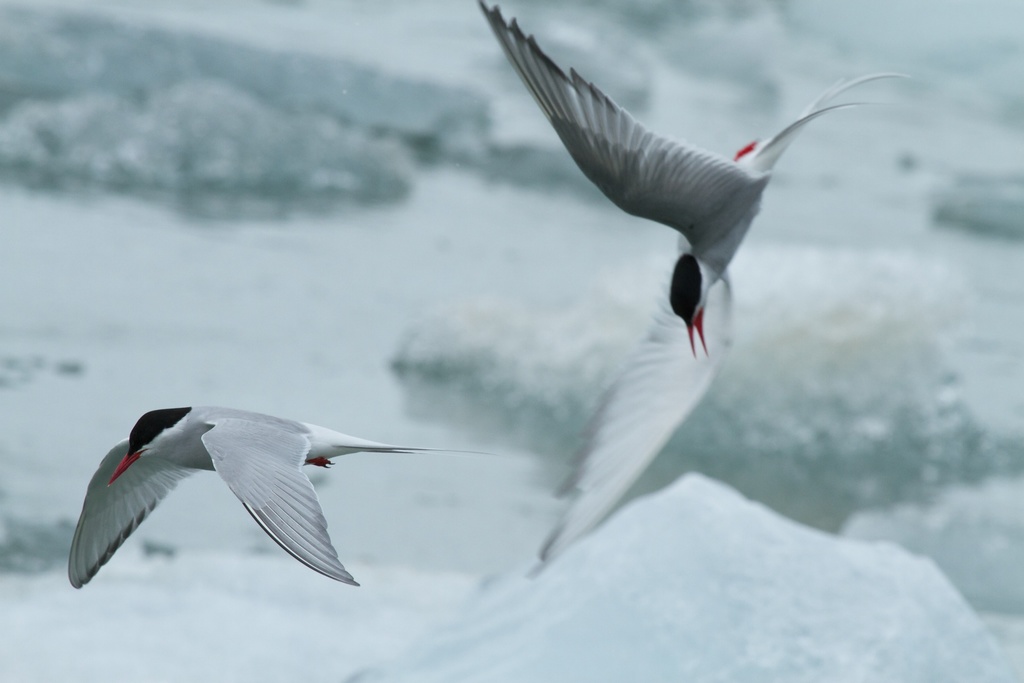
The Arctic Tern completes the longest annual migration of any animal: up to 90,000 km pole to pole. The Bar-tailed Godwit holds the non-stop record at 11,500 km without landing. Across five species, this ranking spans bird, insect, mammal and the boundaries of what a living body can sustain.
Migration is one of the most energetically expensive things an animal does. The distances below are not rough estimates: they come from tagged individuals tracked by satellite, light-level geolocators, and in the monarch's case, isotope analysis. Each record is a confirmed data point from a real animal.
1. Arctic Tern: up to 90,000 km per year
The Arctic Tern is a small seabird, roughly 35 cm long and 100 grams. It breeds on Arctic and subarctic coasts from Canada through Europe to Siberia, then flies south to the Antarctic for the austral summer, returning north in the northern spring. The round trip, measured by geolocator tags attached to individuals in Greenland, reached up to 90,000 km in a single year.
Over a lifespan of 30 years, a single tern may cover more than 2.4 million km. The journey also means the Arctic Tern experiences more hours of daylight per year than any other animal: it follows the midsummer sun from pole to pole, chasing the long days that drive fish productivity. The species carries a Common rarity tier in the Kaught catalog, reflecting its relatively frequent appearance in coastal observations at both ends of its range.
The route is not a straight line. Tagged birds typically make a figure-eight loop, swinging out over the mid-Atlantic on the southbound journey to exploit prevailing winds, then hugging the African and American coasts on the return.
2. Bar-tailed Godwit: 11,500 km non-stop
The Bar-tailed Godwit's migration from western Alaska to New Zealand is the longest confirmed non-stop journey of any animal: 11,500 km in approximately 11 days, completed without eating, drinking or landing. A satellite-tagged individual, known to researchers as B6, completed this crossing in October 2022 in 11 days and 1 hour.
The physiology required for this feat is extraordinary. In the weeks before departure the godwit doubles its body weight to roughly 650 grams by gorging on invertebrates on Alaskan mudflats. It then selectively shrinks its digestive organs, including the stomach, intestine and liver, to reduce dead weight, while enlarging the heart and pectoral muscles for sustained flight. Arriving in New Zealand, the bird's organs rebuild before it begins a shorter westward migration to Australia, and eventually returns to Alaska via the Yellow Sea.
The entire crossing is flown over open ocean with no land to stop on even if the bird wanted to. The godwit navigates using a sun compass, star patterns, magnetic field cues, and possibly infrasound from ocean waves. No external device guides it.
3. Humpback Whale: up to 16,000 km round trip
Humpback Whales feed in cold, productive polar and subpolar waters in summer, building up blubber reserves, then migrate to warm tropical or subtropical waters to breed and give birth in winter. The longest confirmed individual migration was 9,700 km, tracked from feeding grounds off the Antarctic Peninsula to breeding grounds off Costa Rica. The round trip reaches up to 16,000 km.
Unlike the Arctic Tern and the godwit, the humpback feeds heavily on its wintering grounds and does not significantly shrink any organ. The migration is powered by a blubber reserve accumulated over the summer. A male on its breeding ground may fast for up to four months, surviving on stored energy while spending its time singing.
The humpback's song is among the most complex vocalisations of any animal: a structured sequence lasting up to 20 minutes, composed of repeating phrases, that evolves across populations over years. New song elements spread westward across the Pacific like a cultural wave.
4. Monarch Butterfly: up to 4,800 km, multi-generational
The Monarch's migration is unique in this list: no individual completes the full round trip. Each autumn, the generation born in late summer in Canada and the northern United States flies up to 4,800 km south to overwintering colonies in the oyamel fir forests of central Mexico. This individual weighs 0.27 grams. Its fuel is stored fat from milkweed plants it ate as a caterpillar.
The southbound butterflies are navigating using a time-compensated sun compass. A circadian clock in the antennae corrects for the sun's changing position throughout the day, keeping the insect consistently flying southwest. The same individuals overwinter in Mexico for up to eight months, then begin moving north in spring. They mate and lay eggs on milkweed in Texas and the southern United States before dying. Three or four subsequent short-lived generations, each living 4 to 6 weeks, progressively re-colonise the northern range over the summer.
This means the monarchs that arrive in Canada in June have never been to Mexico, have never seen the oyamel forests, and have no ancestor alive to follow. The navigation programme is entirely inherited. The Monarch sits at Common in the catalog: it remains numerous enough at peak migration to stop traffic at known waypoints.
5. Common Wildebeest: 1,800 km, the largest overland loop
The wildebeest migration is the largest overland migration on Earth. Up to 1.5 million Common Wildebeest, joined by hundreds of thousands of zebras and gazelles, complete a clockwise 1,800 km annual loop across the Serengeti in Tanzania and the Masai Mara in Kenya. The movement is not a single directed journey but a continuous response to the availability of fresh grass, triggered by rainfall.
The river crossings, where the column fords the Mara and Grumeti rivers, are the visual set piece of the migration. Crocodiles wait at established crossing points. Wildebeest drown, are taken, or make it across. The sheer number of animals in the column overwhelms predator capacity: the herd moves on whether or not individuals are lost.
Wildebeest calves are born in a tight window of two to three weeks in February and March, producing approximately 400,000 calves simultaneously. The timing overwhelms predators through sheer numbers: more calves are born than any predator population can eat during the window. A calf must stand within seven minutes and keep pace with the herd within hours.
For context on how migration records pair with other remarkable journeys, see our article on how Atlantic Salmon navigate back to their birth river, a different kind of extreme travel that runs upstream rather than across continents.
Why the records matter to Kaught
All five species carry a migrant secondary type in the Kaught catalog, reflecting the dual-habitat nature of their lives: they are not simply residents of one biome but seasonal inhabitants of multiple ones. The deepest-diving animals and the fastest animals rankings show how the catalog's type and rarity data anchor superlative claims in actual observation records. Migration distances follow the same principle: every figure above comes from a satellite-tagged animal in a published study, not an estimate. The green sea turtle is one of the clearest examples of that method at work, tracked across whole ocean basins back to the beach where it hatched.
Longest animal migrations: frequently asked questions
What animal has the longest migration in the world?
The Arctic Tern (Sterna paradisaea) has the longest confirmed annual migration of any animal. Tagged individuals have accumulated annual round-trip distances of up to 90,000 km, travelling from Arctic breeding grounds to the Antarctic and back. Over a lifetime of 30 years, a single bird may cover 2.4 million km.
What animal makes the longest non-stop migration?
The Bar-tailed Godwit (Limosa lapponica) holds the record for the longest confirmed non-stop flight: 11,500 km from Alaska to New Zealand without eating, drinking or landing, completed in approximately 11 days.
How far does the Monarch Butterfly migrate?
Monarch Butterflies migrate up to 4,800 km between their overwintering grounds in central Mexico and their summer breeding range in Canada. No individual completes the full round trip: the overwintering generation makes the southbound journey and survives 8 months, while 3 to 4 short-lived generations are needed to re-colonise Canada each spring.
How far do humpback whales migrate?
Humpback Whales make round-trip migrations of up to 16,000 km between their cold-water feeding grounds in polar and subpolar seas and their warm-water breeding grounds in the tropics. The longest confirmed individual journey was 9,700 km in a single one-way trip.
What is the largest land migration?
The wildebeest migration of the Serengeti is the largest overland migration on Earth by total biomass. Up to 1.5 million Common Wildebeest complete a clockwise 1,800 km annual loop across Tanzania and Kenya, following the rain-triggered growth of fresh grass.
Why do animals migrate?
Animals migrate to exploit seasonal food resources, reach suitable breeding habitat, or escape unfavourable temperatures. The energy cost is offset by the gain in food or reproductive success at the destination. Each of the five species in this list has a distinct evolutionary driver.
The next thing you see could be
your first catch.
Kaught is live on the App Store and Google Play. Free to start, and your first catch is one photo away.
Free to start · Live on the App Store and Google Play
Species data, type, rarity tier and measurements, is drawn from the Kaught catalog, built on open biodiversity records from GBIF and iNaturalist. Rarity reflects how often a species is observed in the wild, not its conservation status.