
Evolution story
How salmon find their home river: smell, magnetism and 3,000 km of open ocean
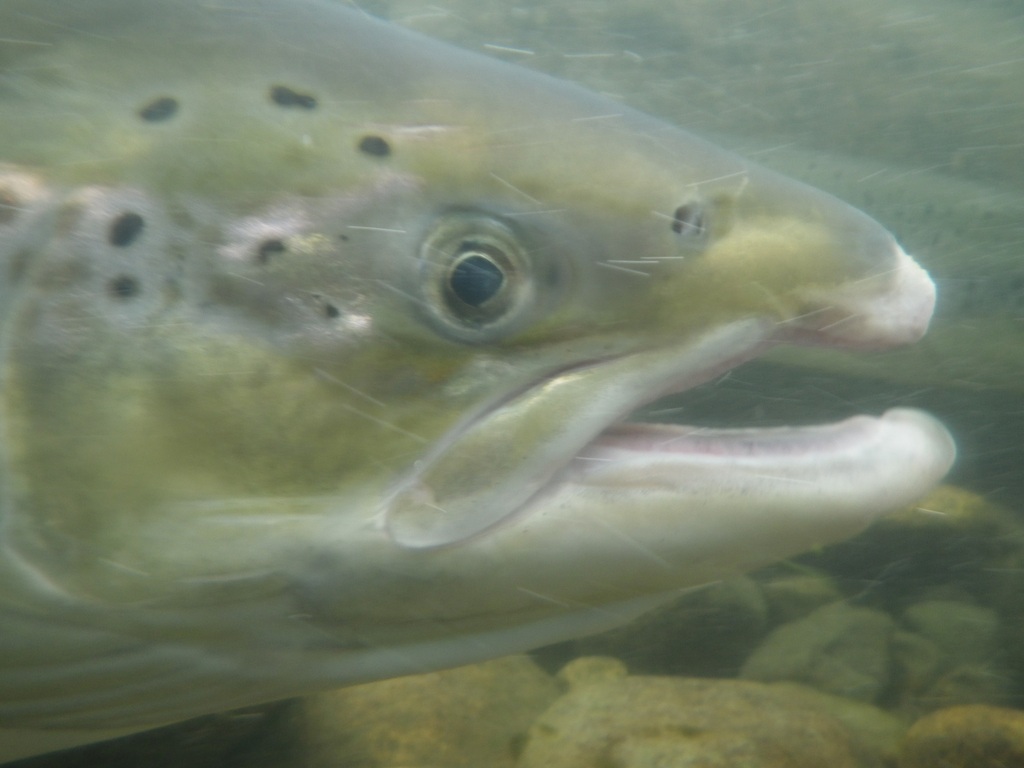
Atlantic Salmon (Salmo salar) hatch in a freshwater river, migrate to the open ocean, and return years later to spawn in the exact stream where they were born. They find it using two systems: the Earth's magnetic field for ocean navigation, and a chemical smell imprinted on their brain as juveniles.
A salmon hatches in a small upland stream. It spends its first years there, eating invertebrates, growing, learning the river. Then, between the ages of one and three, something triggers a profound physical transformation: it changes colour, its kidneys rewire for saltwater, and it heads downstream. Within weeks it is in the open ocean, thousands of kilometres from home.
Three to four years later, it will find that exact stream again. Not just the right river: the right tributary, the right pool, sometimes within metres of the gravel bed where it hatched. This is not a coincidence or a rough guess. It is one of the most precise navigation systems in nature, built over hundreds of millions of years of fish evolution. Here is how it works.
Stage one: the magnetic compass for open ocean
In the open North Atlantic, there are no landmarks. No roads, no signposts. Just water. A salmon navigating from the feeding grounds near Greenland or the Faroe Islands to the mouth of its home river in Scotland or Canada is making a journey of 2,000 to 5,000 km through apparently featureless ocean.
It does this with a biological compass. Salmon carry tiny magnetite crystals in their nasal tissue, minute grains of a magnetic mineral that respond to the Earth's magnetic field. These crystals allow the fish to sense two properties of the local magnetic field: its intensity (how strong it is) and its inclination angle (how steeply it dips into the Earth). Together, these two measurements give the salmon a rough two-coordinate fix on its position, the equivalent of latitude and longitude without a satellite.
Research has shown that exposing salmon to altered magnetic fields deflects their swimming direction, and that the specific magnetic signature of their birth river's ocean entrance is imprinted at the smolt stage alongside the smell of the river itself. This combined magnetic-plus-smell map guides them to the correct stretch of coastline, at which point the second navigation system takes over.
Stage two: the smell memory
Every freshwater stream has a distinct chemical signature: a cocktail of specific minerals leached from local geology, organic compounds released by bankside plants, the metabolic products of particular invertebrates, the water chemistry of specific soils. This signature is not constant, but it is consistent enough to be recognisable.
During the smolt transformation, the juvenile salmon's olfactory system enters an imprinting window of several weeks. During this time it memorises the smell of its home river with extraordinary fidelity. This chemical memory is then stored in the brain for years. When the adult salmon re-enters freshwater at the coast, it begins testing the smell of every stream mouth it passes, comparing it against the stored memory. When the match is correct, it turns upstream.
The evidence for olfactory navigation is direct and strong. Salmon with their nostrils surgically blocked fail to home and end up distributed randomly across all available rivers. Salmon whose nostrils are unblocked home with 90 to 95 percent fidelity. When researchers expose juveniles to an artificial chemical not normally found in rivers (morpholine or phenethyl alcohol, for example) and then release them, the adults return to whichever river outflow has been spiked with that same artificial smell, even if it is not their birth river. The smell is the key.
Why salmon evolved this life history
The Atlantic Salmon belongs to a group called anadromous fish: species that hatch in freshwater, grow at sea, and return to freshwater to breed. The word comes from Greek, meaning "running upward." This life strategy evolved independently in multiple fish families across the Northern Hemisphere, which tells you it must be paying off.
The ocean advantage is calories. Marine productivity near Greenland and the Norwegian Sea is vastly higher than a small upland stream in Scotland or New Brunswick. A salmon eating capelin, sand eels and herring can grow from a few hundred grams to 10 kg in three ocean years. That same salmon in a river, competing for invertebrates with hundreds of other fish in a limited space, might reach 2 kg in the same time. The ocean is, in effect, a free growth subsidy.
The freshwater advantage is safety for eggs. Cold, clear, fast-flowing rivers offer more stable temperatures for developing embryos, fewer egg predators than the open ocean, and the ability to deposit eggs in gravel beds where they are oxygenated by flow but hidden from sight. Spawning in the exact river where you yourself survived to adulthood is also a form of bet-hedging: if a salmon made it from egg to adult in a particular stream, that stream has already been proved as viable habitat.
Atlantic Salmon vs Pacific Salmon: one key difference
Pacific salmon species (Chinook, Sockeye, Coho, Pink, Chum) are semelparous: they die after spawning. Every ounce of their ocean-fed body mass enters the river ecosystem as nutrients, feeding streamside trees, insects, bears and eagles. A healthy Pacific salmon river has more ocean nutrients in its soil and vegetation than a river without salmon. The fish are a pipeline of marine productivity into terrestrial ecosystems.
Atlantic Salmon are iteroparous: they can survive spawning and return to the ocean for another feeding year, potentially spawning again. Most do not survive the physical demands, but some individuals manage two or even three successful spawning runs. This difference is not fully understood, but the colder, harsher Pacific rivers may make survival after spawning less viable for Pacific species than the somewhat milder Atlantic rivers.
What can disrupt the navigation
Stream smell changes with water chemistry, and water chemistry changes when land use changes. Agricultural runoff, forestry practices, road construction and urban drainage all alter the chemical signature of a stream. There is evidence that in rivers with heavily altered chemistry, returning salmon show reduced homing accuracy, straying to neighbouring rivers at higher rates than normal. The smell map is precise, but it maps a specific chemical reality, and if that reality changes, the map is wrong.
Magnetic navigation is more robust to local change but is potentially disrupted by large-scale electromagnetic sources such as power cables on the seabed, which can create local anomalies in the magnetic field. This is an active area of research.
For other fish with remarkable navigation or life-history stories, see our guides to the Ribbon Eel and the Giant Seahorse.
Salmon navigation: frequently asked questions
How do salmon find their home river?
Two systems. In the open ocean, magnetite crystals in the nasal tissue detect the Earth's magnetic field to navigate to the right region of coastline. At the river mouth, the salmon switches to a chemical smell memory, imprinted as a juvenile, to locate the precise stream of its birth.
Do salmon always return to the same river?
Yes, with 90 to 95 percent fidelity. Studies show the vast majority return to their exact birth river or tributary. A small percentage stray, which matters for colonising new habitat but is the minority behaviour.
Why did salmon evolve to migrate?
The ocean offers far more food, allowing fast growth to large size. Freshwater rivers offer safer conditions for eggs. Anadromous migration evolved as a way to exploit both environments at different life stages, and has been independently selected for in multiple fish families.
What happens to salmon after spawning?
Pacific salmon die after spawning, releasing ocean nutrients into the river ecosystem. Atlantic Salmon can survive and return to sea, though many do not. Their carcasses feed bears, eagles, insects and streamside plants with ocean-derived nutrients that would otherwise never reach the river.
How is the Atlantic Salmon rated in Kaught?
Common tier, one diamond. Atlantic Salmon are observed regularly in rivers across Europe and eastern North America, especially during autumn spawning runs when they are visible leaping upstream. Their observation frequency in the wild places them at the Common tier.
How do salmon navigate in the open ocean without landmarks?
Magnetite crystals in the nasal tissue detect magnetic field intensity and inclination angle, providing a rough positional fix. This magnetic map is imprinted at the smolt stage alongside the smell memory of the home river, giving the returning adult a two-part navigation system for the ocean crossing.
Can salmon be disrupted by changes to their river?
Yes. If the chemical signature of a stream changes significantly due to altered land use, returning salmon may not recognise it and stray to neighbouring rivers. The smell map is accurate but maps a specific chemical reality: change the chemistry, and the map fails.
The next thing you see could be
your first catch.
Kaught is live on the App Store and Google Play. Free to start, and your first catch is one photo away.
Free to start · Live on the App Store and Google Play
Species data, type, rarity tier and measurements, is drawn from the Kaught catalog, built on open biodiversity records from GBIF and iNaturalist. Rarity reflects how often a species is observed in the wild, not its conservation status.