
Species spotlight
The Toco Toucan: the bill that reaches fruit, dazzles rivals, and cools the blood
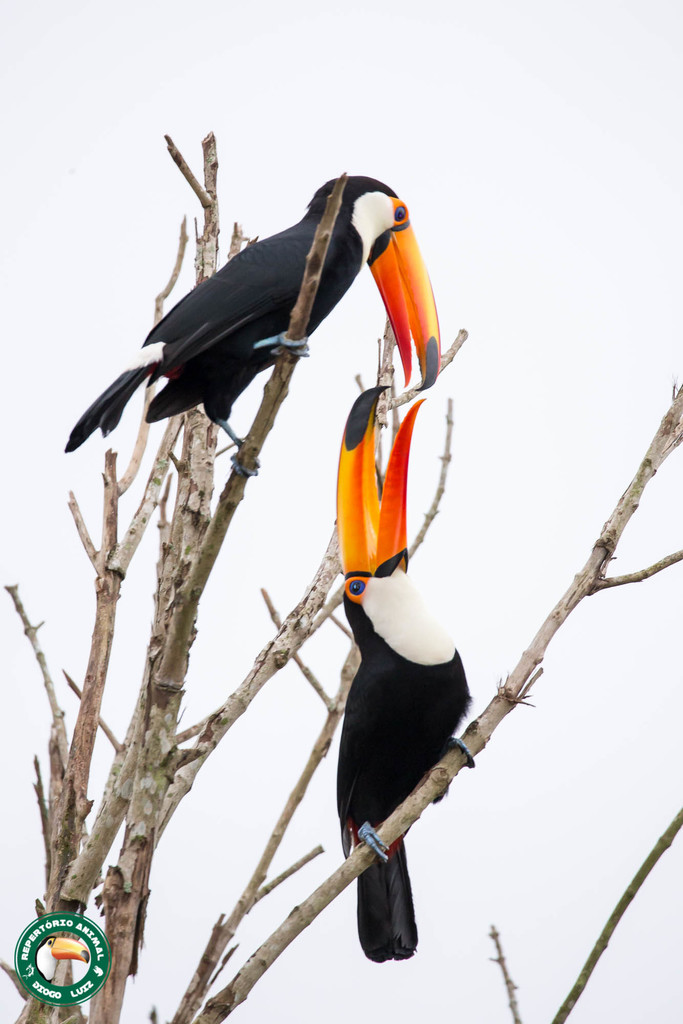
The Toco Toucan (Ramphastos toco) is the largest toucan species, found in open woodland across central and eastern South America. Its bill, up to 19 cm long, is hollow, lightweight, and packed with blood vessels: it reaches fruit on branches too thin to support the bird's weight and radiates body heat like a thermal fin.
The Toco Toucan is one of those animals that looks like a design exercise in exaggeration. Its bill is roughly one third the bird's total body length. It is brighter than almost any other bill on the planet: a deep orange-red shading to yellow at the base, with a black spot at the tip. And yet, despite appearing structurally implausible, the bill is a precise piece of engineering that solves several real problems at once.
How to identify a Toco Toucan
In the field, this is not a bird you need to work to identify. The combination is unique at any range:
- Plumage: almost entirely black with a large white bib covering the throat and upper breast.
- Eye ring: bare blue skin around the orange-red iris, a vivid contrast to the black feathering.
- Bill: orange-red with a yellow base and a black tip, up to 19 cm long in the largest males.
- Size: 55 to 65 cm tip to tail, making it noticeably larger than any other toucan species.
In flight the Toco Toucan is heavy-looking, with shallow wingbeats and an undulating path. It rarely glides. The bill is held slightly upward in flight, giving it a front-heavy silhouette unlike any other South American bird. The call is a series of deep, frog-like croaks and rattles, often the first clue to its presence in tree canopy.
The bill: what it does and what it does not do
For over a century the standard explanation for the toucan's bill was sexual selection: females prefer males with larger bills. That may be partly true, but research published in 2009 added a clearer functional explanation. The bill is extensively vascularised, carrying a dense network of blood vessels close to the surface. By controlling blood flow, the Toco Toucan can shunt warm blood to the bill and radiate heat directly to the air, or restrict flow to conserve warmth. Thermal imaging of toucans at rest shows the bill radiating strongly after exertion or during warm periods and cooling to near-ambient when the bird tucks it away.
The bill accounts for roughly 40% of the bird's total body surface area. Combined with the size of the blood vessel network, this makes it the most important single heat-exchange surface on the bird. For a tropical species that cannot sweat, this matters enormously.
The foraging function is simpler. The Toco Toucan eats fruit, primarily, and the bill allows it to reach figs, palms and other fruit hanging on outer branches too thin to bear the bird's weight. It grips the fruit at the bill tip, then jerks its head back to toss the item to the throat. The serrated edge of the bill helps with grip and with peeling skin from larger fruits.
Despite the size, the bill weighs very little: roughly 5% of total body weight. Its internal structure is a lattice of thin bony struts and air-filled cavities inside a rigid outer keratin shell, much like aerospace foam-core composites. The structure provides rigidity with minimal mass. A Toco Toucan's bill is measurably lighter than a similarly sized solid block of bone would be.
Where to find one
The Toco Toucan's range covers a large portion of South America: Brazil, Argentina, Bolivia, Paraguay and the Guianas, with vagrant records further afield. It is a bird of open country rather than dense rainforest, favouring gallery forest along rivers, forest edge, palm groves and the woody margins of cerrado grassland. In this it differs from its smaller relatives, which tend to occupy denser canopy.
The Pantanal wetlands of Brazil and Bolivia, the Iguazu area along the Brazilian-Argentinian border, and the Bolivian lowlands are reliable locations. The bird is conspicuous when active and calls frequently, which makes it relatively findable by sound before sight. Dawn and dusk see the most activity, with groups of 2 to 6 moving between fruiting trees.
The Kaught catalog places the Toco Toucan at the Epic tier, three diamonds. It is not globally scarce, but it sits outside the everyday observation radius of most users: reaching it means being in the right part of South America and searching the right habitat. The Andean Condor shares the South American range but occupies a completely different elevation and ecosystem, the mountain cliffs and high-altitude páramo rather than the lowland forest edge.
Roosting and social behaviour
Toco Toucans roost communally in tree cavities, tucking the bill under the wing and folding the tail up over the back. The posture reduces the bird's profile significantly: a bird that appears too large for a given cavity fits when it folds itself correctly. Groups of up to 6 individuals may share a cavity.
Outside breeding season they live in small flocks. During the breeding season pairs nest in natural tree cavities or woodpecker holes, with both parents incubating a clutch of 2 to 4 eggs. Incubation takes about 18 days. Chicks hatch with closed eyes and no feathers, and the bill is a short, stubby structure at hatching, reaching adult proportions over the first few months.
Like the Superb Lyrebird and the Bald Eagle, the Toco Toucan is a species where a distinctive feature, the bill, the tail, the white head, has made it globally recognisable far beyond its natural range. But the feature is functional, not decorative.
Three things worth knowing about the Toco Toucan
- The Toco Toucan's tongue is long, narrow and feather-like, with serrated edges. It is used to manipulate food inside the bill and may help detect ripeness by texture.
- The species is the only toucan found in open, non-forested habitats at the scale it occupies; most other toucans are forest interior specialists. This gives it a much wider observable range than its relatives.
- In Brazil and Argentina, the Toco Toucan regularly nests in the cavities of dead palms standing in open grassland, far from any forest, using the same cavity year after year.
Toco Toucan: frequently asked questions
What is a Toco Toucan?
The Toco Toucan (Ramphastos toco) is the largest of the roughly 40 toucan species, found in open woodland, forest edge and gallery forest across central and eastern South America. It is recognisable by its black plumage, white bib, blue eye rings and the enormous orange-red bill that can reach up to 19 cm.
Why does the Toco Toucan have such a large bill?
The bill serves at least two confirmed functions. It allows the toucan to reach fruit on slender outer branches that cannot support the bird's weight. It also acts as a heat radiator: the bill is densely vascularised and the toucan regulates blood flow through it to shed excess body heat, similar in principle to the ears of an elephant.
Is the Toco Toucan's bill heavy?
No. Despite accounting for roughly 40% of the bird's body surface area, the bill weighs only about 5% of total body weight. It is constructed from a rigid keratin shell reinforced by a lightweight mesh of bony struts and air-filled cavities, making it strong and thermally efficient without being heavy.
Where does the Toco Toucan live?
Across central and eastern South America: Argentina, Bolivia, Brazil, Paraguay and the Guianas. It prefers open woodland, forest edge, gallery forest and palm groves, avoiding dense rainforest interior where smaller toucan species are more common.
What does the Toco Toucan eat?
Primarily fruit, especially figs and palms. It also eats insects, small lizards, nestling birds and eggs. Food is held at the bill tip and tossed backward into the throat with a flick of the head.
Why is the Toco Toucan Epic in Kaught?
Kaught's rarity tier reflects how often a species appears in wild observation records. The Toco Toucan is widespread in South America but not globally abundant, and a field sighting requires visiting the right habitat. It sits at the Epic tier: three diamonds out of four.
How does the Toco Toucan sleep?
It tucks its bill under its wing and folds its tail up over its back when roosting, becoming surprisingly compact. The posture reduces heat loss and fits the bird into smaller cavity roosts shared with other individuals.
The next thing you see could be
your first catch.
Kaught is live on the App Store and Google Play. Free to start, and your first catch is one photo away.
Free to start · Live on the App Store and Google Play
Species data, type, rarity tier and measurements, is drawn from the Kaught catalog, built on open biodiversity records from GBIF and iNaturalist. Rarity reflects how often a species is observed in the wild, not its conservation status.