
Exotic spotlight
Oriental Pied Hornbill: the casqued bird of the Southeast Asian forest
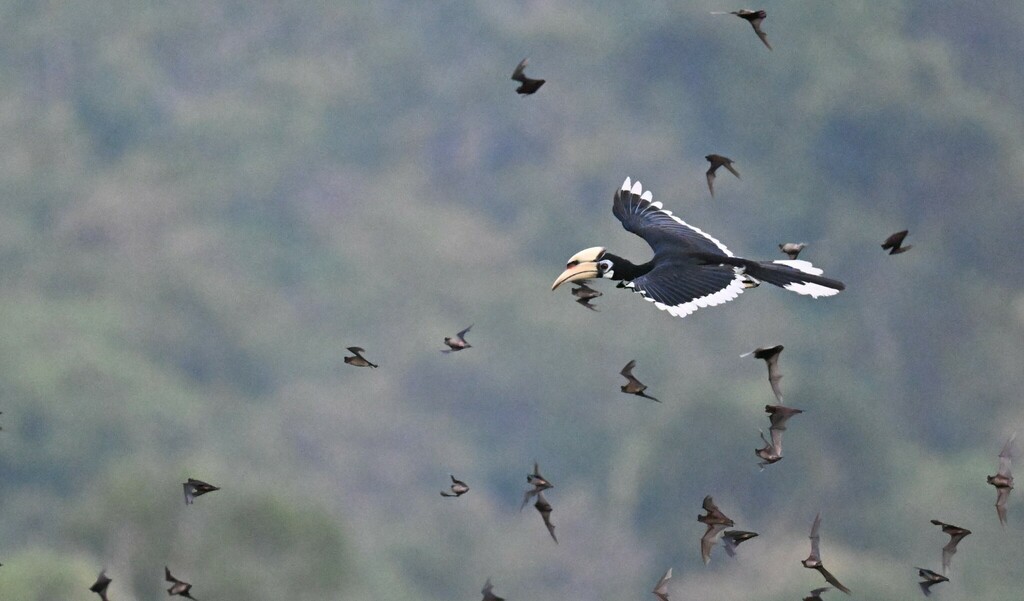
The Oriental Pied Hornbill (Anthracoceros albirostris) is a striking black-and-white forest bird with an enormous casqued bill, found across South and Southeast Asia. It is best known for walling the female inside a hollow tree for the entire breeding season while the male feeds her through a narrow slit.
Most birds you'd recognise at a glance. The Oriental Pied Hornbill is one you stop and stare at. That bill, a banana-sized structure topped with a prominent ridge called a casque, looks like it belongs on a dinosaur. The black-and-white plumage is theatrical. The sound, a loud, rapid cackling, carries through the forest canopy long before the bird appears. If you're anywhere from the forested hills of India through to the jungles of Borneo, this is one of the most rewarding animals you can spot.
How to identify an Oriental Pied Hornbill
Size is the first clue: at 55–60 cm this is a large bird, roughly the length of a crow plus its bill. Key field marks:
- Bill and casque: huge, decurved yellow bill with black markings near the base, topped by a prominent yellow-and-black casque ridge that gives the head its distinctive helmet shape.
- Plumage: glossy black on the back, wings, neck and upper breast; clean white on the belly, vent and outer tail feathers. In flight, the white wing patches flash clearly.
- Face: bare skin around the eye is yellow above and blue below, vivid against the black feathers. The male has a black patch at the base of the bill that is absent or reduced in females.
- Flight: characteristic shallow wingbeats interspersed with short glides; the wings make a whooshing sound clearly audible as the bird passes overhead.
You're most likely to see it in pairs or small groups moving through the canopy, calling loudly. In Singapore it is now a common sight in parks and gardens near large fig trees. In wilder parts of its range it keeps to primary and tall secondary forest.
Where do Oriental Pied Hornbills live?
The species spans a vast range: from the Himalayan foothills of India and Bangladesh east through Myanmar, Thailand and Indochina, then south through the Malay Peninsula, Sumatra, Java and Borneo to the Philippines. It tolerates a wide range of forest types, including forest edges, plantations with large trees, and increasingly urban parks, as long as there are fruiting trees and old hollow trunks for nesting.
Like all hornbills, it is dependent on large, mature trees, specifically old trees with cavities big enough to seal a nesting female inside. Forest fragmentation removes these trees first, which is why hornbills are good indicators of forest quality.
What does the casque actually do?
This is the question every visitor to Southeast Asia eventually asks. In the Oriental Pied Hornbill, the casque is not a resonating chamber. Unlike some relatives (such as the helmeted hornbill, whose casque is solid ivory), the Oriental Pied Hornbill's casque is a lightweight hollow structure that reinforces the large bill. It changes in shape and colour as the bird ages, acting as a visual signal of life stage. Older, more dominant birds carry larger, more distinctly patterned casques.
In some hornbill species the casque does amplify calls, but here the noise comes from the syrinx and throat, not the bill structure.
The most unusual nest in Southeast Asia
Hornbill nesting behaviour is extraordinary. A pair finds a natural tree hollow. The female enters the cavity and, working from inside while the male works from outside, seals the entrance with a paste of mud, droppings and regurgitated food. The result is a hard wall with only a narrow vertical slit remaining, barely wide enough to pass food through.
The female then moults her entire flight plumage inside the cavity, becoming flightless while she incubates the eggs. For up to three months, she is entirely dependent on the male to feed her and the chicks through the slit. He makes dozens of feeding visits per day, passing figs, insects and small animals one item at a time. When the chicks are large enough that space inside the cavity becomes tight, they all break out together.
The strategy protects the nest from snakes, macaques and other nest raiders. An intact mud seal is almost impossible for a predator to break quietly from the outside.
What do they eat?
Fruit dominates the diet, particularly figs, which fruit asynchronously and provide a reliable year-round food supply. The hornbill plays an important ecological role as a seed disperser: it swallows entire fruits, digests the pulp, and passes the seeds intact, often at considerable distances from the parent tree. In forests where hornbills have disappeared, certain tree species fail to regenerate.
Protein comes from insects, lizards, small snakes and occasionally the eggs and chicks of smaller birds. The bill is long enough to reach into crevices and strong enough to grip and subdue struggling prey.
How rare is it?
In the Kaught catalog the Oriental Pied Hornbill sits at the Epic tier, three diamonds out of four. That reflects its position in real-world observation records: it is locally abundant where good forest with old trees remains, but those conditions are increasingly patchwork across its range. In fragmented landscapes, the species becomes genuinely scarce. A clear, unobstructed view of a nesting pair at an active hollow, rather than a distant silhouette crashing through the canopy, is one of the more satisfying catches in Southeast Asian birdwatching.
If hornbills interest you, see also our guide to Europe's Eagle Owl for another large forest bird with an equally distinctive silhouette, or our Wedge-tailed Eagle guide for a southern hemisphere parallel in terms of canopy dominance.
Oriental Pied Hornbill: frequently asked questions
What does an Oriental Pied Hornbill look like?
A large black-and-white bird, 55–60 cm long, with a massive yellow-and-black bill topped by a prominent casque ridge. The back and wings are black, the belly and outer tail white. Bare skin around the eye is yellow above and blue below. In flight, white wing patches flash clearly on each wing.
Where does the Oriental Pied Hornbill live?
Tropical and subtropical lowland forest, forest edges, mangroves and gardens across South and Southeast Asia, from India and Bangladesh east through Indochina, Malaysia and Borneo to the Philippines. Increasingly seen in urban parks wherever large fruit-bearing trees and old hollow trunks persist.
What does the hornbill's casque actually do?
In this species, the casque is a hollow structural ridge, not a sound resonator. It reinforces the large bill and changes shape and pattern with age, giving other hornbills a visual read on the bird's life stage and body condition.
What do Oriental Pied Hornbills eat?
Mainly fruit, especially figs, supplemented by insects, lizards, small snakes and occasionally the eggs or chicks of other birds. They swallow fruit whole and pass seeds intact, making them important seed dispersers for many forest tree species.
How do hornbills nest?
The female enters a tree hollow and both birds seal the entrance with mud and droppings, leaving only a narrow slit. The female incubates the eggs and moults her flight feathers inside. The male feeds her and the chicks through the slit for up to three months, until the chicks are big enough to break out. The sealed entrance deters most predators.
Why is the Oriental Pied Hornbill Epic in Kaught?
Kaught's rarity reflects how often a species is actually recorded in the wild, not its conservation status. The hornbill is locally common in intact forest but scarce wherever old-growth trees with cavities are absent. Across its fragmented range, a confirmed sighting of an active nest or a foraging pair at close range is genuinely uncommon, placing it at the Epic tier.
The next thing you see could be
your first catch.
Kaught is live on the App Store and Google Play. Free to start, and your first catch is one photo away.
Free to start · Live on the App Store and Google Play
Species data, type, rarity tier and measurements, is drawn from the Kaught catalog, built on open biodiversity records from GBIF and iNaturalist. Rarity reflects how often a species is observed in the wild, not its conservation status.