
Adaptation explainer
How do bats echolocate? The biology of living sonar
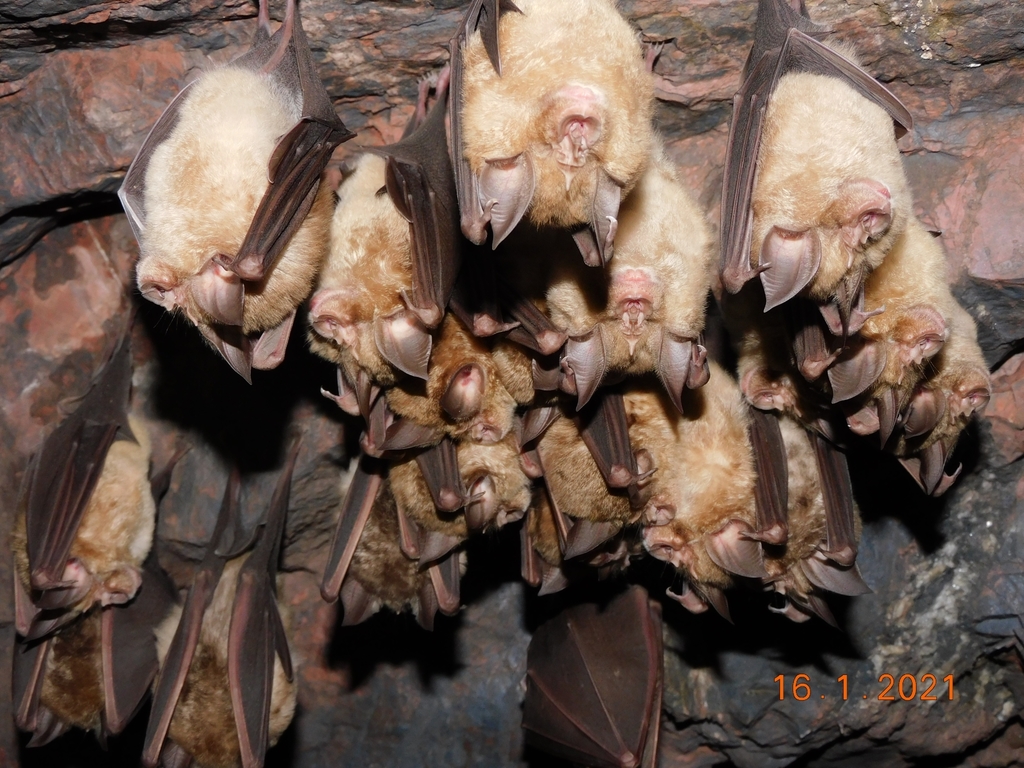
Bats produce ultrasonic pulses in the larynx, emit them through the mouth or nose, and listen to the returning echoes. The delay between pulse and echo gives distance. The frequency shift (Doppler effect) gives speed and direction. The result: a three-dimensional acoustic map of the surroundings, updated dozens of times per second.
One summer evening in a limestone valley in southern Europe, a bat leaves its roost in the ceiling of an old farmhouse and enters a world of complete darkness that it navigates with the precision of a guided missile. It is not using sight. It is not using smell. It is listening to its own voice bounce back from the world around it, and from the information in those returning echoes it builds a real-time acoustic map detailed enough to catch a moth by the beat of its wings. This is echolocation, and it is one of the most sophisticated sensory systems evolution has ever built.
Step 1: producing the pulse
Most echolocating bats produce ultrasonic pulses in the larynx, using specialised vocal folds that vibrate at frequencies between roughly 20 kHz and 200 kHz. These frequencies are inaudible to humans (human hearing tops out at about 20 kHz), which is why a room full of hunting bats sounds silent to us while being, in acoustic terms, deafeningly busy.
The calls are extraordinarily loud at source. The greater horseshoe bat emits pulses at about 83 kHz and around 90 dB at close range. Some species emit pulses equivalent to a jet engine at close range, up to 130 dB at the point of emission. The bat does not deafen itself because of a remarkable muscular adaptation: just before each pulse is emitted, the bat contracts the stapedius muscle in its middle ear, which temporarily dampens hearing. It releases the muscle to receive the echo. This contraction and release happens dozens of times per second, perfectly timed to the call rhythm.
Step 2: the nose or the mouth
Different species emit their pulses through different routes:
- Mouth emitters (most vesper bats, family Vespertilionidae, including the common pipistrelle): calls are produced in the larynx and emitted through the open mouth during flight. The mouth acts as a simple cone-shaped megaphone.
- Nose emitters (horseshoe bats, family Rhinolophidae; and leaf-nosed bats): calls are emitted through the nostrils, shaped and directed by a complex fleshy structure, the noseleaf. The greater horseshoe bat's horseshoe-shaped noseleaf focuses the outgoing pulse into a narrow directional beam, like a parabolic dish antenna. This reduces clutter from surrounding vegetation and allows the bat to scan targets with precision.
The common pipistrelle we covered in the common pipistrelle article emits calls through its mouth at around 45 kHz, a frequency suited to detecting small insects at 3 to 5 m range. The greater horseshoe bat's higher-frequency nose-emission at 83 kHz gives finer resolution at shorter range, suited to hunting in dense woodland where close-range precision matters more than long-range detection.
Step 3: reading the echo
When the pulse hits an object, an echo returns to the bat's ears. The bat's brain extracts several pieces of information simultaneously:
- Distance: the time delay between the emitted pulse and the returning echo tells the bat exactly how far away the target is. Sound travels at approximately 340 m per second; a 3 ms delay means the target is roughly 50 cm away.
- Speed and direction of movement: if the target is moving, the echo returns at a slightly different frequency to the emitted pulse (the Doppler effect). A moth flying toward the bat compresses the echo frequency upward; one moving away stretches it downward. The bat's brain processes this shift to calculate the target's velocity and heading in real time.
- Size and texture: the intensity and frequency content of the echo vary with the target's surface. A smooth hard surface reflects a clean, sharp echo; a soft furry moth wing scatters it.
- Identity: here is where the greater horseshoe bat earns its place as the study animal of choice for echolocation researchers. It emits a long, constant-frequency pulse rather than the brief frequency-modulated sweep used by most bats. This constant frequency is exquisitely sensitive to Doppler shifts. As a moth flies, its wingbeats produce a characteristic flickering modulation in the echo frequency: wings up, wings down, at a species-specific rate. The horseshoe bat can read this flicker pattern and identify the exact species of moth it is pursuing before contact, allowing it to assess whether the target is worth chasing, whether it is likely to be toxic, or whether it is a species that has evolved evasive manoeuvres.
Step 4: the approach, and the arms race
As a bat closes in on a target, it increases its pulse repetition rate. In the final phase of pursuit, called the terminal buzz, the bat can emit 200 or more pulses per second, each just a millisecond or two long, to build a rapid picture of the target's exact position at close range. The period just before a strike is the most acoustically intense moment in the hunt.
This is not a one-sided interaction. Many moth species have evolved ears specifically tuned to bat echolocation frequencies. When a moth detects an approaching bat call, it takes evasive action: folding its wings and dropping, spiralling, or diving toward foliage. Some moth species have even evolved ultrasonic clicks that appear to jam the bat's echolocation or warn of their distastefulness. The result is a sensory arms race that has been running for at least 65 million years.
The greater horseshoe bat as a catalog species
The greater horseshoe bat ranges across southern Europe, the Middle East and Asia east to Japan. In Britain it is mainly found in warm limestone country in the southwest, roosting in old barns, mines and caves in groups that can reach several hundred individuals. It is the largest British horseshoe bat and a distinctive roost subject for bat surveyors: when roosting, it hangs free by its hind feet with wings wrapped around its body like a cloak, the noseleaf clearly visible.
It hunts large beetles, moths and craneflies in open woodland and along hedgerows, hovering briefly to detect wingbeat patterns before pursuing. Flight speed is relatively slow for a bat, suited to methodical detection rather than speed pursuit.
Its Kaught rarity tier is Common (one diamond), a reflection of how frequently it is detected by bat surveyors with ultrasonic detectors across its range. Hearing one requires the right equipment; seeing one in flight requires patience and timing. The nocturnal animals guide covers the broader family.
Can you echolocate?
Humans cannot echolocate naturally, but a small number of blind people have learned to do so by clicking their tongues and listening to the returning sound. Research has shown that some individuals achieve a level of spatial resolution sufficient to navigate rooms, detect doorways and even ride bicycles. Brain imaging shows they process these self-generated echoes in the visual cortex rather than the auditory cortex, essentially using the same neural real estate that sighted people use for vision. The brain's architecture is more plastic than the word "visual" suggests.
Bat echolocation: frequently asked questions
How does bat echolocation work?
Bats produce ultrasonic pulses (20 to 200 kHz) in the larynx, emit them through the mouth or nose, and listen for returning echoes. Echo delay gives distance; Doppler frequency shift gives speed and direction of moving targets. The brain builds a real-time acoustic map updated dozens of times per second.
Can bats see at all?
Yes. All bats have functioning eyes. Large fruit bats use vision rather than echolocation. Small insectivorous bats rely on echolocation in darkness because it outperforms vision at close range, but they are not blind: "blind as a bat" is a myth.
How do bats avoid deafening themselves?
By contracting the stapedius muscle in the middle ear about 6 milliseconds before each pulse, temporarily dampening their own hearing, then releasing it to receive the echo. This contraction-and-release cycles dozens of times per second, perfectly synchronised to the call rate.
Do all bats echolocate?
No. Large fruit bats (Pteropodidae) generally do not echolocate and rely on vision and smell. About 70% of bat species, mostly insect-eaters, use laryngeal echolocation. Rousettus fruit bats use a simpler tongue-click echolocation as an exception within Pteropodidae.
What can a bat tell from an echo?
Distance (echo delay), speed and direction of movement (Doppler shift), size and surface texture (echo intensity and frequency content), and in some species like the greater horseshoe bat, prey identity from the characteristic wingbeat pattern embedded in a flickering echo.
Why does the greater horseshoe bat have that strange nose?
The horseshoe-shaped noseleaf focuses the outgoing sonar pulse into a narrow directional beam, like a parabolic dish. This reduces clutter from surrounding vegetation and allows the bat to scan targets with precision at close range in dense woodland, rather than broadcasting sound in all directions.
The next thing you see could be
your first catch.
Kaught is live on the App Store and Google Play. Free to start, and your first catch is one photo away.
Free to start · Live on the App Store and Google Play
Species data, type, rarity tier and measurements, is drawn from the Kaught catalog, built on open biodiversity records from GBIF and iNaturalist. Rarity reflects how often a species is observed in the wild, not its conservation status.