
Species spotlight
The Common Pipistrelle: the tiny bat that eats 3,000 insects a night over your garden
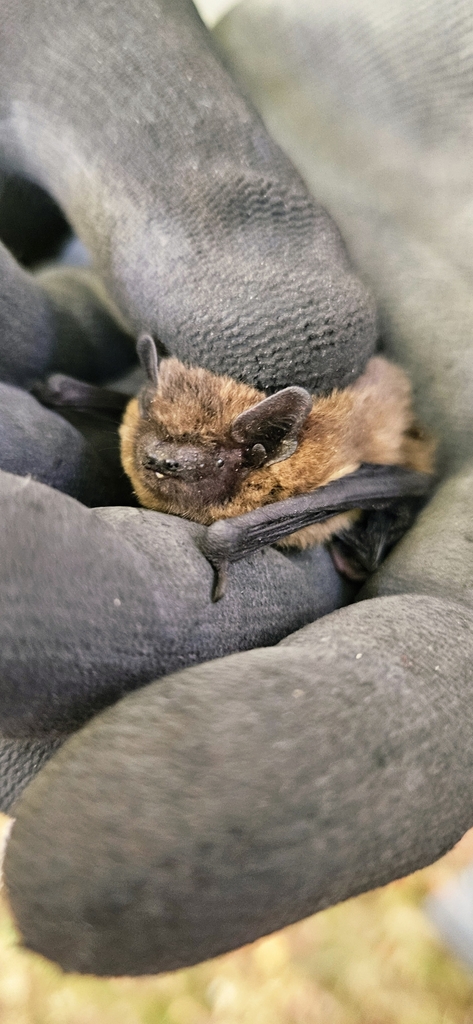
The common pipistrelle (Pipistrellus pipistrellus) is Britain's most common and smallest bat: a 5-gram, dark-brown flicker that emerges from roosts around sunset to hunt moths and midges by echolocation. A single bat can eat up to 3,000 insects in one night. It is the bat most likely darting over your garden right now.
Twenty minutes after sunset on a warm June evening, something small and fast begins to flicker above the hedgerow. It is not a swift: the wingbeats are too rapid and the path too erratic. It banks sharply, drops, spirals back upward, then vanishes around the garden corner. That is a common pipistrelle, and it is in the middle of a hunt.
How to identify a common pipistrelle
At dusk, pipistrelles are easier to watch than to photograph, but a few things pin the identification:
- Size: very small. Body roughly the size of your thumb, wingspan around 22 cm. The smallest bat you are likely to encounter in the UK.
- Flight: fast and erratic, with rapid wingbeats. It does not glide in long arcs like a swift; it twists constantly as it tracks individual insects.
- Colour: dark brown above, slightly paler below. Ears, face and wing membranes are dark brown to black.
- Height: usually hunts within five metres of a hedge, tree line or water surface. You will often see it passing repeatedly along the same route, a beat it works over and over.
The echolocation call of the common pipistrelle peaks at around 45 kHz, inaudible to human ears. A bat detector tuned to that frequency gives the game away immediately: a rapid series of dry clicks that speeds up as it closes on prey.
How echolocation works
The common pipistrelle navigates and hunts entirely by sound. It emits ultrasonic pulses through its mouth or nose, and listens to the echoes that bounce back. The time it takes for the echo to return tells the bat the distance to an object. The difference in arrival time between the two ears tells it the direction. The shift in pitch of the returning echo (the Doppler effect) tells it whether the object is moving, and how fast.
As a bat approaches prey, the pulse rate increases: from around ten pulses per second on a general search to several hundred per second in the final "terminal buzz" just before capture. At that rate, the pipistrelle is receiving a near-continuous acoustic picture of exactly where the midge is in three-dimensional space, at a level of precision we can barely replicate in lab conditions.
Prey is caught in the tail or wing membrane and transferred to the mouth mid-flight. A skilled pipistrelle can detect, target and catch a single midge in a fraction of a second.
What pipistrelles eat, and why the number 3,000 matters
Common pipistrelles eat small flying insects: gnats, midges, caddisflies, small moths, lacewings and any other aerial invertebrate small enough to handle. They do not eat mosquitoes specifically, but mosquitoes and their kin make up a large part of the prey base.
A single pipistrelle on an active summer night can consume up to 3,000 insects. Over a roost of 50 to 100 bats, common for a maternity colony, that amounts to a substantial local suppression of biting insects. This is not intentional pest control; it is just a very hungry mammal with a very fast metabolism.
Weight context: this animal weighs about 5 grams, roughly the same as a two-pence coin. Eating 3,000 insects in a night, even very small ones, represents a significant fraction of body weight in food consumed and then metabolised by dawn.
Summer: maternity colonies and the single pup
Through June and July, female pipistrelles gather in maternity roosts, typically in the roof spaces of buildings, behind fascia boards, or in bat boxes. Colonies of 50 to 100 are common; exceptional roosts may hold several hundred. Each female gives birth to a single pup in late June or early July.
The pup is born hairless and eyes-closed, but grows quickly. By three to four weeks old it can fly. The maternity roost disperses from around August onward as juveniles become independent. The commotion at a maternity roost at dusk, bats streaming out of a gap you can barely see, is one of the most dramatic wildlife spectacles available from a British back garden.
Hibernation and the winter roost
Common pipistrelles hibernate from October to March, roosting in crevices in trees, buildings and stonework. Winter roosts are typically smaller than summer ones, and individuals may move between roost sites through the season. Like the European hedgehog, a pipistrelle's winter survival depends on fat reserves built up through a productive summer feeding season.
Warm spells in winter can rouse bats from torpor prematurely, with the same problem: burned fat reserves and no insects to replace them.
Where and when to see one
The common pipistrelle is present across almost all of the UK, including urban centres. The best places to watch are:
- Along a garden hedge or over a garden pond: pipistrelles follow linear features and are drawn to the insect hatches over water.
- Under streetlights: moths and other insects gather in the warm glow, and bats follow them.
- At the edge of a wood or along a river bank at dusk.
Timing is precise. The emergence from a roost begins around 20 minutes after sunset and the main feeding burst runs for 60 to 90 minutes. Return later and they are often gone. June and July evenings are the most reliable: long days, warm air, abundant insects, and active maternity colonies. See our guide to nocturnal wildlife spotting for tips on watching after dark.
Why the common pipistrelle is Common in Kaught
Kaught's rarity tier reflects how often a species is recorded in the wild, not how hard it is to see well. The common pipistrelle is by far the most frequently logged bat in Britain and one of its most numerous mammals, so it sits at the Common tier: one diamond of four. It can still be a satisfying catch, since pinning down a fast, low-light flier takes patience, but on the numbers it is a species you will meet again and again. Scarcer bats and the truly elusive mammals climb the tiers from there. See the full UK rarity tier ranking for context across the catalog.
Common pipistrelle bat: frequently asked questions
What does a common pipistrelle bat look like?
Very small, with a body length of about 4.5 cm and a wingspan of around 22 cm, weighing roughly 5 grams. Dark brown fur above, slightly paler below, with dark ears, face and wing membranes. In flight it looks tiny, fast and erratic, twisting sharply as it tracks insects.
How do pipistrelle bats hunt?
By echolocation: they emit ultrasonic pulses at around 45 kHz and listen to the returning echoes to locate insects in three dimensions. The pulse rate accelerates to hundreds per second in a terminal buzz as they close on prey. They catch insects in the wing or tail membrane and transfer them to the mouth mid-flight.
When can I see pipistrelle bats?
Emerging around 20 minutes after sunset from April through October. June and July are peak season. Look along hedgerows, over garden ponds, near streetlights or by any open water at dusk. The main feeding burst lasts about 60 to 90 minutes after emergence.
How many insects does a pipistrelle eat in one night?
Up to 3,000 small insects in a single night at peak feeding in summer. Prey includes gnats, midges, caddisflies, small moths and similar aerial invertebrates caught individually at high speed.
Are pipistrelle bats dangerous?
No. They will not fly into your hair and do not attack people. They manoeuvre with precision around human heads because warm air and body heat attract the insects they are hunting. They are protected by law in the UK, so roosts must not be disturbed or destroyed.
How rare is the common pipistrelle in Kaught?
It sits at the Common tier, one diamond of four. Kaught's rarity reflects how often a species is recorded in the wild, and the common pipistrelle is the most frequently logged bat in Britain. It can still take patience to catch a fast, low-light flier, but on the numbers you will meet it again and again.
The next thing you see could be
your first catch.
Kaught is live on the App Store and Google Play. Free to start, and your first catch is one photo away.
Free to start · Live on the App Store and Google Play
Species data, type, rarity tier and measurements, is drawn from the Kaught catalog, built on open biodiversity records from GBIF and iNaturalist. Rarity reflects how often a species is observed in the wild, not its conservation status.