
Legendary spotlight
The Leopard: the spotted big cat that climbs, swims and outruns almost everything in its range
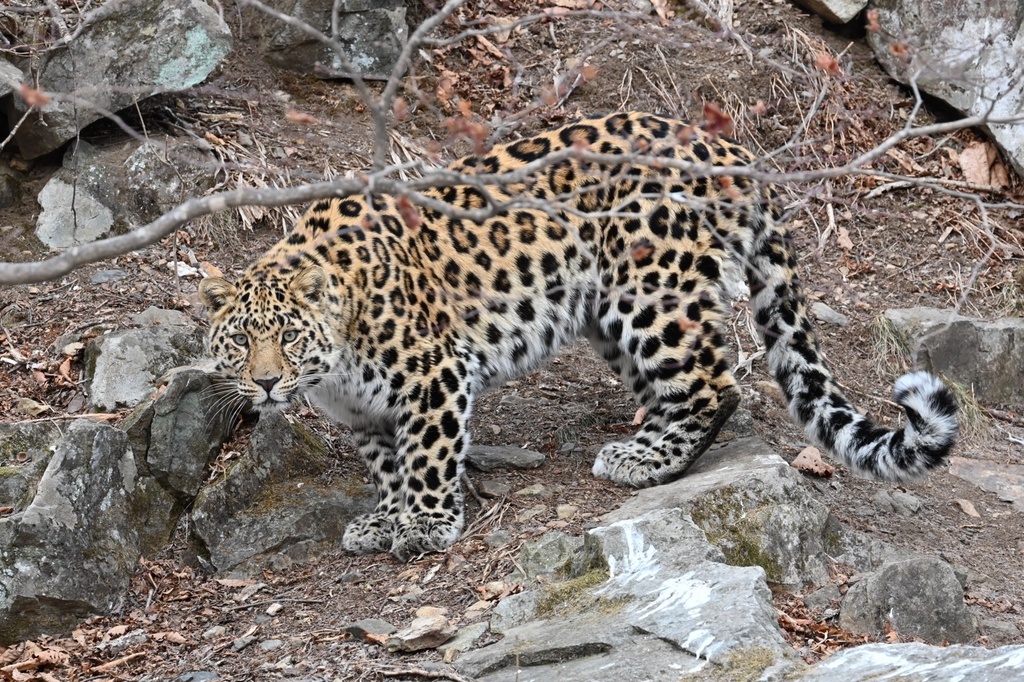
The leopard (Panthera pardus) is the most widely distributed wild big cat on Earth: a powerful, solitary ambush predator with a pale coat covered in distinctive black rosettes. Found across sub-Saharan Africa and pockets of Asia, it hunts at night, hauls prey into trees and is famously almost impossible to observe in the wild. Legendary tier in the Kaught catalog.
There are animals you can hope to see on a good day in the right habitat, and then there is the leopard. Even people who spend weeks in African reserves leave without a sighting. A wild leopard knows you are there before you know it exists. That invisibility, in an animal up to 90 kg with a coat that seems designed to catch the eye, is one of the more astonishing facts in natural history.
How to identify a leopard
The coat is unmistakable once you know what to look for. The base colour ranges from pale straw yellow to rich tawny or ochre, and the entire coat is covered in rosettes: open rings of dark brown to black spots arranged around a slightly paler centre. The belly and inner limbs carry solid black spots on white fur.
Telling a leopard from its relatives comes down to three things:
- Versus cheetah: cheetahs have solid, round black spots, a tear-streak from eye to jaw, and a narrow racing-dog build. A leopard is bulkier, with a larger head and no tear-marks.
- Versus jaguar: jaguars (Americas only) look almost identical but are larger, heavier and have rosettes with a central spot inside each ring. A leopard's rosettes are empty in the centre.
- Versus lion: lions are uniformly tawny with no spots (though cubs have faint spots). A leopard is smaller and always patterned.
Black leopards, sometimes called black panthers, are not a separate species. They are leopards carrying a recessive gene that produces excess melanin; in the right light you can still see the rosettes beneath the dark coat.
Where leopards live
No other big cat comes close to the leopard's geographical range. It occupies sub-Saharan Africa, the Middle East, Central Asia, South Asia, Southeast Asia and isolated populations in the Russian Far East and China. Roughly 40 countries still hold wild populations.
The habitat range is equally broad. Leopards are at home in savanna, tropical rainforest, mountain ranges, rocky scrubland, mangrove swamps and, in some parts of India, the fringes of large cities. The key variable is prey availability and somewhere to hide: a leopard can make a living almost anywhere those two conditions are met.
This flexibility makes it the most adaptable of the five big cats and the hardest to survey. Unlike lions, which live in open, well-studied habitats and move in visible groups, a single leopard can occupy dense forest the size of a city and be detected only through camera traps or the occasional kill left in a tree.
How the leopard hunts
The leopard is a textbook ambush predator. It does not run prey down over distance: it closes the gap silently, relying on its rosette coat to break up its outline in dappled light, and launches from within a few metres. The killing bite targets the throat or the back of the neck.
Prey ranges from small rodents and birds to adult wildebeest or impala. In areas where lions and hyenas operate, leopards routinely haul their kills into trees, sometimes 4 or 5 metres off the ground. A leopard can carry a carcass heavier than itself vertically up a trunk: the muscle-to-weight ratio required is extraordinary, and no other big cat can match it.
Hunting happens almost entirely at night. The leopard's eyes have a reflective tapetum lucidum that amplifies available light, and the long whiskers detect air movement and texture in total darkness. By day it rests, often in a tree, draped along a high branch with legs hanging either side.
A leopard's territory and social life
Leopards are solitary outside of mating. Adults hold large territories, typically 30–60 km² for females and up to 300 km² for males in some African habitats, marked with scent, scratch marks on trees and vocalisations: a rasping, sawing cough unlike any other cat sound.
Cubs (usually two or three per litter) stay with the mother for 18–24 months while learning to hunt. A cub's survival in areas with lions depends heavily on the mother's ability to cache kills out of reach.
How rare is the leopard?
In the Kaught catalog the leopard sits at the Legendary tier, four diamonds. Kaught's rarity reflects how often a species is observed in the wild, not whether it is at risk. A leopard sighting scores Legendary not because leopards are scarce everywhere, but because they are, species-wide, among the hardest wild animals to actually encounter.
Compare the tiger, another Legendary-tier cat: tiger territories are vast but the animal is often detected from pugmarks and vocalisations. A leopard in dense forest may cross camera traps twice a week and never be seen with human eyes. Their talent for remaining invisible in proximity to people is genuinely unmatched among large mammals.
Three things that make the leopard extraordinary
- It is the only big cat capable of living undetected in the suburbs of major cities: leopards have been found hunting feral dogs in Mumbai, a metropolitan area of 20 million people.
- Individual rosette patterns are unique, like fingerprints, allowing researchers to identify individuals from camera-trap photographs without ever seeing the animal in person.
- A leopard can carry prey twice its own body weight into a tree: for a large male, that means hauling a 180 kg zebra foal 4 metres off the ground in a single sustained effort.
For more on the biggest, fastest and most powerful catalog species, see strongest animals in the world and fastest animals in the world. For other legendary big cats, see Eurasian lynx.
Leopard: frequently asked questions
What does a leopard look like?
A large, muscular cat with a pale tawny coat covered in black rosettes: open rings of spots around a lighter centre. The belly is white with solid black spots. Stockier than a cheetah, smaller and more lightly built than a jaguar. Black individuals (black panthers) carry a melanin gene and are the same species.
Where do leopards live?
Across sub-Saharan Africa and scattered populations through the Middle East, South Asia, Southeast Asia and the Russian Far East: the widest range of any big cat. They occupy savanna, rainforest, mountain ranges, scrubland and the outskirts of cities.
How does a leopard hunt?
By ambush, almost entirely at night. It stalks prey to within a few metres using its patterned coat as camouflage in dappled light, then kills with a bite to the throat or nape. After a kill it often carries the carcass up into a tree, sometimes hauling prey twice its own weight vertically.
How is a leopard different from a cheetah or jaguar?
Cheetahs have solid spots, a narrow build and a tear-streak from eye to jaw. Jaguars (Americas only) are bigger with rosettes that have a central spot inside them. A leopard is medium-built with empty-centred rosettes and no tear-marks.
Are leopards dangerous to people?
Leopards can be dangerous and occasionally attack people, particularly near settlements. Most avoid contact with humans. Never approach one: a cornered or injured leopard is unpredictable. In areas where leopards are known to be present, avoid walking alone at night.
Why is the leopard Legendary in Kaught?
Kaught's rarity tier reflects how often a species is actually observed in the wild, not its conservation status. Leopards are famously secretive and almost entirely nocturnal, rarely recorded even in areas with healthy populations. A confirmed wild sighting is one of the rarest genuine wildlife encounters, earning the Legendary tier.
The next thing you see could be
your first catch.
Kaught is live on the App Store and Google Play. Free to start, and your first catch is one photo away.
Free to start · Live on the App Store and Google Play
Species data, type, rarity tier and measurements, is drawn from the Kaught catalog, built on open biodiversity records from GBIF and iNaturalist. Rarity reflects how often a species is observed in the wild, not its conservation status.