
Behaviour guide
The Superb Lyrebird: the Australian bird that mimics chainsaws, cameras and every bird in the forest
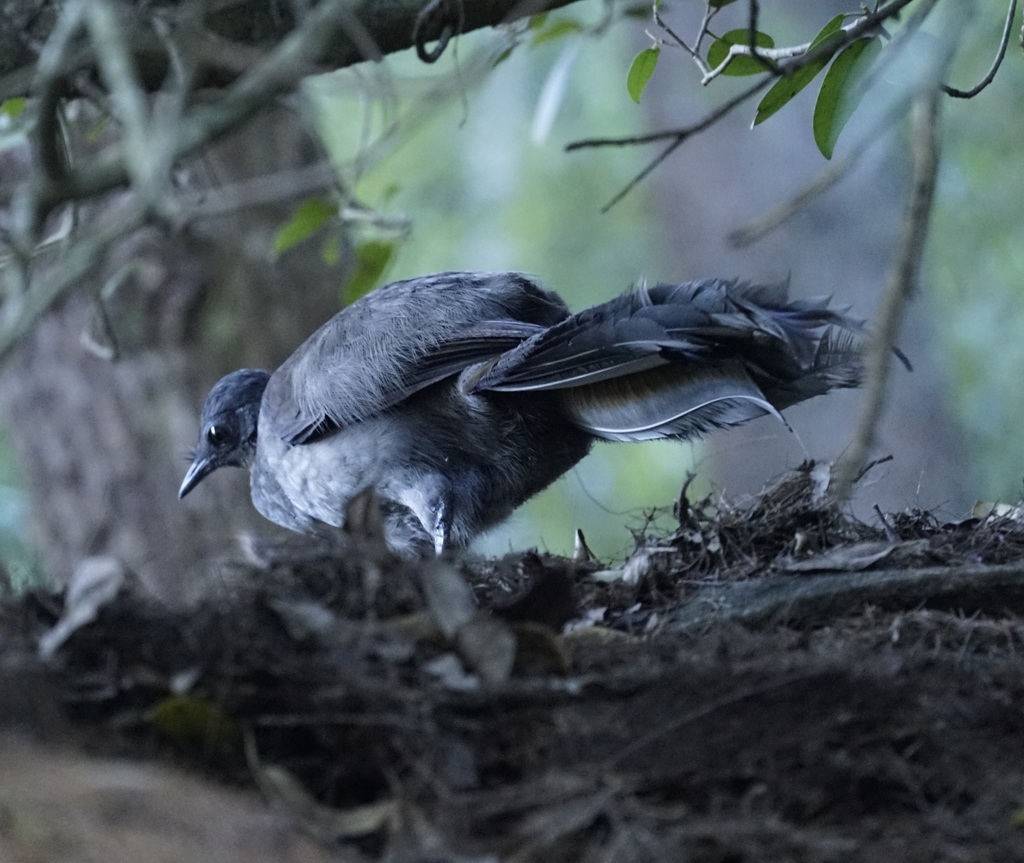
The superb lyrebird (Menura novaehollandiae) is a large, ground-dwelling Australian bird that can reproduce nearly any sound in its environment: other bird species, chainsaws, camera shutters, car alarms and human voices. Males perform an extraordinary display in winter, fanning a lyre-shaped tail while mixing mimicry into a continuous song. Rare tier in the Kaught catalog.
Stand in the right stretch of wet eucalyptus forest in southeastern Australia on a winter morning and you may hear what sounds like a full dawn chorus compressed into a single bird. Kookaburra, crimson rosella, grey fantail, eastern yellow robin: all present, all apparently calling at once, all emerging from the same source. Then a sound that does not belong: the rising whine of a chainsaw, or the staccato click of a camera motor drive. The superb lyrebird is performing, and it is using your world as its material.
What a superb lyrebird looks like
The lyrebird is roughly the size of a pheasant, a large, ground-dwelling bird with a surprisingly plain body given the fame of its voice and tail. The plumage is rufous-brown with chestnut tones on the wings, darker above and paler below. Seen walking through leaf litter, it looks like a large, long-legged thrush. Nothing prepares you for the tail.
In a displaying male, the tail has three types of feathers. Two long outer filaments curve outward at the tips in a lyre shape, giving the bird its name. Inside these are 12 lacy, filament-like feathers called lyrates. Between them, two broad, ribbon-like median feathers frame the whole structure. Fanned forward over the head during display, the tail becomes a translucent silver-white cage. The total tail length can exceed 55 cm, longer than the bird's entire body.
Females and young males are smaller and lack the elaborate outer feathers, though they share the same extraordinary vocal ability.
The syrinx: the instrument behind the mimicry
Most birds have a syrinx (the avian equivalent of a larynx) controlled by two muscle pairs. The lyrebird's syrinx is controlled by five pairs, making it one of the anatomically most complex vocal organs of any known bird. This allows the lyrebird to control multiple independent sound sources simultaneously, producing the harmonic richness of a flute, the percussive crack of a whip or the frequency-modulated sweep of a chainsaw, all from the same throat.
The mimicry is not reflex. It is learned. A young male listens to sounds in its environment over its first few years of life and practices, adding new sounds as it encounters them. Songs are culturally transmitted: males learn partly from their fathers, partly from neighbouring males in a local dialect, and partly by direct environmental sampling. A lyrebird that lives near a logging operation will add chainsaw sounds; one in a busier habitat will add car alarms and camera shutters.
Accuracy is striking. Researchers playing back recorded lyrebird mimicry to experienced birdwatchers have found that trained observers regularly misidentify the source species from the lyrebird's replica. The playback quality is high enough to elicit territorial responses from real birds.
Why evolve mimicry?
Mimicry in lyrebirds is primarily a sexual display. Males display from cleared mounds (up to 1 m high, built from scratched earth) in the understorey during winter, the breeding season in southeastern Australia. A displaying male fans the tail forward, vibrates it, and sings continuously for periods of up to an hour.
The song mixes mimicry with the male's own species-specific calls. Females observe and assess. A male that has accumulated a larger, more accurately reproduced repertoire signals age (it takes years to learn this many sounds), good health and a territory with enough variety to encounter many sound sources. These are honest signals of fitness: a younger or less healthy male simply has fewer resources for sustained display and a shorter, less varied repertoire.
Some researchers have proposed a second role: that males use alarm mimicry (kookaburra and cockatoo alarm calls) to startle females during mating, prolonging contact time. The evidence for this is debated, but if accurate it adds a distinctly manipulative layer to the most elaborate performance in Australian bird life.
Foraging: the other extraordinary adaptation
What the lyrebird does when it is not singing is almost as remarkable. It forages entirely in leaf litter, raking through deep accumulations of dead leaves and bark with oversized, powerful feet. In a good-quality forest, a single lyrebird may turn over 11 cubic metres of leaf litter per day in its search for earthworms, beetles, insect larvae, spiders and centipedes.
This makes it a significant driver of nutrient cycling in wet Australian forests. Where lyrebirds are present, litter decomposition rates are measurably higher and soil carbon and nitrogen distributions differ from lyrebird-free forest. The bird is, alongside the beaver and the earthworm, one of the clearer examples of a single animal species shaping the physical properties of its ecosystem.
How rare is the superb lyrebird?
The Kaught catalog rates the superb lyrebird at Rare tier, two diamonds. Lyrebirds are secretive, move quietly through dense understorey and detect human observers at considerable distance, at which point they stop singing and melt away. Hearing one is common in suitable habitat; seeing one in display is far less so.
The species is restricted to wet eucalyptus forest in a relatively narrow belt of southeastern Australia. Outside this zone, no sighting is possible. Within it, the best chance is a cool, still morning in June or July, moving slowly and waiting at the edge of a gully or cleared mound area.
For another bird with an extraordinary relationship with sound, see grey heron. For more on Australia's wildlife, compare with Andean condor, another large bird shaped by a very specific habitat.
Superb lyrebird: frequently asked questions
Can lyrebirds really mimic chainsaws?
Yes. Superb lyrebirds have been recorded producing near-perfect replicas of chainsaws, car alarms, camera shutters and human voices, all learned from sounds in their environment. The mimicry is accurate enough to regularly fool experienced ornithologists listening to recordings.
Why do lyrebirds mimic sounds?
Males mimic to impress females during winter display. A larger and more varied repertoire signals a longer life, better health and a territory rich enough to encounter many sound sources: all honest signals of fitness. Females assess males partly on the quality and range of mimicry during display.
What does a superb lyrebird look like?
A large, ground-dwelling bird with rufous-brown body plumage. The male's tail is spectacular: two outer lyre-shaped filaments framing 14 lacy inner feathers, fanned forward over the head during display into a translucent silver cage over 55 cm long. Females are smaller and lack the elaborate tail.
Where do superb lyrebirds live?
Dense wet eucalyptus forest in southeastern Australia: Victoria, New South Wales and southern Queensland. They need deep, moist leaf litter, mature trees and undisturbed understorey. Best found on cool, still winter mornings in the Dandenong Ranges, Blue Mountains or similar forested ranges.
How rare is the superb lyrebird?
Rare tier in the Kaught catalog, two diamonds. Lyrebirds detect observers early and stop performing when aware of a human presence. Hearing one is possible in good habitat; seeing a full male display is a genuinely uncommon encounter even for experienced Australian birdwatchers.
What do lyrebirds eat?
Earthworms, beetles, insect larvae, spiders, centipedes and small lizards found in deep leaf litter. They rake through litter with powerful, digging-adapted feet. A single lyrebird may turn over 11 cubic metres of leaf litter per day, significantly affecting nutrient cycling in the forest floor.
The next thing you see could be
your first catch.
Kaught is live on the App Store and Google Play. Free to start, and your first catch is one photo away.
Free to start · Live on the App Store and Google Play
Species data, type, rarity tier and measurements, is drawn from the Kaught catalog, built on open biodiversity records from GBIF and iNaturalist. Rarity reflects how often a species is observed in the wild, not its conservation status.