
Exotic spotlight
Spotted Garden Eel: the reef fish that lives half-buried in the sand and never leaves
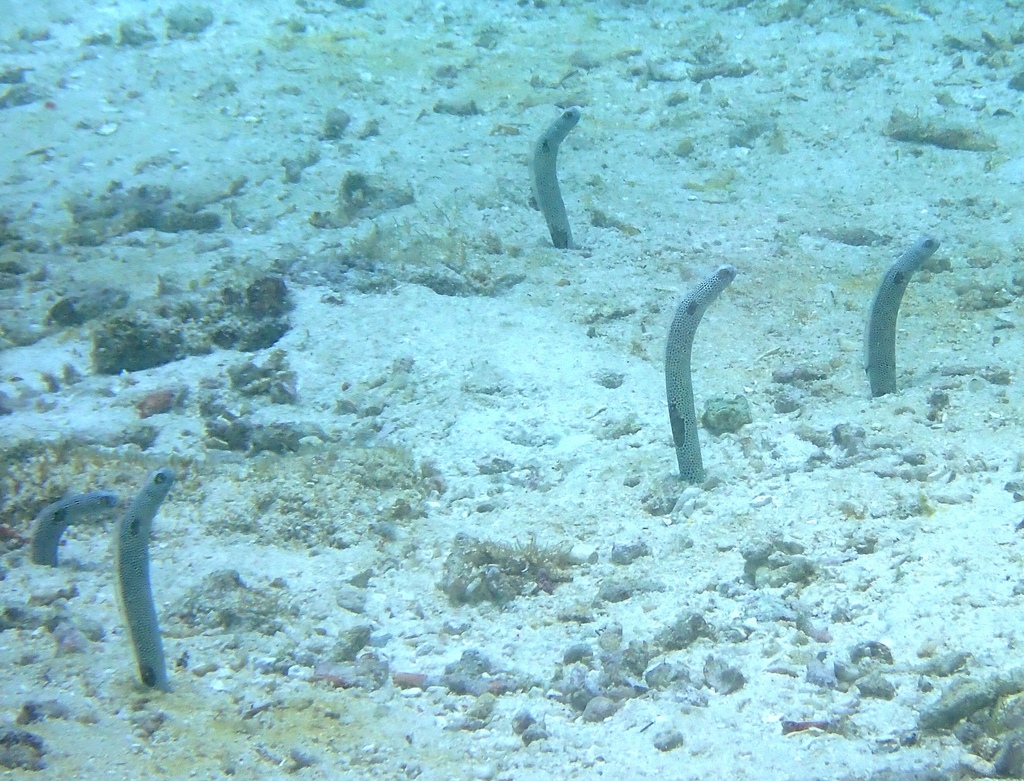
The spotted garden eel (Heteroconger hassi) spends its entire adult life half-buried in a sand burrow on the Indo-Pacific seafloor, extending its upper body into the current to catch plankton and retreating tail-first when threatened. It mates without ever leaving the burrow. Epic tier in the Kaught catalog.
From a distance, a garden eel colony looks like a field of grass swaying in the current. Hundreds of pale, spotted tubes rise from the sand, sway gently, then collapse flat the instant a diver gets within 3 or 4 metres. Get closer still and there is nothing: just bare sand and a quiet reef. The eels are still there, buried, watching.
The spotted garden eel is one of the strangest fish on the reef, not for what it does, but for what it has entirely stopped doing.
What a spotted garden eel looks like
The body is long, pencil-thin and pale grey to cream with three distinct black spots: one behind the gill opening, one in the middle of the body and one near the tail. The head is small with large, forward-facing eyes and a tiny upturned mouth. The dorsal and anal fins run the length of the body, merging at a pointed tail.
At rest in the burrow, only the front half to two-thirds of the body protrudes from the sand. The tail is permanently anchored inside the burrow, held in place by a sticky mucus that binds loose sand grains to create a firm tube lining.
The burrow: a home that is also a trap
A garden eel digs its burrow by pushing its tail into the sand and secreting mucus to stabilise the walls, a process that takes several days for a new burrow and must be maintained continuously. Once established, the eel never voluntarily leaves it. The burrow is the eel's entire territory: its feeding station, sleeping place and mating site combined.
This sedentary existence is not laziness. The burrow solves several problems at once. It provides immediate cover from predators: at the first sign of a threat, the eel retracts into the burrow in under a second. It allows the eel to exploit a consistent, low-competition food source (zooplankton carried by the reef current) without expending energy on swimming or competing for a feeding spot. And it is irreplaceable: a garden eel evicted from its burrow is dangerously exposed until it can dig a new one.
Colony life on the sand flat
Garden eels are colonial. A single colony may span hundreds of square metres of sand flat and hold thousands of individuals, all spaced roughly one body-length apart. Each eel maintains its own burrow and treats the space around it as its immediate territory, but the colony as a whole provides collective vigilance: if eels on one side of the colony retreat, the wave of retreat spreads across the whole field in under two seconds.
The spacing is not random. Each eel needs to extend into the current without being blocked by a neighbour, so colonies orient perpendicular to the prevailing water flow, maximising the plankton available to the outer eels facing into the current.
How garden eels mate (without moving)
The logistics of reproduction for an animal that refuses to leave its burrow are extraordinary. Neighbouring pairs court by swaying toward each other, bodies entwined in the water column above their separate burrows, for days or weeks. When spawning occurs, the partners stretch to their maximum extent so their upper bodies meet above the sand and release eggs and sperm into open water. Each fish then slides back into its own burrow. Neither ever relocates.
The fertilised eggs drift in the plankton and larvae settle to the sand as juveniles, digging their first burrow within hours of landing. They spend the rest of their lives in a social field, surrounded by thousands of neighbours, in one of the most stationary existences of any vertebrate.
How rare is the spotted garden eel?
The spotted garden eel sits at the Epic tier in the Kaught catalog, three diamonds out of four. Garden eels live at diving depth on open sand flats, retreat when approached and are rarely held still long enough for a clear observation. Their distribution across the Indo-Pacific is widespread but the species is genuinely hard to observe in any detail.
For other extraordinary reef fish, see ribbon eel and dragon seamoth. For more on deep-sea and marine catalogue species, see vampire squid.
Spotted garden eel: frequently asked questions
What is a spotted garden eel?
A species of conger eel (Heteroconger hassi) from the Indo-Pacific that spends its entire adult life half-buried in a self-made sand burrow, extending its upper body into the current to catch zooplankton and retreating tail-first when threatened.
Where do spotted garden eels live?
On sandy seafloor in the Indo-Pacific, from the Red Sea and East Africa through to the Pacific Islands, at depths of 7 to 45 metres on open sand flats adjacent to coral reefs with gentle to moderate currents.
Why do garden eels never leave their burrows?
The burrow is both shelter and feeding station. Leaving entirely would expose the eel to predators with no quick escape route. Instead, the eel exploits a reliable current-borne food supply while maintaining instant access to cover.
How do garden eels mate without leaving their burrows?
Neighbouring pairs stretch toward each other until their upper bodies meet above the sand and release eggs and sperm into the water column between them. Each retreats back into its own burrow immediately. Neither fish relocates or abandons its burrow.
Are spotted garden eels rare?
They carry the Epic tier in the Kaught catalog, three diamonds out of four. Kaught's rarity reflects observation frequency, not abundance. Garden eels live at depth, retreat rapidly when approached and are rarely recorded clearly even by experienced divers.
The next thing you see could be
your first catch.
Kaught is live on the App Store and Google Play. Free to start, and your first catch is one photo away.
Free to start · Live on the App Store and Google Play
Species data, type, rarity tier and measurements, is drawn from the Kaught catalog, built on open biodiversity records from GBIF and iNaturalist. Rarity reflects how often a species is observed in the wild, not its conservation status.