
Legendary spotlight
The Tiger: the biggest wild cat on Earth and one of the hardest animals to actually see
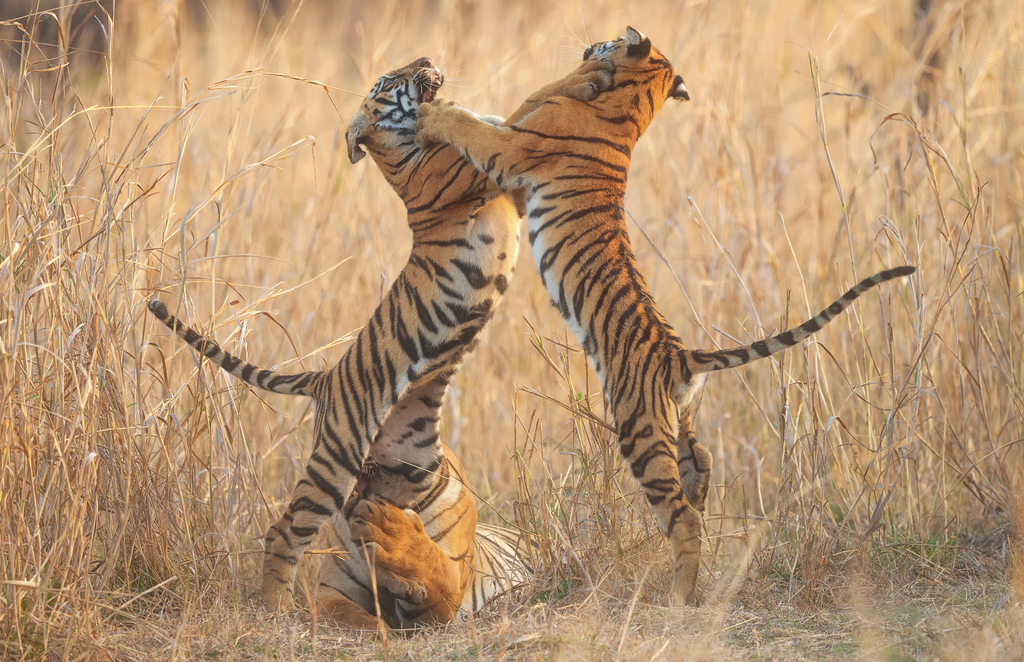
The tiger (Panthera tigris) is the largest living wild cat: up to 3.3 m long and 306 kg. It hunts by ambush in dense forest across Asia, is mostly active at night, and is so rarely observed in the wild that it sits at the Legendary tier in the Kaught catalog.
There are animals that almost everyone knows the shape of, and almost no one has ever actually seen. The tiger is the clearest example. Across most of its remaining range, a tiger will know you are there long before you know it is. You will read signs: a pug mark pressed into damp soil, a scrape against a tree trunk, the alarm calls of a distant deer. The animal itself may be ten metres away behind a screen of bamboo, watching you leave.
Six subspecies, one animal
All tigers belong to the species Panthera tigris, but six subspecies survive today, each shaped by a different corner of Asia.
- Bengal tiger (P. t. tigris): the most numerous, found across India, Bangladesh, Nepal and Bhutan. Males average 180 to 260 kg.
- Amur (Siberian) tiger (P. t. altaica): the largest subspecies. Lives in the temperate conifer forests of the Russian Far East. Paler coat, broader stripes, heavier build to conserve heat. Males have reached 306 kg and 3.3 m body length.
- Sumatran tiger (P. t. sumatrae): the smallest living subspecies, adapted to dense tropical forest on the island of Sumatra. Males average around 130 kg, with closer-spaced stripes.
- Malayan, Indochinese, and South China tigers: smaller populations in mainland Southeast Asia, each with distinct proportions and stripe density.
Three more subspecies (Bali, Javan, Caspian) are extinct, the last vanishing in the twentieth century.
How to identify a tiger
The basics are well known: orange coat, black stripes, white belly and white patches behind the ears. But a few details are worth knowing in the field:
- Stripe pattern: no two tigers share the same pattern. Each individual can be identified from photographs alone, which is how camera-trap surveys count populations without ever touching an animal. The stripes are also on the skin, not just the fur, so a shaved tiger retains its pattern.
- White ear spots: on the back of each rounded ear is a white patch edged in black. The leading hypothesis is that these "false eyes" make a resting tiger look alert from behind, deterring other animals from approaching.
- Size: head-and-body length of 1.5 to 2 m (females) or 1.8 to 2.8 m (males). Much larger than any other cat you are likely to encounter. A Bengal tiger male stands roughly 95 cm at the shoulder.
- Tracks: round pug marks, 8 to 16 cm wide. Four toes and a large three-lobed heel pad; claws usually retracted. Much rounder than a wolf or dog print.
Where tigers live
The tiger's original range stretched from eastern Turkey to Siberia and the Indonesian archipelago. Today it is fragmented into a series of protected areas and corridors across 13 countries, with the bulk of the remaining population in India.
Tigers are habitat generalists as large cats go. They occupy:
- Tropical rainforest (Sumatra, Malaysia)
- Mangrove swamps (the Sundarbans of India and Bangladesh, where tigers swim between islands and have learned to hunt in tidal channels)
- Dry deciduous and scrub forest (central India)
- Grassland and floodplain forest (the Terai of Nepal and Assam)
- Temperate conifer and birch forest (Amur region, Russia)
The common requirement across all of these is cover for stalking and a population of large prey, typically deer, wild boar or gaur in tropical habitats, and wapiti or roe deer in the Amur.
How the tiger hunts
The tiger is a pure ambush predator. It does not chase prey across open ground in the way a cheetah does. Instead, it uses cover methodically.
A hunt typically runs like this: the tiger detects prey by sight or sound, then freezes and begins a slow, low approach, pausing when the target looks up. It closes to within 10 to 20 m. Then it rushes, covering the final distance in two or three bounds at up to 60 km/h, and kills with a bite to the throat or nape, holding on until the prey stops moving.
A single tiger kills roughly one large prey animal per week. It will drag a carcass weighing twice its own body weight to a secluded spot, eat over two or three days, and cache the remains under vegetation.
Tigers are also strong swimmers and will cross wide rivers readily. In the Sundarbans they hunt in salt water.
Why tigers are so rarely observed
The Kaught catalog places the tiger at Legendary tier: four diamonds, the rarest category. That reflects how infrequently this animal is recorded in actual field observations, relative to the hundreds of thousands of other species in the catalog.
Three things drive that scarcity:
- Solitary and low-density: a tiger needs a large, exclusive territory (20 to 100 km²). At that space requirement, a national park of 1,000 km² might hold 20 resident adults. Compare that with the thousands of songbirds in the same area.
- Mostly nocturnal: tigers are active mainly between dusk and dawn. Diurnal visitors to tiger reserves share the forest with an animal that is largely invisible during opening hours.
- Expert use of cover: even where tigers are relatively habituated to safari vehicles, they spend most of their time in vegetation that makes photographing them difficult. A tiger in tall grass ten metres away is effectively invisible.
Getting a clear sighting in India's best parks typically requires multiple days, experienced naturalist guides who read the alarm calls of langurs and spotted deer, and some luck with thermals and morning light.
Three things that might surprise you
- A tiger can leap 10 m horizontally and clear a vertical drop of about 5 m. The rush phase of a hunt is over before a prey animal can react.
- Unlike domestic cats and many other felids, tigers actively enjoy water. They wade and swim to cool down in the heat of the day, and cubs play in water readily.
- The Amur tiger, living through Siberian winters at minus 40°C, grows a paler coat and has more closely spaced stripes than tropical subspecies, not because of genetic isolation alone, but because the colder climate supports different grass and snow patterns that the stripe arrangement matches.
Tiger: frequently asked questions
Where do tigers live?
Tigers live in South and Southeast Asia and the Russian Far East. Habitats range from tropical rainforest in Indonesia and India to mangrove swamps in the Sundarbans and cold Siberian taiga. Each adult holds a territory of 20 to 100 km² depending on prey density.
How big is a tiger?
The Amur (Siberian) tiger is the largest: males can reach 3.3 m body length and 306 kg. Bengal tiger males average 180 to 260 kg. Females are consistently smaller at roughly 65 to 70 percent of male weight.
How does a tiger hunt?
Tigers are ambush predators. They stalk prey slowly through cover, close to within 10 to 20 m, then rush and kill with a bite to the throat or nape. A tiger can carry prey weighing twice its own body weight to a secluded spot before feeding.
Why is the tiger Legendary in Kaught?
Kaught's Legendary tier reflects how rarely a species is actually recorded in wild observations. Tigers are solitary, hold vast territories in remote forest, and move mostly at night. Even in known tiger habitat, a clear sighting requires days of effort with experienced guides.
What makes a tiger's stripes unique?
Each tiger's stripe pattern is as distinct as a human fingerprint. Researchers use this to identify individuals from camera-trap photos without handling the animals. The stripes are also present on the skin, so a shaved tiger still shows the pattern.
Are all tigers the same species?
All living tigers belong to the species Panthera tigris. Six subspecies survive: Bengal, Amur (Siberian), Sumatran, Malayan, Indochinese, and South China. Each evolved in a different climate, resulting in differences in body size, coat colour, and stripe density.
How far can a tiger jump?
A tiger can leap up to 10 m horizontally in a single bound and clear a vertical obstacle of around 5 m. This reach covers the final ground in a stalk faster than prey can react.
The next thing you see could be
your first catch.
Kaught is live on the App Store and Google Play. Free to start, and your first catch is one photo away.
Free to start · Live on the App Store and Google Play
Species data, type, rarity tier and measurements, is drawn from the Kaught catalog, built on open biodiversity records from GBIF and iNaturalist. Rarity reflects how often a species is observed in the wild, not its conservation status.