
Adaptation explainer
Leafy Seadragon: how a fish evolved to look exactly like floating seaweed
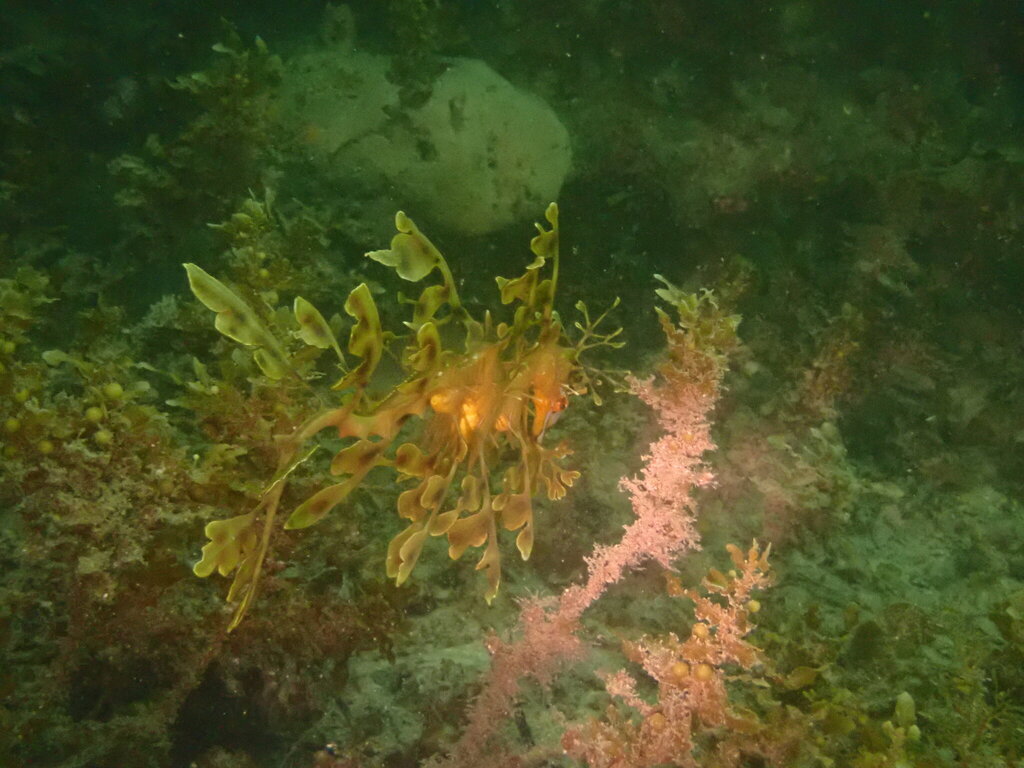
The Leafy Seadragon (Phycodurus eques) is an Australian fish related to seahorses, with elaborate leaf-like appendages covering its body. These appendages play no role in swimming: they exist purely as camouflage, making the fish functionally indistinguishable from drifting kelp. Propulsion comes from a single tiny transparent dorsal fin.
There is a fish in the kelp beds off South Australia that looks nothing like a fish. It looks like a piece of seaweed: yellow-green, lobed, drifting. If you were not told to look for it, you would float directly over it and see weed. Even knowing it is there, finding it takes patience.
The Leafy Seadragon is one of the most extreme examples of body-shape camouflage in any vertebrate on Earth. Understanding why it evolved this way requires a look at where it lives, what it eats, and what it is running from.
The appendages: decorative only
The elaborate lobed projections covering the Leafy Seadragon's body are called leaf-like papillae, or simply appendages. They grow from the skin surface along the head, neck, back, belly and tail, in shapes that mirror the fronds of the Ecklonia and Macrocystis kelp species that dominate its habitat.
Here is the key biological fact: these appendages contain no fin rays, no muscles, no propulsive structure of any kind. They cannot move independently. The fish drifts with gentle ocean surge and its own slow swimming, and the appendages move passively with the current, just as a kelp frond would. They are, in engineering terms, purely cosmetic structures on a fish that has paid a significant metabolic and hydrodynamic cost to grow them.
The cost is worth it. The Leafy Seadragon has no scales (the body is covered in bony rings, like a seahorse), no spine, no venom, no speed. Its entire defence is looking like something a predator would not bother eating.
How it actually moves
Propulsion comes from two small transparent fins: a dorsal fin on the back and paired pectoral fins near the head. The dorsal fin beats at approximately 70 times per second, nearly invisible to the naked eye, creating gentle forward movement. The pectoral fins steer. The tail, which is prehensile and can grip substrate (though the Leafy Seadragon rarely holds on the way seahorses do), provides minimal propulsion.
The result is an animal that moves as slowly as a drifting piece of weed, swaying slightly with the current. This speed is not a limitation: it is the camouflage completing itself. A piece of kelp that moved at fish speed would look like a fish. A fish that moves at kelp speed looks like kelp.
The seahorse connection
The Leafy Seadragon belongs to the family Syngnathidae, the same family as seahorses and pipefish. The family shares several unusual traits that the seadragon inherits: no functional stomach (food passes from oesophagus to intestine within seconds, forcing near-continuous feeding), male pregnancy, and a tubular snout that works as a vacuum to suck up tiny crustaceans.
The Leafy Seadragon is the only species in its genus, Phycodurus. Its closest visible relative is the Weedy Seadragon (Phyllopteryx taeniolatus), which shares some appendages but is less elaborately decorated. The Giant Seahorse, the largest seahorse in the Pacific, shares the family but lives on a completely different coastline. For more on that group, see our Giant Seahorse article.
Male pregnancy
Like all syngnathids, the female Leafy Seadragon deposits eggs onto a specialised brood patch under the male's tail. The male carries up to 250 eggs through the incubation period of roughly eight weeks, providing oxygen to developing embryos through a network of blood vessels in the patch. Hatchlings emerge as fully formed miniature seadragons, independent from the first moment.
The evolutionary logic of male pregnancy is not fully settled, but one strong hypothesis is that it frees the female to begin producing the next clutch of eggs immediately after depositing one, rather than waiting for the eggs to hatch while carrying them. The male does the incubation work while the female maximises reproductive output.
Where to find one
The Leafy Seadragon is endemic to Australia: it exists nowhere else on Earth. Its range runs along the southern and south-western coastline, from Port Stephens in New South Wales clockwise around the south coast to Geraldton in Western Australia. The highest density of sightings comes from the kelp reefs of South Australia's Yorke Peninsula and Fleurieu Peninsula.
Finding one requires calm water, good visibility, and patience. They are most reliably found by snorkellers and divers in rocky reef areas with dense kelp canopy between 3 and 20 m depth. The Rare tier in the Kaught catalog reflects exactly this: observable, but only with location knowledge and effort. Endemic to one country's coastline, cryptically coloured, slow-moving in dense weed: a Rare find in practice.
Australian law fully protects the Leafy Seadragon from collection. It cannot be taken from the wild, and a separate permit system governs its use in aquaria.
For other ocean camouflage specialists, see our guide to the Dragon Seamoth. For the deepest and strangest fish from Australian and Indo-Pacific waters, see our guide to the Spotted Garden Eel.
Leafy Seadragon: frequently asked questions
What is the Leafy Seadragon?
A fish endemic to southern Australian coastal waters, closely related to seahorses. Its elaborate leaf-like appendages make it look exactly like floating kelp. The appendages play no role in swimming: propulsion comes from a tiny transparent dorsal fin beating 70 times per second.
How does the Leafy Seadragon camouflage itself?
Its body is covered in lobed appendages that match the shape and colour of local kelp species. The fish drifts slowly through kelp beds with gentle swaying movements identical to floating weed. It cannot rapidly change colour like an octopus, but its static pattern, combined with slow movement, makes it functionally invisible in its habitat.
Is the Leafy Seadragon a type of seahorse?
It is closely related: both belong to the family Syngnathidae. But it is the sole species in its own genus (Phycodurus). It shares seahorse traits including no stomach, male pregnancy, and a tubular snout for vacuuming up tiny crustaceans. The leaf appendages are unique to this genus.
Do male Leafy Seadragons carry the eggs?
Yes. The female deposits eggs onto a brood patch under the male's tail, where he carries them for eight weeks. Up to 250 eggs per clutch. Hatchlings emerge as fully formed miniature seadragons, independent from birth.
Where does the Leafy Seadragon live?
Rocky reef, seagrass and kelp beds off southern and western Australia only, from New South Wales south and west to Western Australia. It is found nowhere else on Earth. The highest densities are in South Australia's kelp reefs between 3 and 20 m depth.
How is the Leafy Seadragon rated in Kaught?
Rare tier, two diamonds. Endemic to a specific Australian coastline, cryptically camouflaged in kelp, and requiring local knowledge to find. Observable with effort, but not a species most people encounter by chance.
The next thing you see could be
your first catch.
Kaught is live on the App Store and Google Play. Free to start, and your first catch is one photo away.
Free to start · Live on the App Store and Google Play
Species data, type, rarity tier and measurements, is drawn from the Kaught catalog, built on open biodiversity records from GBIF and iNaturalist. Rarity reflects how often a species is observed in the wild, not its conservation status.