
Evolution story
Greater Siren: the salamander that never finished growing up
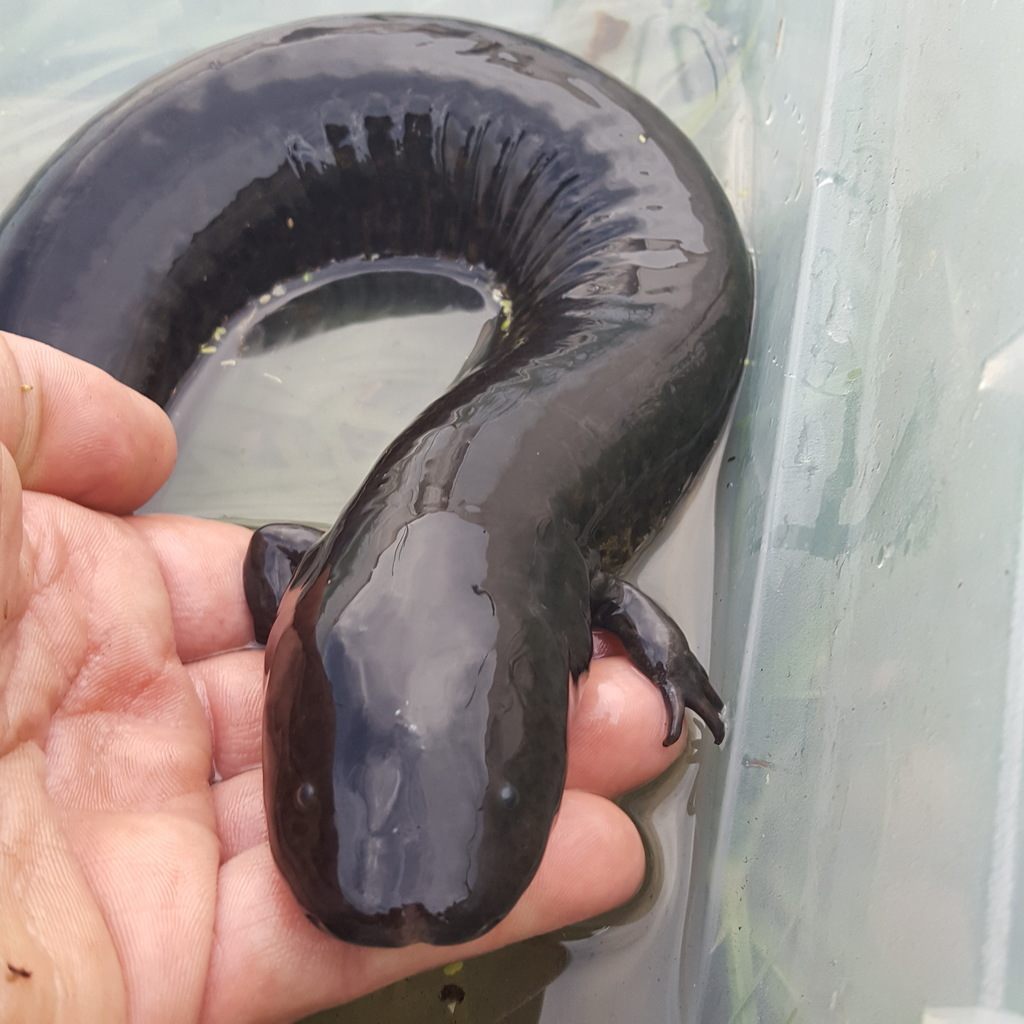
The greater siren (Siren lacertina) is a giant, eel-shaped salamander from the southeastern United States that keeps its feathery external gills for its entire life and never grows hind legs. If its swamp dries up, it seals itself in a mucus cocoon underground and waits, sometimes for up to two years, for rain.
Most salamanders live a double life: gilled and aquatic as larvae, then lungs take over and legs carry them onto land as adults. The greater siren skipped that second half entirely. It spent its whole evolutionary history staying exactly as it started, gilled, limbless at the back end, and welded to the water, and in doing so became one of the strangest amphibians in North America.
What exactly is a greater siren?
The greater siren is a thick, eel-bodied salamander of the swamps, marshes and drainage ditches along the Atlantic and Gulf coastal plain, from Virginia down through Florida and west into southern Alabama, with a separate population reported in the Rio Grande valley of Texas and Mexico. It is one of the largest amphibians in North America, reaching up to 97 cm (38 in) in exceptional individuals, though most adults run closer to 60–77 cm.
Three feathery gill tufts sit just behind its head. Just past them, two small front legs poke out, each with four tiny toes, often tucked half-hidden in the gill folds. That's it. There are no hind legs, no hind feet, and no pelvis to attach them to even if it had grown any. The body simply tapers to a flattened, finned tail built for swimming, not walking.
Why does it still have gills as an adult?
In most amphibians, metamorphosis is the whole point: a gilled, swimming larva rebuilds itself into an air-breathing, leggier adult. The greater siren's lineage never completes that second step. It keeps larval features, external gills chief among them, for its entire adult life and breeding career, a condition biologists call paedomorphosis.
It isn't an accident or a deformity. It's the ancestral plan for the whole family Sirenidae, carried forward rather than lost. The siren does grow functional lungs alongside its gills, and it does breathe air at the surface, especially in warm, oxygen-poor water, but it never swaps the aquatic body plan for a terrestrial one. Why commit to legs and dry skin when the swamp has never stopped working?
Is the greater siren related to an eel?
Not even distantly. An eel is a bony fish; the greater siren is an amphibian, closer on the tree of life to a frog than to anything with fins and scales. The resemblance, a long, limbless, water-smoothed body built for eel-like swimming, is convergent evolution: two completely unrelated lineages arriving at the same shape because it solves the same problem, moving fast through dense, weedy water, without legs to catch on obstructions.
The siren's own family tree is unusually deep to begin with. Some genetic studies place Sirenidae as the single oldest branch of the entire salamander order, splitting off before every other living salamander family diverged from one another, though other analyses point instead to the giant-salamander group as the most ancient line. Either way, the siren sits near the root, not the tip, of the salamander family tree.
How does it survive when its pond disappears?
Coastal-plain wetlands dry out most summers, and a siren without legs can't walk to find a new one. Instead it burrows straight down into the mud and seals its body inside a cocoon of shed skin and mucus, leaving only its mouth exposed to the air. Inside that seal, its metabolism drops by as much as 70%, and it can wait like this, essentially suspended, for up to two years until rain refills the swamp above it.
The greater siren also does something almost no other salamander bothers with: it makes noise on purpose. Disturbed, it lets out sharp yelping clicks, oddly close to the call of a green tree frog. The genus name Siren is a direct nod to the vocal sirens of Greek myth, earned because early naturalists kept hearing a sound they couldn't quite place coming from the reeds.
Is the greater siren dangerous?
No. It carries no venom and has no interest in confrontation, spending its nights hunting snails, mussels, crayfish, aquatic insects and the occasional small fish along the bottom. Its jaws have no true teeth, only a horn-covered beak with small tooth patches tucked on the roof of the mouth, so a siren picked up and mishandled can deliver a surprisingly firm pinch. Left alone in the water, it simply disappears back into the weed.
How rare is the greater siren in Kaught?
In the Kaught catalog the greater siren sits at the Rare tier, two diamonds out of four. That reflects how often the species is actually confirmed in the field, not how unusual its biology is: a siren spends almost all of its life buried in mud or screened by submerged vegetation, so even in swamps where it's genuinely common, a clear sighting is far harder to come by than a basking turtle or a calling frog.
Permanent gills and a size of over half a metre still aren't the strangest trick in the amphibian world. Another Kaught catalog species, the hellbender, breathes mostly through folds of skin instead of lungs, while the marbled newt can regrow an entire lost limb on demand, a trick the siren's lineage gave up on hind limbs entirely rather than master. For more of the real evolutionary stories behind Kaught's catalog, see why the echidna is one of only five mammals left that still lay eggs, and why the ribbon eel, a true fish this time, is born male and becomes female.
Greater siren: frequently asked questions
Why does the greater siren have no hind legs?
Its lineage, the Sirenidae, branched off early in salamander history and never evolved to finish the move onto land. A greater siren keeps only two tiny clawless front legs, useless for walking, and has no hind limbs or pelvis at all.
Does the greater siren ever turn into a land-living adult?
No. Most salamanders lose their gills and lungs take over at metamorphosis. The greater siren never does this: it keeps its external gills and stays fully aquatic for its entire life, a condition called paedomorphosis.
How does the greater siren survive when its pond dries up?
It burrows into the mud and seals its body in a cocoon of shed skin and mucus, leaving only its mouth exposed. Its metabolism slows by up to 70%, letting it survive encased like this for as long as two years until rain returns.
Is the greater siren a type of eel?
No. An eel is a bony fish; the greater siren is an amphibian. Their similar long, limbless, swimming bodies are convergent evolution, two unrelated lineages arriving at the same shape for the same aquatic lifestyle.
Is the greater siren dangerous or venomous?
No. It has no venom and no interest in people. Handled roughly, it can deliver a pinching bite with its horny jaw plates, but it poses no real danger and will always retreat into cover given the chance.
Why is the greater siren "Rare" in Kaught?
Kaught's rarity tracks how often a species is actually recorded, not its biology. The greater siren spends almost its whole life hidden in mud and weed at the bottom of swamps, so confirmed sightings stay well below those of a basking turtle or pond frog.
The next thing you see could be
your first catch.
Kaught is live on the App Store and Google Play. Free to start, and your first catch is one photo away.
Free to start · Live on the App Store and Google Play
Species data, type, rarity tier and measurements, is drawn from the Kaught catalog, built on open biodiversity records from GBIF and iNaturalist. Rarity reflects how often a species is observed in the wild, not its conservation status.