
Adaptation explainer
Box Crab: the reef crab with a built-in can-opener for a claw
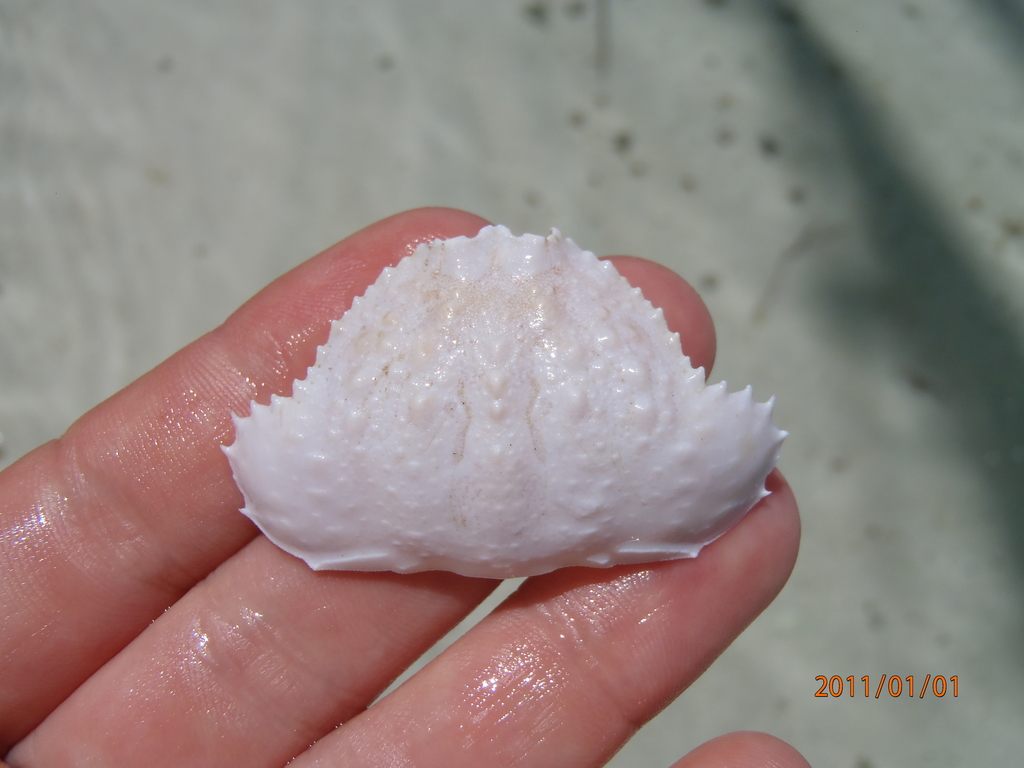
The box crab (Calappa hepatica) cracks open snail and clam shells with a hooked tooth on its right claw that works opposite a flat plate, exactly like a can-opener. It buries in sand by day, hunts at night, and is completely harmless to people.
Most crabs crush their way into a meal. The box crab does something closer to surgery. Reach into the right patch of sand on an Indo-Pacific reef flat and you might find one holding a snail shell in its claws, patiently peeling it open turn by turn like the lid of a tin. Here is how that claw actually works, how to recognise the crab that owns it, and where you would need to look.
How to identify a box crab
The name gives away the shape before you even see the animal:
- Carapace: broad, rounded and domed, about 4 cm across, mottled grey-brown with small raised bumps that break up its outline against sand.
- The claws: flat, shield-shaped and oversized, folding up in front of the body to cover the legs and mouthparts almost completely, the single field mark that separates a box crab from every other crab on the reef.
- Asymmetry: look closely and the two claws don't match. The right is thick and heavy-toothed for crushing, the left is slimmer and more pointed.
- Eyes: small and set high, often the only part visible when the crab is buried.
That folded-claw posture is not incidental. It is a defensive shape the crab can snap into on demand, and it is also the origin of its other common name, more on that below.
How does a box crab open a snail shell?
This is the adaptation that sets the box crab apart from almost every other crab on the reef. Its right claw carries a specialised tooth at the base of the hinged pincer, sitting directly opposite a flat plate on the fixed part of the claw. Closed together, the two work like a vice fitted with a can-opener: the crab hooks the tooth under the lip of a snail's shell and cranks it back, chipping and peeling the spiral away turn by turn rather than simply crushing it flat.
Once the shell is breached, the crab switches tools. The left claw is longer, slimmer and more pointed, built for precision rather than force, and it does the delicate work of drawing the soft body out once the right claw has done the breaking. Few crabs carry two claws built for two completely different jobs; the box crab's pair is a matched set of can-opener and forceps.
Where do box crabs live?
Calappa hepatica is common across the tropical and subtropical Indo-Pacific and the Red Sea, with a range that stretches from the Red Sea itself to Hawaii, French Polynesia, Cocos Island and northern Australia. It favours sandy or shelly bottoms on coral reef flats and seagrass meadows, from shallow water down to around 150 metres.
Wherever it turns up, the habitat has to offer two things: loose enough sediment to bury into, and enough snails and clams nearby to make the digging worthwhile.
What does a box crab eat, and how does it hunt?
By day, a box crab lies buried in sand with only the area around its eyes exposed, effectively invisible to anything passing overhead. It emerges after dark to forage, using that specialised claw pair to work through bivalve and gastropod molluscs, and it will take an unlucky hermit crab too if the opportunity comes up. If something disturbs it mid-hunt, the same claws that crack shells double as digging tools: pressed hard against the seabed, they drive the carapace down and backward into the sediment, and the crab can vanish from sight in seconds.
Is a box crab dangerous to humans?
Not in any meaningful way. It carries no venom and no interest in confrontation, its entire strategy is built around staying hidden rather than fighting. The one real risk is the obvious one: that heavy, shell-cracking right claw can deliver a genuine pinch if the crab is handled carelessly, so admire it without picking it up.
Why is it called a "box crab" or "shame-faced crab"?
Both nicknames describe the same posture. "Box crab" refers to the bulky, shield-like shape the animal makes when its flat claws fold up over the front of the body, turning a soft-bodied crustacean into something closer to a sealed container. Its genus, Calappa, carries the second nickname, "shame-faced crabs," because that same folded pose looks uncannily like a pair of hands raised to cover a face.
How rare is the box crab in Kaught?
In the Kaught catalog the box crab sits at the Epic tier, three diamonds out of four. That is a measure of how often the species is actually logged in the wild, not a statement about its future. A box crab spends daylight hours completely buried, exposes only its eyes even when active, and does its hunting after dark, which keeps a confirmed daytime sighting genuinely uncommon.
Three things you didn't know about the box crab
- The genus name Calappa comes from "kelapa," the Malay word for coconut, a nod to the crab's rounded, husk-like carapace.
- Its right and left claws are so different in shape and job that researchers describe the pair as functionally specialised, one for breaking, one for extracting, rather than a matched set doing the same work twice.
- The same claw-driven burying motion that hides it from predators also lets it vanish from view in a matter of seconds, fast enough that a diver watching one forage can lose it mid-glance.
A claw built like a tool is a rare thing in the animal kingdom, and the box crab shares that trick with only a handful of other reef specialists worth meeting. The mantis shrimp carries an entirely different kind of weaponised limb, a punch fast enough to boil water around it, while the Sally Lightfoot crab and coconut crab show just how differently a crustacean claw can be built depending on the job it needs to do. For more animals that solve ordinary problems in extraordinary ways, see the weirdest animals in the world.
Box crab: frequently asked questions
What does a box crab look like?
A rounded, domed crab about 4 cm across the carapace, mottled grey-brown and covered in small raised bumps for camouflage. Its two front claws are flat and shield-shaped, folding up to cover the front of the body almost like a closing lid.
Where do box crabs live?
Sandy and shelly seabeds on coral reef flats and seagrass meadows across the tropical Indo-Pacific and the Red Sea, from Hawaii and French Polynesia to northern Australia, in water from the shallows down to roughly 150 metres.
How does a box crab open a snail shell?
Its right claw carries a hooked tooth at the base that sits opposite a flat plate, working together like a can-opener. The crab clamps the shell's lip between the two and peels the spiral open turn by turn to reach the animal inside.
What does a box crab eat?
Mostly snails and clams, along with the occasional hermit crab. The heavy right claw does the shell-breaking, while the slimmer, more pointed left claw picks the soft tissue out once the shell is open.
Is a box crab dangerous to humans?
No. It has no venom and no interest in people, and it spends daylight hours buried in sand rather than out in the open. Handled carelessly it can deliver a pinch with its crushing claw, but that is the extent of the risk.
Why is it called a box crab or shame-faced crab?
Box crab refers to the bulky, shield-like shape it makes when its flat claws fold up in front. Its genus, Calappa, is also nicknamed the shame-faced crabs, since the folded claws look like hands drawn up to cover a face.
Why is the box crab "Epic" in Kaught?
Kaught's rarity tier reflects how often a species is actually recorded in the wild, not its status. Box crabs spend daylight buried in sand with only their eyes showing and hunt only after dark, so a confirmed sighting is genuinely uncommon: Epic, three diamonds out of four.
The next thing you see could be
your first catch.
Kaught is live on the App Store and Google Play. Free to start, and your first catch is one photo away.
Free to start · Live on the App Store and Google Play
Species data, type, rarity tier and measurements, is drawn from the Kaught catalog, built on open biodiversity records from GBIF and iNaturalist. Rarity reflects how often a species is observed in the wild, not its conservation status.