
Adaptation explainer
Hellbender: the giant salamander that breathes entirely through its skin
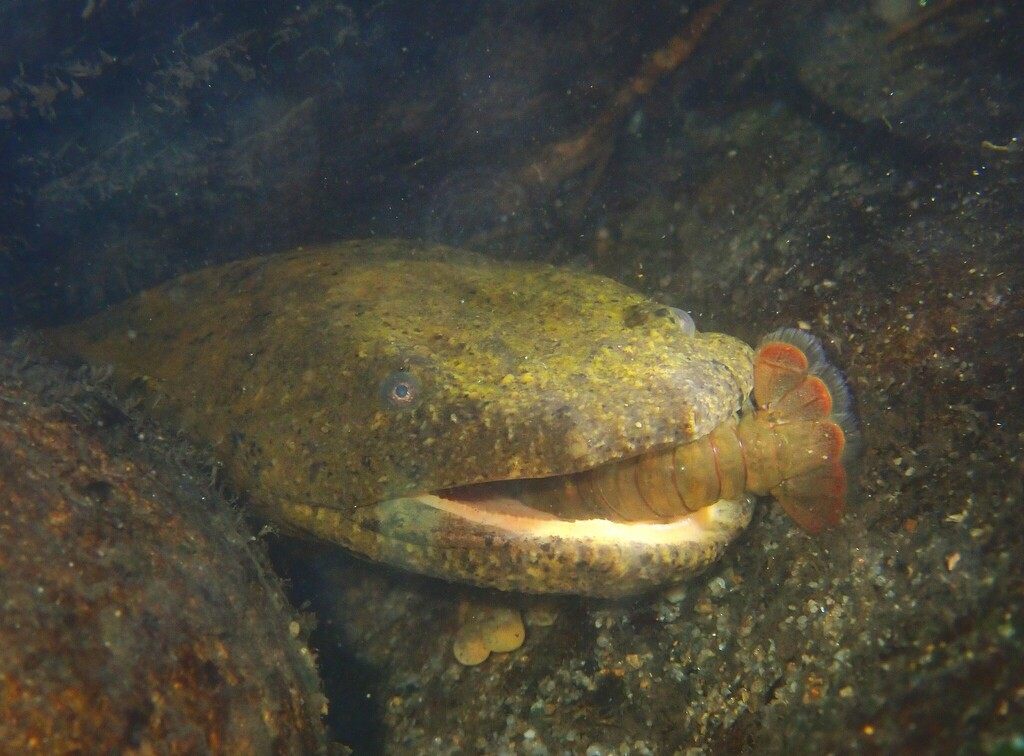
The hellbender (Cryptobranchus alleganiensis) is North America's largest salamander, up to 74 cm long, and it breathes almost entirely through its wrinkled, folded skin rather than its lungs. Fully aquatic and nocturnal, it needs cold, fast, oxygen-rich streams to survive, and it is completely harmless to people.
Turn over the right flat rock in the right Appalachian stream and something the length of your forearm might slide out from underneath it: a flattened, wrinkled, faintly prehistoric-looking salamander that has been doing exactly this since long before the mountains around it took their current shape. It has almost no use for its lungs. Instead, its entire skin works as a gill. Here's how that actually functions, how to identify one, and where you would need to look.
How to identify a hellbender
Nothing else in North American fresh water looks quite like it:
- Size: up to 74 cm nose to tail, making it the largest salamander in North America by a wide margin.
- Skin: loose, deeply wrinkled and folded along each flank, brown to grey-brown with darker mottling, slick with protective mucus.
- Head and eyes: broad and flattened, with tiny, almost lidless eyes set well forward, built for squeezing under rocks rather than for sharp vision.
- Build: four short, sturdy legs and a thick, laterally flattened tail used to scull through current.
The wrinkled skin folds are the field mark that matters most, they are the entire point of the animal, and the next section explains why.
How does a hellbender breathe through its skin?
A hellbender has lungs, but it barely uses them to breathe. They are simple, poorly vascularised sacs that mostly help the animal control its buoyancy in current, not exchange gas. Almost all of its oxygen comes in through the skin instead, a process called cutaneous respiration.
That only works because of the folds. Flat skin does not have enough surface area to keep a two-kilogram animal supplied with oxygen, so the hellbender's skin is thrown into loose, wrinkled folds along each side of the body, dense with capillaries sitting close to the surface. More folds mean more surface area pressed against oxygen-rich water, and a hellbender will rock and sway its body in the current to keep fresh, oxygenated water moving across that surface, the amphibian equivalent of a fish working its gills. A male guarding a nest uses that exact same rocking motion to fan oxygenated water over his eggs.
The trade-off is that this only works in cold, fast, highly oxygenated water. Warm, slow or oxygen-poor streams simply cannot supply enough oxygen through skin alone, which is precisely why a hellbender's fortunes are tied so tightly to clean, cold, well-aerated rivers.
Where do hellbenders live?
Two subspecies split a patchy range across the eastern and central United States. The eastern hellbender runs through Appalachian streams from southern New York down to northern Georgia and Alabama. The Ozark hellbender is restricted to a handful of rivers in the White River system of Missouri and Arkansas. Missouri is the only place both subspecies occur, though never side by side in the same stretch of water.
Wherever it lives, a hellbender needs the same thing: clear, cold, fast-flowing water tumbling over a rocky bed, with large flat rocks to shelter beneath. Each adult holds a personal rock as a territory, defended against other hellbenders and rarely abandoned unless the shelter itself is disturbed.
What does a hellbender eat?
Crayfish make up roughly 90% of the diet, supplemented with small fish, worms and aquatic insects. Its eyesight is poor, so it hunts almost entirely by touch and vibration, a lateral-line system running along its flanks detects the faint water disturbance of a moving crayfish in total darkness. Once prey is close enough, the hellbender opens its mouth in a sudden, explosive gape, creating enough suction to pull the animal straight in.
Is a hellbender dangerous to humans?
Not in any real sense. A hellbender has no venom, no interest in biting people, and nothing to gain from a confrontation, it will try to wedge itself back under a rock long before it tries to fight. Handled roughly, it may deliver a harmless defensive nip, but the greater danger runs the other way: hellbenders are sensitive to stress and to warming or drying out of their skin, so the right way to appreciate one is to look without lifting it clear of the water.
Hellbender or mudpuppy? The one field mark that settles it
Anglers and waders regularly confuse the hellbender with the smaller, superficially similar common mudpuppy. The fix is simple: a mudpuppy keeps a set of bushy, red external gills behind its head for its entire life, while an adult hellbender has none, it loses its larval gills at metamorphosis and switched over to skin breathing instead. Size settles any remaining doubt: a mudpuppy tops out around 20 to 33 cm, while a hellbender can reach more than twice that.
How rare is the hellbender in Kaught?
In the Kaught catalog the hellbender sits at the Rare tier, two diamonds out of four. That reflects how often the species is actually logged in the wild, not any judgement about its future. It is fully aquatic, active only at night, and spends daylight wedged invisibly under a single rock in streams most people never wade into, which is exactly the combination that keeps confirmed sightings scarce.
Three things you didn't know about the hellbender
- It has been wearing this exact body plan for roughly 65 million years, one of the oldest living amphibian lineages still doing business much as it always has.
- Regional nicknames include snot otter, lasagna lizard, mud-devil and Allegheny alligator, and in 2019 the public vote to name Pennsylvania's official state amphibian was won decisively by "snot otter."
- Its family, Cryptobranchidae, also includes the Chinese and Japanese giant salamanders, the two largest living amphibians on Earth, both built on the same skin-breathing, gill-losing plan.
A body that breathes like a gill and a rock it never leaves make the hellbender one of the stranger success stories in the weirdest corners of the animal kingdom. It is far from the only amphibian with an unusual trick for staying alive: the marbled newt solves the problem of a lost limb by simply regrowing it, the fire salamander relies on toxic skin instead of thick mucus, and the giant African bullfrog survives drought by digging in and waiting it out. The hellbender's answer was to turn its entire skin into a gill and never come up for air.
Hellbender: frequently asked questions
What does a hellbender look like?
A large, flat-headed salamander up to 74 cm long, with loose, deeply wrinkled brown-to-grey skin, tiny eyes, four short stubby legs and a paddle-like tail. The folds of skin running down each side are the giveaway field mark.
Where do hellbenders live?
Clean, cold, fast-flowing, rocky rivers and streams across the Appalachian region and the Ozarks of the eastern and central United States. They spend the day wedged under a single large flat rock, a personal territory they defend and rarely leave.
How does a hellbender breathe?
Almost entirely through its skin. Capillaries running through its wrinkled lateral skin folds absorb oxygen directly from the water, a process called cutaneous respiration. Its lungs are simple and barely vascularised, used mainly to control buoyancy rather than for gas exchange.
What do hellbenders eat?
Mostly crayfish, which make up around 90% of the diet, plus small fish, worms and aquatic insects. With poor eyesight, a hellbender ambushes prey it detects through water vibrations, then engulfs it with a sudden wide-mouthed suction gape.
Is a hellbender dangerous to humans?
No. Hellbenders have no venom and no interest in people; they will only give a harmless defensive nip if picked up. The real risk runs the other way, they are easily stressed by handling, so look without lifting them out of the water.
How is a hellbender different from a mudpuppy?
A mudpuppy keeps a set of bushy red external gills for its entire life and stays smaller. An adult hellbender loses its external gills after metamorphosis and relies on skin folds instead, growing far larger, up to 74 cm versus a mudpuppy's usual 20 to 33 cm.
Why is the hellbender "Rare" in Kaught?
Kaught's rarity tier reflects how often a species is actually recorded in the wild, not its status. Hellbenders are fully aquatic, nocturnal and hidden under a single rock by day, which makes a confirmed sighting genuinely uncommon: Rare, two diamonds out of four.
The next thing you see could be
your first catch.
Kaught is live on the App Store and Google Play. Free to start, and your first catch is one photo away.
Free to start · Live on the App Store and Google Play
Species data, type, rarity tier and measurements, is drawn from the Kaught catalog, built on open biodiversity records from GBIF and iNaturalist. Rarity reflects how often a species is observed in the wild, not its conservation status.