
Exotic spotlight
Bush Stone-curlew: the Ground Bird Whose Scream Sounds Human
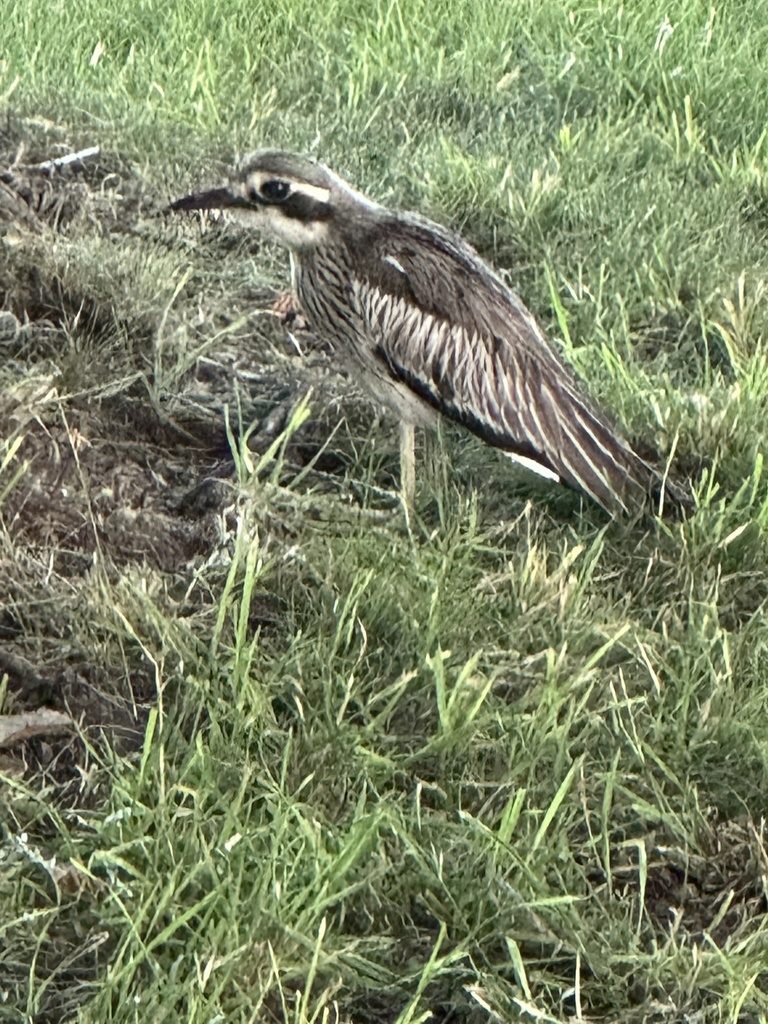
The bush stone-curlew (Burhinus grallarius) is a large, ground-dwelling Australian bird whose wailing night call is so close to a human scream it has fooled people into calling for help. It stands frozen and camouflaged by day, forages alone after dark, and freezes flat against the ground rather than flying when something gets too close.
Somewhere in an Australian park after dark, a rising, wavering scream cuts across the lawns. Newcomers reach for their phones, convinced someone nearby is in trouble. Locals barely look up. It's almost certainly a bush stone-curlew, a bird that spends its days standing so still it looks like a garden ornament and its nights sounding like the opening scene of a horror film.
How to identify a bush stone-curlew
A bush stone-curlew is hard to miss once you know what you're looking at, and easy to walk straight past if you don't:
- Size: a large ground bird, 50 to 59 cm tall, standing upright on unusually long, pale legs.
- Plumage: streaky grey-brown above and paler below, a pattern built to disappear into dry grass and leaf litter, not to stand out.
- The eye: a huge, lemon-yellow eye, oversized even for the head, the clearest sign this is a nocturnal hunter.
- Posture: by day it typically stands bolt upright and motionless in the shade of a tree or shrub, often on one leg, rather than moving around in the open.
It belongs to the wader order, Charadriiformes, yet you'll rarely find one near water. Most of its relatives in the thick-knee family wade estuary mudflats; the bush stone-curlew traded the coast for dry woodland and grassland instead.
The scream that sounds human
The signature sound is a rising, wailing "wee-loo", often called back and forth between a pair after dark and picked up by neighbouring pairs until it rolls across an entire suburb or paddock. It carries hundreds of metres over open ground, and to an ear that has never heard it before, it sounds uncannily like a person screaming or sobbing in the dark. The resemblance is close enough that in towns where the birds have moved into parks and golf courses, newcomers have called emergency services convinced someone was hurt, only to be told it was a curlew.
There is no danger behind the sound. It is a contact and territorial call, nothing more, but the eeriness has earned the bird a place in Australian bush folklore for well over a century, long before anyone strapped a microphone to a tree to check.
Freeze first, fly last
Most birds respond to a threat by taking off. A bush stone-curlew's first instinct is the opposite: it drops low, stretches its neck flat along the ground, narrows its eyes to slits, and goes completely still. Against leaf litter and dry grass, that streaky brown plumage does the rest, and a bird standing a few metres away can become almost impossible to see. Chicks copy the same freeze response within days of hatching, flattening themselves in the open the moment a parent gives the alarm. Only when a predator gets genuinely close does a curlew break and run or fly, and adults will also feign a broken wing to drag a predator away from a nest or chick, a classic ground-nester's trick.
Where it lives, and why it's moved into town
The bush stone-curlew is found across mainland Australia, in open eucalypt woodland, grassy plains and farmland from the tropical north down through the eastern states. It has become genuinely used to people in parts of Queensland and the Northern Territory, where pairs now nest on school ovals, golf courses and quiet suburban streets, tolerating foot traffic by day because they are, in effect, invisible to anyone not looking for a motionless grey shape under a tree.
Nests are barely nests at all: a shallow scrape on bare ground, no lining, holding one or two mottled eggs that are just as well camouflaged as the adults sitting over them.
What it eats and how it hunts
Foraging happens almost entirely after dark. A bush stone-curlew walks slowly across open ground, pausing and scanning, picking up insects, spiders and other invertebrates along with the occasional small reptile, frog or seed. There is no aerial hunting and no daylight shift, its whole feeding life runs on the same nocturnal clock as its call.
Why the "thick-knee" name
The bush stone-curlew's family, Burhinidae, is better known worldwide as the thick-knees, named for a joint partway up each leg that looks swollen enough to be a knee. It isn't one. That bulge is the intertarsal joint, the bird's true ankle, sitting well above the foot the way a human ankle never would. About ten thick-knee species exist worldwide; the bush stone-curlew and the coastal beach stone-curlew are Australia's only two.
How rare is the bush stone-curlew in Kaught?
In the Kaught catalog the bush stone-curlew sits at the Epic tier, three diamonds out of four. That's a measure of how often a species is actually logged in real sightings, not a comment on its numbers or conservation status. A bird that spends daylight frozen into near-perfect camouflage and does all its foraging after dark is, almost by design, a bird that rarely gets a confirmed daytime sighting, which is exactly why confirmed records stay scarce.
For more Australian ground-level company, the continent's largest bird of prey, the wedge-tailed eagle, hunts the same open country from the air. If a call that sounds unsettlingly human is what drew you here, the South American southern screamer is worth a look too, though its trick is a crackling skin rather than a scream. For the freeze-and-vanish strategy in more detail, see the best camouflaged animals in the world, and for more species that trade daylight for darkness, browse nocturnal animals you can actually spot after dark.
Bush stone-curlew: frequently asked questions
What does a bush stone-curlew sound like?
A rising, wailing "wee-loo" scream, often given by a pair in duet after dark. It carries hundreds of metres across open ground and is so close to a human cry that people unfamiliar with the bird have called it in as a person in distress.
Is the bush stone-curlew's scream dangerous or a bad omen?
No. The call is purely a territorial and contact call between birds, with no connection to danger. It has picked up eerie folklore in parts of Australia simply because it sounds so human on a dark night, not because the bird poses any threat.
How do you identify a bush stone-curlew?
Look for a large, long-legged ground bird about 55 cm tall with streaky grey-brown plumage, a big lemon-yellow eye, a short dark bill and pale, unusually long legs. By day it usually stands frozen and upright in the shade rather than moving.
Where do bush stone-curlews live?
Across mainland Australia, in open eucalypt woodland, grassy plains and farmland, and increasingly in parks, golf courses and leafy suburban streets in parts of Queensland and the Northern Territory.
What do bush stone-curlews eat?
Mostly insects, spiders and other invertebrates, plus small reptiles, frogs and occasional seeds, all found by walking slowly across open ground after dark and picking prey from the surface.
Why is it called a "thick-knee"?
The name refers to the swollen-looking joint partway up the leg. That joint is actually the intertarsal joint, the bird's ankle, not a true knee, but the bulging look gave the whole family, Burhinidae, its common name.
Why is the bush stone-curlew "Epic" in Kaught?
Kaught's rarity tier tracks how often a species is actually logged in sightings, not its conservation status. The bush stone-curlew is strictly nocturnal and freezes into near-perfect camouflage by day, so confirmed sightings are far scarcer than the bird's real numbers, placing it at the Epic tier.
The next thing you see could be
your first catch.
Kaught is live on the App Store and Google Play. Free to start, and your first catch is one photo away.
Free to start · Live on the App Store and Google Play
Species data, type, rarity tier and measurements, is drawn from the Kaught catalog, built on open biodiversity records from GBIF and iNaturalist. Rarity reflects how often a species is observed in the wild, not its conservation status.