
Exotic spotlight
Wedge-tailed Eagle: Australia's largest eagle, and the apex of the sky
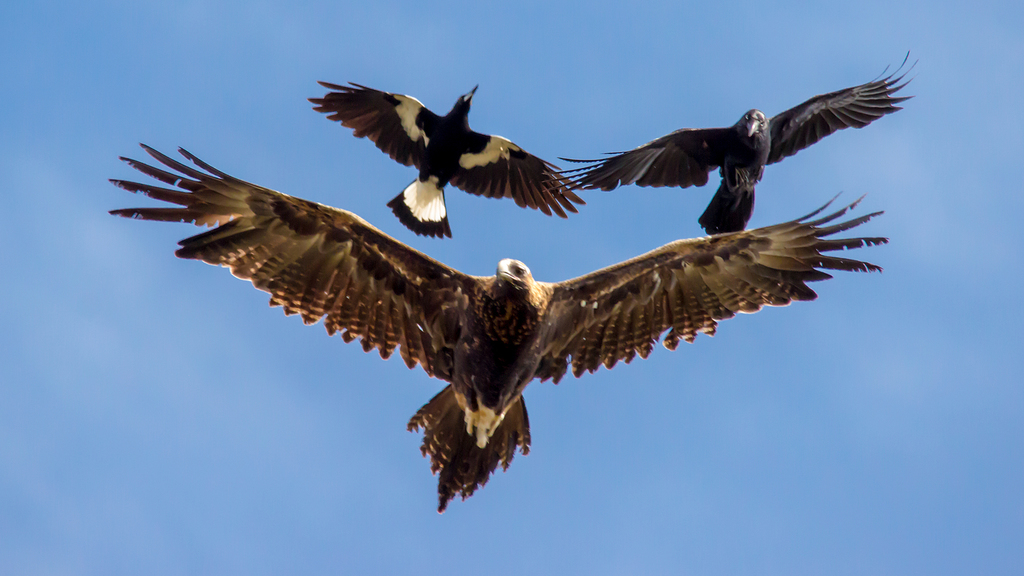
The wedge-tailed eagle (Aquila audax) is Australia's largest bird of prey, with a wingspan reaching 2.3 m and a distinctive long diamond-shaped tail. It soars over open country from near ground level to above 2,000 m, hunts everything from rabbits to wallabies, and is found across virtually the entire Australian continent.
Most raptors command attention when they appear, but the wedge-tailed eagle is in a different category. When one banks overhead with wings stretched flat and that long wedge of a tail fanning out behind it, there is nothing else in the Australian sky that looks even remotely similar.
How to identify a wedge-tailed eagle
The tail is the single most reliable field mark. Where other large raptors have short, rounded or fanned tails, the wedge-tail extends into a long, unmistakable diamond or kite shape. In flight, combined with broad, slightly upswept wings held in a shallow V, the silhouette is unique.
- Colour: Adults are very dark brown, approaching black, with a pale golden-brown wash on the nape and upper back. Juveniles and immatures are pale streaky brown and darken over five to seven years of maturation.
- Size: The largest Australian raptor. Females are considerably larger than males, a size difference visible when a pair soars together.
- Wings: Long and broad with clearly fingered primary tips, held in a shallow dihedral when soaring. From below, look for the pale wing panel at the base of the primaries.
- Tail: Distinctive diamond or wedge shape when spread. No other large Australian bird has this profile.
At distance a soaring wedge-tail can resemble the bald eagle in silhouette, but the tail shape separates them immediately. A perched bird reveals the large hooked bill, heavily feathered legs (to the base of the toes) and the pale golden eyes of a mature adult.
Where wedge-tailed eagles live
The wedge-tailed eagle occupies virtually every habitat across mainland Australia, Tasmania and southern New Guinea. Open woodland, scrub, farmland, mountain ranges and arid zones all suit it. The only consistent absences are dense rainforest and built-up urban centres.
Territories are enormous: a breeding pair may defend 30 to 50 km² of open country. They favour areas where thermals form reliably over exposed ridges and open ground, which is why elevated observation points along escarpments and ridgelines are the best places to scan for them.
Nest sites are reused for decades. The nest, a large flat platform of sticks, can reach 2 m across and 4 m deep after years of annual additions. Most are in tall eucalyptus trees, though cliff ledges are also used in more rugged terrain.
What wedge-tailed eagles hunt
Rabbits and hares make up the bulk of the diet across much of Australia, particularly since European rabbits became established in the 1800s and provided a reliable prey base. Beyond rabbits, the menu is broad: wallabies, small kangaroos, large lizards, birds, and a substantial amount of carrion.
A pair will cooperate to take prey larger than either bird could manage alone. They work in relay, one bird driving the prey while the other rests, then swapping, until the target is exhausted. This cooperation allows them to pull down animals much larger than themselves on occasion.
The visual hardware behind this precision is remarkable. Each eye contains two foveae (high-resolution zones), giving depth perception far sharper than human vision. From above 1,000 m, a wedge-tail can resolve a rabbit moving through grass at speed and calculate its trajectory, something that requires both the foveal acuity and the raptor's capacity to process fast-moving targets without visual blur.
The soaring strategy
Wedge-tailed eagles are masters of thermal soaring. They rise on columns of warm air without flapping, circle to gain altitude, then glide downwind to the base of the next thermal and repeat. A bird can cover 200 km in a morning at negligible energy cost.
The characteristic soaring height varies by the strength of thermals. On calm mornings they may be seen gliding low over ridge crests. By late morning, when thermals strengthen, they climb to 1,500 m or higher, where they are visible only as a dark speck. A pair soaring together at height is one of the signature sights of the Australian outback.
They share their Apex type in the Kaught catalog with the continent's other large diurnal raptors, but no Australian bird approaches the wedge-tail's combination of size, thermal efficiency and cooperative hunting capability. The white-tailed eagle of Eurasia fills a comparable niche, but at a latitude and in a landscape utterly unlike Australia's open dry country.
Wedge-tailed eagle rarity: what Epic tier means
The wedge-tailed eagle is not scarce in the sense of being hard to find if you go looking in the right places. Drive through open woodland in southeastern Australia on a warm morning and the odds of seeing one soaring are reasonable. But a clear, close sighting, where the wedge-tail shape is obvious and the pale nape visible, is less common than the species' presence might suggest. The birds spend much of the day at altitude or hidden in large canopy nests. In the Kaught catalog this places them at the Epic tier, three diamonds out of four, reflecting genuine observation scarcity rather than any question of population size.
Three facts about the wedge-tailed eagle
- The species can live for over 40 years in the wild, one of the longest confirmed lifespans of any Australian bird.
- Wedge-tails have been observed at altitudes exceeding 2,000 m, high enough that they are invisible to the naked eye from the ground.
- In early aviation history, wedge-tails repeatedly struck low-flying aircraft over the Australian interior; the birds appeared to treat them as rival predators entering their territory.
Wedge-tailed eagle: frequently asked questions
What does a wedge-tailed eagle look like?
An adult is very dark brown to black overall with a pale golden-brown nape and a long, distinctive diamond-shaped tail. Juveniles are streaky pale brown and darken over several years. Wingspan reaches 2.3 m, making it unmistakable in the Australian sky.
Where do wedge-tailed eagles live?
Across virtually all of mainland Australia, Tasmania and southern New Guinea. They occupy open woodland, scrub, farmland, mountain ranges and arid zones. The only consistent absences are dense rainforest and built-up urban areas.
What do wedge-tailed eagles eat?
Rabbits and hares make up most of the diet across their range, alongside wallabies, small kangaroos, large lizards, birds and carrion. A pair will cooperate to drive large prey to exhaustion before striking.
How high do wedge-tailed eagles fly?
They routinely soar above 1,800 m and have been reported at over 2,000 m. They use thermals efficiently and rarely flap while soaring, staying aloft for hours while patrolling a huge territory.
Are wedge-tailed eagles dangerous to people?
No. They pose no threat to people and actual attacks are essentially unknown. A nesting pair may perform close fly-overs as a warning display, but contact is not the aim. Hang-gliders occasionally report close passes as the birds investigate airborne objects in their territory.
Why is the wedge-tailed eagle Epic tier in Kaught?
Kaught's rarity tier reflects how often a species is actually recorded in the wild, not its conservation standing. The wedge-tail is widespread but spends much of its time at altitude or at nest sites, and a close, clear sighting is genuinely uncommon, placing it at Epic, three diamonds out of four.
The next thing you see could be
your first catch.
Kaught is live on the App Store and Google Play. Free to start, and your first catch is one photo away.
Free to start · Live on the App Store and Google Play
Species data, type, rarity tier and measurements is drawn from the Kaught catalog, built on open biodiversity records from GBIF and iNaturalist. Rarity reflects how often a species is observed in the wild, not its conservation status.