
Exotic spotlight
Blanket Octopus: Why the Male Is 40,000 Times Smaller
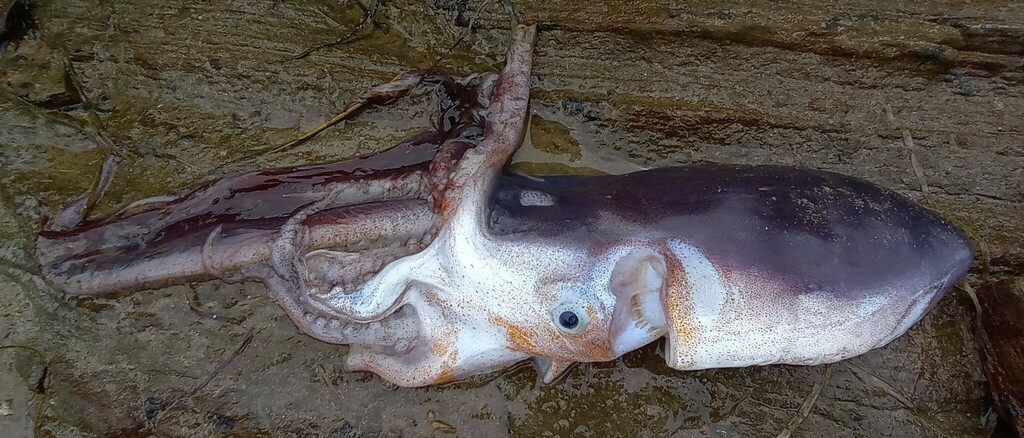
The blanket octopus (Tremoctopus violaceus) shows one of the most extreme size gaps of any animal: females reach 2 m across, males just 2.4 cm. Immune to its sting, small males and juveniles also rip tentacles from a Portuguese man-of-war and carry them as weapons.
Most sexual size differences between male and female animals are a matter of degree. The blanket octopus isn't. A female can grow to two metres across when her webbing is spread, and the male she mates with could sit on a fingernail. That isn't the only strange thing about this open-ocean mollusk: the ones most likely to need a weapon are also the ones that steal one, ripping a live stinging tentacle straight off a Portuguese man-of-war and keeping it on hand.
How to identify a blanket octopus
A blanket octopus is unmistakable mostly because so few people ever see one up close. The female is the one usually meant by the name: a soft-bodied, gelatinous mollusk with long arms connected by sheets of thin webbing stretched between the first and second pairs. When she spreads that webbing it billows out like a cape, shimmering with an iridescent purple, gold and red sheen that can stretch metres across in a large individual, and her underside runs pale, almost silvery gold. The male and the juvenile female look nothing like this: tiny, unwebbed, and easy to mistake for an entirely different animal.
Why is the male so much smaller than the female?
Tremoctopus violaceus holds one of the most extreme size gaps recorded in any animal. A female can reach about 2 m (6.6 ft) including her trailing arms and webbing, while a mature male measures roughly 2.4 cm and weighs around a quarter of a gram. Estimates of the weight ratio run from about 10,000:1 up to 40,000:1 depending on the individuals compared, either way it's the largest size gap between the sexes documented in a non-microscopic animal. Live males are rarely caught at all; much of what's known about them comes from a handful of encounters logged decades apart.
Mating matches the mismatch. The male's third right arm is modified into a hectocotylus, which he detaches entirely and leaves lodged inside the female's mantle cavity to fertilise her eggs later, then he dies shortly after, a reproductive trick shared with the greater argonaut. A female carries more than 100,000 eggs on a calcified strand at the base of her dorsal arms until they hatch, sometimes holding detached arms from more than one male at once.
The weapon it borrows from a Portuguese man-of-war
Here's the part that gets this species onto highlight reels. Juveniles and small males are immune to the sting of the Portuguese man-of-war, a floating colonial siphonophore whose venom can seriously hurt a human swimmer and rivals entries in Kaught's most venomous animals in the world ranking. Rather than avoid it, a young blanket octopus approaches from below, tears a fragment of tentacle free, and holds it in specialised suckers on its first pair of arms. The stinging cells keep firing for some time after they're torn loose, so the stolen weapon still works, one of the few documented cases of tool use in a mollusk, alongside the shell-carrying habit of the coconut octopus. It's used to fend off predators and, it's suspected, to help subdue small prey. Large adult females mostly skip the trick and rely on the blanket display instead, since a borrowed tentacle is only effective against something roughly the octopus's own size. Exactly how its skin resists the venom in the first place isn't fully settled, but compounds in its skin and mucus are thought to stop the stinging cells from firing on contact.
Where blanket octopuses live
The Atlantic blanket octopus lives entirely in open water, the epipelagic zone in the upper 200 m of the ocean, with no reef, seafloor or shoreline involved at any stage of its life. Its documented range runs through the Atlantic from about 40°N to 35°S, including the Gulf of Mexico, the Caribbean and the Mediterranean. Three other Tremoctopus species fill the same role in the Pacific and Indian Oceans, all commonly grouped under the same "blanket octopus" name, the open-ocean counterpart to deep-water mollusks like the giant squid. Diet matches the habitat: small fish, pteropods (free-swimming sea snails), planktonic crustaceans, squid larvae and other soft-bodied drifters, caught in open water rather than hunted off a den.
Is a blanket octopus dangerous to humans?
Not on its own. It carries no venom of its own and poses no direct threat to a diver. The danger, where it exists, is secondhand: a small male or juvenile female can be carrying a live fragment of man-of-war tentacle, and that fragment keeps its sting regardless of whose arm it's attached to. A diver who picked one up without knowing this could come away with a real, painful sting that has nothing to do with the octopus itself. Treat it the way you'd treat anything carrying a weapon you can't see: look, don't touch.
How rare is the blanket octopus in Kaught?
In the Kaught catalog the blanket octopus sits at the Epic tier, three diamonds out of four. That's a measure of how often the species is actually confirmed in the wild, not its conservation status. Its entire life plays out in open ocean far from any coastline or reef most divers visit, and the adult female, the life stage most people could actually identify, spends her time near the surface of water most people never cross. A confirmed sighting, let alone a photograph of the blanket display in full, is a genuine rarity even for people who spend their lives on the water, on par with other open-ocean rarities like the wonderpus.
Blanket octopus: frequently asked questions
What is a blanket octopus?
The blanket octopus (Tremoctopus violaceus) is an open-ocean mollusk best known for the female's huge iridescent webbing and for one of the most extreme size gaps between male and female of any animal. It lives its entire life in open water, never on a reef or the seafloor.
How big is a blanket octopus?
A female can reach about 2 m (6.6 ft) across including her webbing and trailing arms, while a mature male measures roughly 2.4 cm, about the size of a thumbnail, and weighs around a quarter of a gram.
Why is the male so much smaller than the female?
It's an extreme case of sexual size dimorphism. Estimates put the weight ratio between female and male at roughly 10,000:1 to 40,000:1, the largest documented gap between the sexes of any non-microscopic animal. A tiny male needs only enough body to deliver sperm and survive long enough to find a mate.
Does a blanket octopus sting?
The octopus itself carries no venom. But small males and juvenile females rip tentacle fragments from a Portuguese man-of-war and carry them as weapons, immune to the sting themselves. Those borrowed fragments stay venomous, so handling one can still result in a real sting.
Where do blanket octopuses live?
In open water, the sunlit upper 200 m of the ocean known as the epipelagic zone. The Atlantic species ranges roughly from 40°N to 35°S, including the Gulf of Mexico, the Caribbean and the Mediterranean, with related Tremoctopus species filling the same niche in the Pacific and Indian Oceans.
What does a blanket octopus eat?
Small fish, pteropods (free-swimming sea snails), planktonic crustaceans, squid larvae and other soft-bodied animals drifting in open water, caught as it swims rather than hunted from a den.
Why is the blanket octopus "Epic" in Kaught?
Kaught's rarity tier reflects how often a species is actually confirmed in the wild, not its conservation status. The blanket octopus lives its whole life in open ocean far from reefs and coastlines, so even a clear sighting of the adult female's display is genuinely uncommon. That places it at the Epic tier, three diamonds out of four.
The next thing you see could be
your first catch.
Kaught is live on the App Store and Google Play. Free to start, and your first catch is one photo away.
Free to start · Live on the App Store and Google Play
Species data, type, rarity tier and measurements, is drawn from the Kaught catalog, built on open biodiversity records from GBIF and iNaturalist. Rarity reflects how often a species is observed in the wild, not its conservation status.