
Behaviour explainer
Coconut Octopus: the Octopus That Carries Its Own Armor
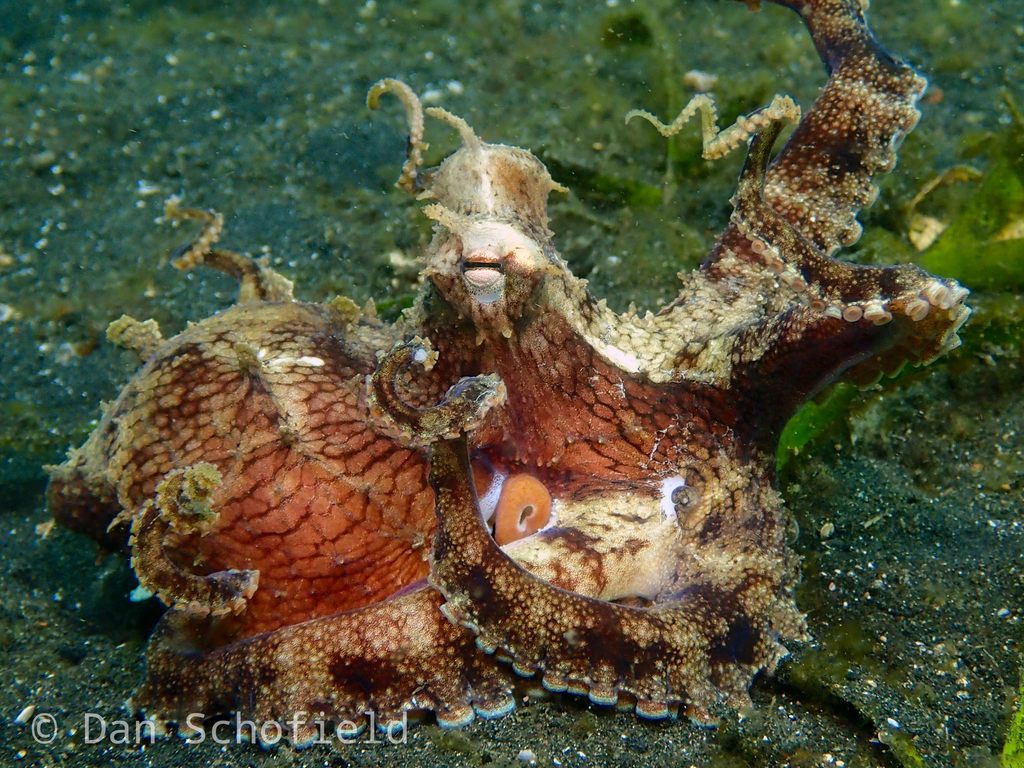
The coconut octopus (Amphioctopus marginatus) is a small Indo-Pacific octopus that collects coconut shell halves or clam shells, stacks them, and carries them stilt-walking across open sand to assemble into a shelter later. Filmed in 2009, it is one of the clearest cases of tool use ever recorded in an invertebrate, and the same species separately disguises itself by rolling along the seabed upright on two arms.
Most animals that use a shell for cover simply live inside one, like a hermit crab. The coconut octopus does something stranger: it goes and gets a shell it isn't using yet, carries it a considerable distance across open sand, and only fits itself inside once it decides it actually needs to. That distinction, carrying an object for later rather than for right now, is why a small, unremarkable-looking octopus from the muck-diving flats of Indonesia became one of the most cited animals in the study of animal tool use.
The dive study that rewrote the rules on invertebrate tools
The behaviour was formally described in 2009 by marine biologists Julian Finn, Tom Tregenza and Mark Norman, in a short paper for the journal Current Biology titled "Defensive tool use in a coconut-carrying octopus." The team logged more than 500 hours of diving on soft-sediment seafloor off Sulawesi and Bali between 1999 and 2008, watching more than 20 individual coconut octopuses. On four separate occasions they filmed an octopus manipulating a matched pair of coconut shell halves, or empty bivalve shells, into a stack with the hollow sides facing up, tucking the stack under its body, and then extending its arms rigidly to walk across the seabed on their tips, a gait the researchers nicknamed "stilt-walking." One individual carried its shells over 20 metres this way before stopping.
Once it settled somewhere, the octopus pulled the two halves closed around its soft body, sealing itself inside a portable, hinged shelter built entirely from parts it had gone out of its way to collect in advance.
Why this counts as real tool use, and a hermit crab doesn't
Biologists are cautious about the phrase "tool use," and for good reason: an animal that merely lives inside a shell, like a hermit crab, is using found shelter, not a tool. The coconut octopus clears a higher bar. It hauls the shells around while gaining no protection at all in the moment, an awkward, exposed, energy-costly journey with no payoff until later. That gap between the cost paid now and the benefit collected afterward is the working definition of carrying a tool for future use, and at the time it was one of the first clean examples of that behaviour documented in any invertebrate.
A second trick: walking like a rolling coconut
Separately from shell-carrying, the coconut octopus has a second unusual gait. It can draw six of its eight arms up over its head and mantle, tucking them close to the body, and push off across the sand using only the remaining two arms extended stiffly like stilts. Researchers who documented the behaviour suggested the resulting silhouette and rolling motion may mimic a drifting coconut husk or a loose clump of algae, giving a soft-bodied animal with no shell of its own a moment's disguise while it crosses open, exposed ground. It is one of only two octopus species known to walk bipedally this way, the other being a related species, Abdopus aculeatus.
What it hunts, and when
Coconut octopuses feed mainly at night, probing sand and silt with their arms for shrimp, crabs and small fish, and prying open clams. Like other octopuses they carry a mild venom used to subdue prey rather than for defence against anything as large as a person, a useful contrast with their infamous relatives in the genus Hapalochlaena, the blue-ringed octopuses, whose venom is genuinely dangerous to humans.
Where to actually find one
The species lives on soft sand and silt seafloor across the tropical Indo-West Pacific, from India and Sri Lanka east through Southeast Asia to the Philippines, and south to northern Australia. It is a signature find of "muck diving," a style of diving focused on unglamorous-looking sand and silt rather than coral reef, and nowhere is it more reliable than Indonesia's Lembeh Strait and the black-sand sites of Bali, where guides know it well enough to point it out by name. A slow night dive over open, featureless sand in the shallows, generally less than 20 metres down, is the standard way to find one, often by spotting the give-away outline of two shell halves moving with no visible legs underneath.
How rare is it to actually see one?
In the Kaught catalog the coconut octopus sits at the Rare tier, two diamonds out of four. As with every species in the catalog, that is a read on how often it is actually recorded, not a statement about its conservation status. It is small, patterned to blend into sand and silt, mostly active after dark, and tied to a specific soft-sediment habitat rather than the reef structure most divers gravitate toward, so a confirmed sighting takes more searching than most reef life. That combination of genuine scarcity in casual encounters, without being anywhere close to the hardest animals in the catalog to find, is exactly what the Rare tier is built to describe.
Coconut octopus: frequently asked questions
Why does the coconut octopus carry coconut shells?
It carries matched coconut shell halves or clam shells so it has a ready-made shelter wherever it happens to stop. It stacks the shells, tucks them under its body, and walks on rigid extended arms, then pulls the two halves together around itself like a shell whenever it needs to hide.
Is carrying a shell really "tool use"?
Yes, and it is a stricter kind than a hermit crab living in a shell. Researchers in 2009 filmed the octopus hauling stacked shells for no immediate benefit, purely so it could assemble them into cover later. Carrying an object for future use, not present use, is the standard that made this a landmark case.
How does the coconut octopus disguise itself as a rolling coconut?
Separately from shell-carrying, it can pull six of its eight arms up over its head and body and push off with the remaining two like stilts, rolling itself across the sand. Researchers think the gait is meant to resemble a drifting coconut husk or clump of algae rather than an octopus.
What does the coconut octopus eat?
Mostly shrimp, crabs, small fish and clams, hunted by probing sand and silt with its arms or pouncing under a web of skin stretched between them. It usually feeds at night, when it also does most of its shell-carrying and hunting.
Where can you find a coconut octopus?
On soft sand and silt seafloor across the tropical Indo-West Pacific, most famously the muck-diving sites of Indonesia's Lembeh Strait and Bali, and also the Philippines, Malaysia and northern Australia. Night dives over open sand in the shallows, down to about 20 metres, are the most reliable way to spot one.
Is the coconut octopus dangerous?
No. Like most octopuses it carries mild venom to subdue small prey, but it poses no real danger to a diver who leaves it alone. That is a genuine contrast with its blue-ringed relatives, whose bite can be lethal to people.
Why is the coconut octopus "Rare" in Kaught?
Kaught's rarity tier reflects how often a species is actually recorded in the wild, not conservation status. The coconut octopus is small, well camouflaged and largely nocturnal, and it only turns up reliably on specific soft-sediment habitat, so a confirmed sighting is less common than a typical reef fish. That places it at the Rare tier.
The next thing you see could be
your first catch.
Kaught is live on the App Store and Google Play. Free to start, and your first catch is one photo away.
Free to start · Live on the App Store and Google Play
Species data, type, rarity tier and measurements, is drawn from the Kaught catalog, built on open biodiversity records from GBIF and iNaturalist. Rarity reflects how often a species is observed in the wild, not its conservation status.
More cephalopods and tool users: Most venomous animals in the world · Wonderpus octopus · Vampire squid · Why sea otters hold hands