
Exotic spotlight
Giant Squid: the deep-sea animal with eyes the size of dinner plates
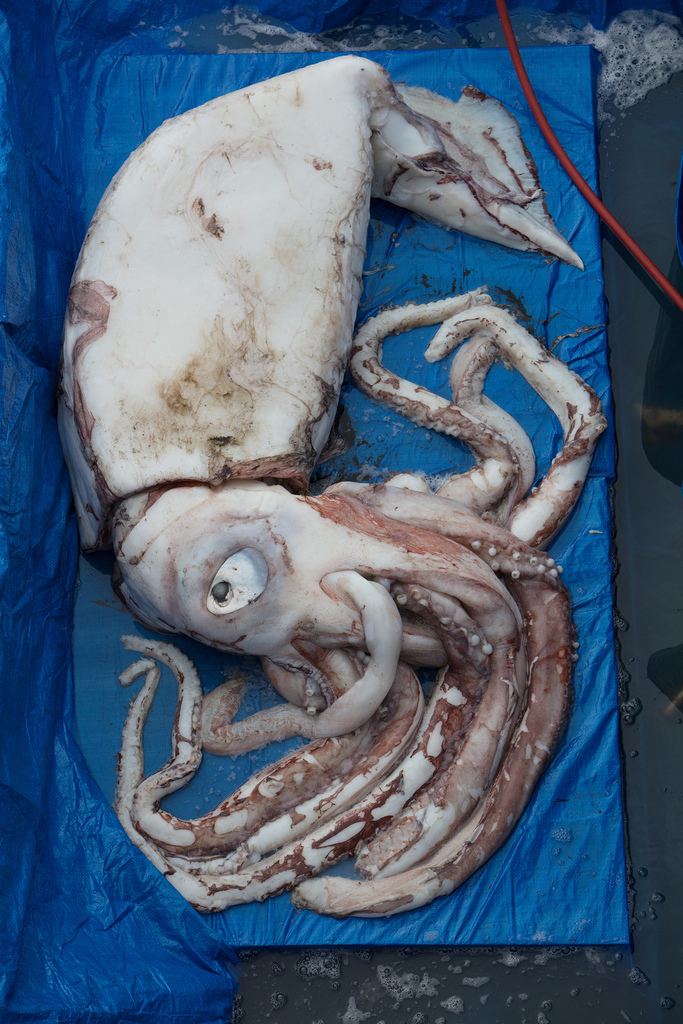
The giant squid (Architeuthis dux) is the largest invertebrate on Earth, reaching 13 m and 275 kg in the deep ocean. Its eyes, at up to 30 cm across, are the largest of any living animal, an adaptation for detecting bioluminescent sperm whales in total darkness.
For most of human history, the giant squid was a legend. Ancient sailors reported sea monsters whose arms reached out to capsize ships. Norwegian fishermen called it the Kraken. It took until 2004 for the first photograph of a living giant squid in its natural deep-sea habitat to exist. It took until 2019 for the first colour footage. Every piece of knowledge about this animal has come at enormous scientific effort, and most of what we know still comes indirectly, from the stomach contents of sperm whales.
What does a giant squid look like?
A giant squid has the same basic body plan as its relatives: a torpedo-shaped mantle (the main body), a head with eight arms and two longer feeding tentacles, and a beak at the centre where the arms converge. Scale that plan to its full dimensions and the effect is startling:
- Body (mantle): typically 2 m long in females, shorter in males.
- Arms: eight muscular arms lined with suckers, each sucker ringed with sharp chitinous teeth.
- Tentacles: two longer feeding tentacles, expanding at the tip into a paddle-shaped club lined with suckers. These add the bulk of the total length, accounting for most of the 13 m maximum figure.
- Colour: reddish-brown to orange; chromatophores in the skin can produce rapid flashes.
- Eyes: the most striking feature. Up to 30 cm in diameter, about the size of a dinner plate, the largest eyes of any animal alive today.
Why are the eyes so large?
This question has driven serious evolutionary research. At first, large eyes seem redundant: the deep ocean is completely dark, so what is there to see?
The answer involves sperm whales. Sperm whales are the giant squid's primary predator, diving to over 1,000 m to hunt them. As a sperm whale descends and moves through the water, it disturbs the bioluminescent plankton around it, producing a faint but detectable halo of blue light, a biological bow-wave of glowing organisms triggered by displacement.
A 2012 study argued convincingly that the giant squid's enormous eyes evolved specifically to detect this sperm-whale light signature, giving it just enough warning to attempt escape before the whale closes in. Smaller eyes would be insensitive to such faint, diffuse light at distance; the 30 cm eye captures enough photons to resolve the approaching shape. This is one of the most compelling examples of predator-prey co-evolution in any known species.
Where do giant squid live?
Everywhere and almost nowhere, simultaneously. Architeuthis dux is found in all major oceans, from the North Atlantic to the North Pacific, the South Atlantic to the South Pacific and the Indian Ocean. Strandings have occurred on beaches from New Zealand to Newfoundland.
But its actual living habitat is the mesopelagic and bathypelagic zones: roughly 200 to 1,000 m below the surface, in permanent darkness and near-freezing water. No surface vessel goes there routinely. No diver can reach it. Only deep-sea submarines and remotely operated vehicles equipped with cameras have ever recorded living giant squid in the wild.
Most of what we know about their distribution comes from sperm whales. Whalers who opened sperm whale stomachs in the 19th and 20th centuries found giant squid beaks inside, hundreds of them, sometimes. A single sperm whale may eat a thousand giant squid in its lifetime.
How do giant squid hunt?
Giant squid are active predators of deep-sea fish and other squid. They strike with their two long feeding tentacles, which shoot out at speed to capture prey at range. The sucker rings on the tentacle clubs bear sharp teeth that hook into flesh. The prey is drawn back toward the beak at the centre of the arms, which is powerful enough to shear through bone.
The squid itself bears the scars of its own predator's tactics. Sperm whale skin is frequently marked with circular sucker-ring impressions from giant squid that fought back during capture. Some of the circles are 10 cm across, suggesting the attacking squid was extraordinarily large.
Why is the giant squid Epic in Kaught?
Kaught's rarity reflects wild observation frequency. The giant squid is one of the most rarely recorded large animals on Earth: iNaturalist holds around 57 verified records, mostly of strandings and museum specimens. No living individual in deep-sea habitat has been photographed by a recreational naturalist, and the total global observation count from any source is tiny relative to any terrestrial animal of comparable body size. That scarcity of real-world records places it at the Epic tier: three diamonds out of four.
It is worth noting: the colossal squid (Mesonychoteuthis hamiltoni) of Antarctic waters is even rarer in the catalog and arguably heavier, but the giant squid holds the length record and remains the more thoroughly documented of the two.
For a cephalopod you can realistically hope to see yourself, the Australian giant cuttlefish is the opposite case: the largest cuttlefish in the world, in shallow water, and it gathers in thousands at a single South Australian site each winter.
Three facts that sound made up but aren't
- The beak survives everything. Giant squid beaks are made of chitin and resist decomposition for years inside a whale's stomach. More is known about where giant squid live from whale stomach beak surveys than from any direct observation.
- They fight sperm whales. Sperm whales regularly bear sucker-ring scars from giant squid inflicted during the struggle at depth. The battles happen in total darkness at pressure that would crush a human to death instantly.
- One species, entire ocean. Genetic analysis of giant squid from across the Atlantic, Pacific and Indian Oceans shows remarkably little genetic variation, suggesting regular gene flow between populations despite the enormous distances involved.
Giant squid: frequently asked questions
How big do giant squid get?
Up to 13 m in total length including tentacles, and up to 275 kg in weight. Females are larger than males. Most size data comes from specimens found washed ashore or from beaks recovered inside sperm whales.
Where do giant squid live?
In mesopelagic and bathypelagic zones, roughly 200 to 1,000 m depth, across all major oceans. Strandings have been recorded from New Zealand to Newfoundland. Most distribution data comes from sperm whale stomach contents rather than direct sightings.
Why do giant squid have such large eyes?
Eyes up to 30 cm across, the largest of any living animal, are thought to detect the faint bioluminescent halo produced when a sperm whale descends toward them in total darkness, giving the squid time to attempt escape.
Have giant squid ever been filmed alive?
Yes. The first footage in natural habitat came from a baited Japanese deep-sea camera in 2004. Full colour footage in the Gulf of Mexico followed in 2019. Both required remotely operated vehicles descending hundreds of metres.
What do giant squid eat?
Deep-sea fish and other squid, including their own species. They strike with two long feeding tentacles tipped with hooked suckers, drawing prey back to a parrot-like beak powerful enough to shear through bone.
Why is the giant squid Epic in Kaught?
Kaught rarity reflects wild observation frequency, not population size. Giant squid have around 57 verified iNaturalist records worldwide, mostly strandings. That extreme scarcity places the species at the Epic tier, three diamonds out of four.
The next thing you see could be
your first catch.
Kaught is live on the App Store and Google Play. Free to start, and your first catch is one photo away.
Free to start · Live on the App Store and Google Play
Species data, type, rarity tier and measurements, is drawn from the Kaught catalog, built on open biodiversity records from GBIF and iNaturalist. Rarity reflects how often a species is observed in the wild, not its conservation status.