
Identify safely
The Beaked Sea Snake: the small-headed reptile behind most sea snake bites
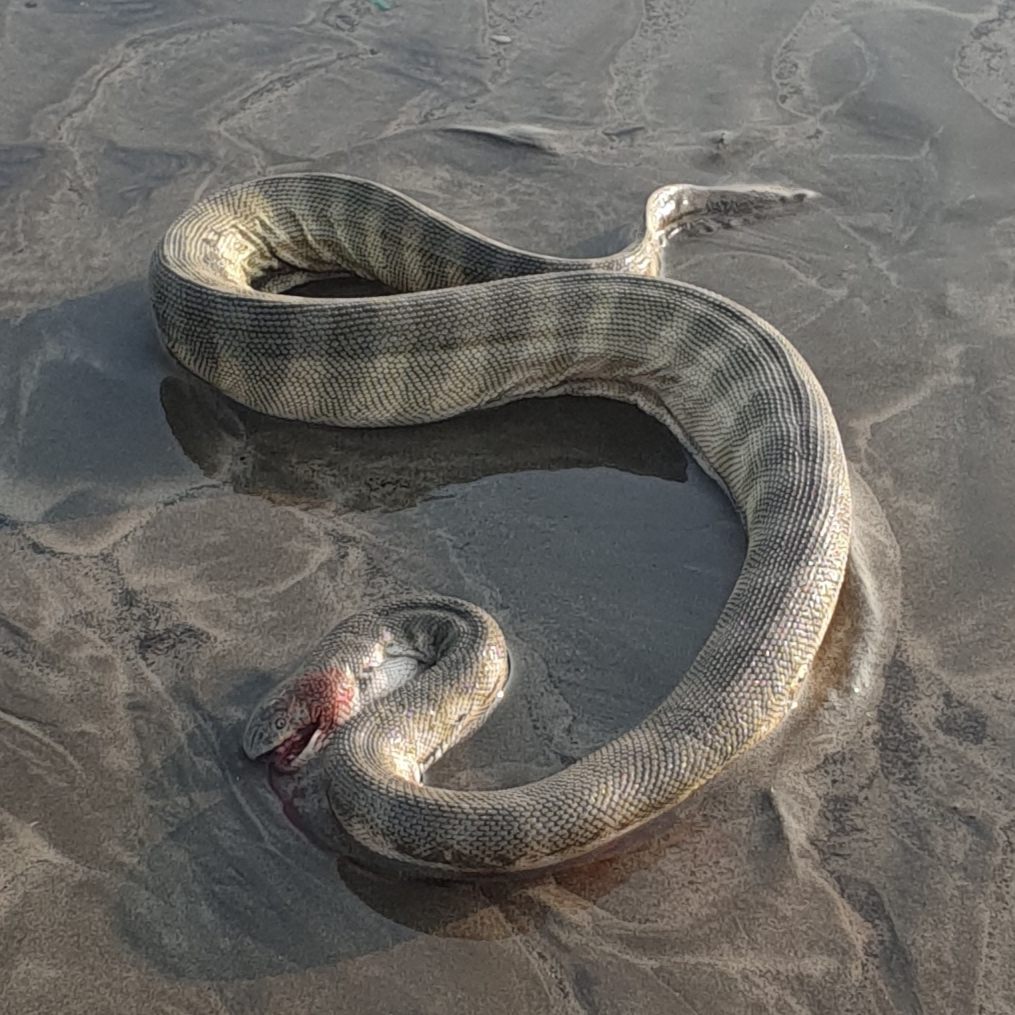
The beaked sea snake (Hydrophis schistosus) is a small-headed, hook-snouted reptile from the tropical Indo-Pacific. It is genuinely dangerous, implicated in more than half of all recorded sea snake bites, but it is not aggressive. Almost every bite happens when a fisher handles one hidden inside a net.
Most people who meet a beaked sea snake never see it coming. It rides in with the catch, hauled up in a trawl net alongside a hundred wriggling fish, and looks almost harmless until a bare hand closes around it. The beaked sea snake is a small, unassuming reptile from the coastal tropical Indo-Pacific, and despite its size it is implicated in more sea snake bites than every other species combined. Here's how to recognise one, where it lives, and exactly how dangerous it is.
What does a beaked sea snake look like?
The giveaway is the head: small, narrow and noticeably less wide than the body, tipped with an upturned, hooked snout that gives the species both its common name and its alternate name, the "hook-nosed sea snake". The body is thick for its length, pale olive, grey or yellowish, marked with darker grey-black crossbands or blotches that fade and blur as the snake ages, so old adults can look almost uniformly pale. Like every sea snake, the tail is flattened side to side into a paddle, useless for crawling but built for swimming, and the nostrils sit on top of the snout with valves that seal shut underwater. Most adults stay under a metre and a half.
Where do beaked sea snakes live?
Shallow, turbid coastal water: river mouths, estuaries, mudflats and seagrass beds across the tropical Indo-Pacific, from the Persian Gulf through India and Sri Lanka, across Southeast Asia, to northern Australia and the southern China coast. It hunts low over soft seabed for catfish and other small fish, rarely straying into open ocean or clear water reefs the way many showier sea snakes do.
Is the beaked sea snake dangerous?
Genuinely, yes. Its venom combines nerve-blocking neurotoxins with toxins that break down muscle tissue, a combination capable of causing progressive paralysis and kidney damage if a bite goes untreated. The species is implicated in more than half of all recorded sea snake bites and a large share of sea-snake-related deaths in fishing communities around the Persian Gulf, India and Sri Lanka. What it is not, however, is aggressive. Beaked sea snakes do not chase people or strike unprovoked; the danger comes entirely from direct contact.
Why does it cause so many bites?
Geography, not temperament, explains the numbers. The beaked sea snake lives in precisely the shallow, muddy coastal waters that shrimp and fish trawlers work every day, so it turns up in nets constantly, sometimes dozens at a time mixed in with the catch. Fishers sorting that catch by hand, often barefoot and working fast, are the ones who get bitten, almost always on the hand or forearm while unhooking or clearing a net. A wader who steps on one in a shallow estuary is at similar, if rarer, risk.
How the venom works
A bite can be almost painless at first, since the fangs are short and the puncture small, which means a fisher can be envenomated without immediately realising it. Neurotoxins then begin interrupting the signal between nerve and muscle, and myotoxins start breaking down muscle fibre, a process that can take hours to show serious symptoms and, left untreated, can damage the kidneys as broken-down muscle protein passes through them. Specific antivenom exists and is effective when given promptly, which is why treating any sea snake bite as an emergency, symptoms or not, is the standard advice across the region.
Built for a life that never touches land
Away from the danger, the beaked sea snake is a tidy piece of engineering for full-time life at sea. The valved nostrils close automatically underwater, the paddle tail gives it far more thrust than any land snake's body could manage, and its skin can absorb a meaningful share of the oxygen it needs directly from the water, cutting down how often it must surface to breathe. A gland under the tongue helps flush the excess salt that comes from living permanently in seawater. Unlike sea kraits, which still crawl ashore to lay eggs, the beaked sea snake gives birth to live young in the water and never needs to touch land at all.
Staying safe around one
The practical rule is simple: never handle a sea snake with bare hands, particularly while sorting a net or a catch, and give any snake in shallow water room to swim away rather than reaching past it. If a bite does happen, keep the limb still and below heart level, get to a hospital for antivenom immediately, and skip the folk remedies: no cutting the wound, no tourniquet, no attempting to suck out venom. Left alone, a beaked sea snake has no interest in a confrontation it can simply swim away from.
How rare is the beaked sea snake in Kaught?
In the Kaught catalog the beaked sea snake sits at the Epic tier, three diamonds out of four. That tier is purely a record of how often a species is confirmed by naturalists in the wild, not a statement about how common it is in a trawl net or its conservation status. Turning up often as fishing bycatch does not translate into frequent, photographed sightings on land, so confirmed records stay scarce next to a familiar coastal animal.
If venom is the theme you're following, Africa's gaboon viper carries the longest fangs of any snake on land, and the wider most venomous animals in the world ranking puts this species' toxin load in context against the rest of the animal kingdom. For land-based snakebite risk specifically, the deadliest snakes in the world ranking covers the species responsible for the most human deaths. And if a forked tongue and a life spent partly submerged interests you more than venom, the water monitor lizard is another reptile that reads its aquatic world by taste rather than sight.
Beaked sea snake: frequently asked questions
Is the beaked sea snake dangerous to humans?
Yes. Its venom contains potent neurotoxins and muscle-damaging toxins, and it is implicated in more than half of all recorded sea snake bites. It is not aggressive, though, and almost every bite happens when someone handles one hidden in a fishing net or catch.
What does a beaked sea snake look like?
A small-headed reptile with a distinctive upturned, hooked snout, a thick body for its length, and a flattened, paddle-shaped tail. Colouring is pale olive to cream with darker grey or black crossbands that fade as the snake ages.
Where do beaked sea snakes live?
Shallow, muddy coastal waters, river mouths and estuaries across the tropical Indo-Pacific, from the Persian Gulf through India and Sri Lanka to Southeast Asia and northern Australia. It rarely strays far from the seabed it hunts over.
Why does the beaked sea snake cause so many bites?
It lives in exactly the shallow, muddy waters that shrimp and fish trawlers work, so it is one of the most commonly netted sea snakes in the region. Bites happen when fishers sort a catch by hand and grab one hidden among the fish.
Do beaked sea snakes ever come on land?
No. Unlike sea kraits, which crawl ashore to lay eggs, the beaked sea snake is fully aquatic and gives birth to live young in the water, so it never voluntarily leaves the sea.
What should you do if bitten by a beaked sea snake?
Treat it as a medical emergency even if the bite is painless. Keep the affected limb still and below heart level, get to a hospital immediately for antivenom, and do not cut the wound, apply a tourniquet, or attempt to suck out venom.
Why is the beaked sea snake "Epic" in Kaught?
Kaught's rarity tier reflects how often a species is actually logged in the wild, not conservation status or how common it is in fishing nets. Confirmed sightings by naturalists stay far scarcer than for familiar coastal wildlife, which places it at the Epic tier: three diamonds out of four.
The next thing you see could be
your first catch.
Kaught is live on the App Store and Google Play. Free to start, and your first catch is one photo away.
Free to start · Live on the App Store and Google Play
Species data, type, rarity tier and measurements, is drawn from the Kaught catalog, built on open biodiversity records from GBIF and iNaturalist. Rarity reflects how often a species is observed in the wild, not its conservation status.