
Species spotlight
Atlantic Goliath Grouper: the largest reef fish in the Atlantic and the one that changes sex
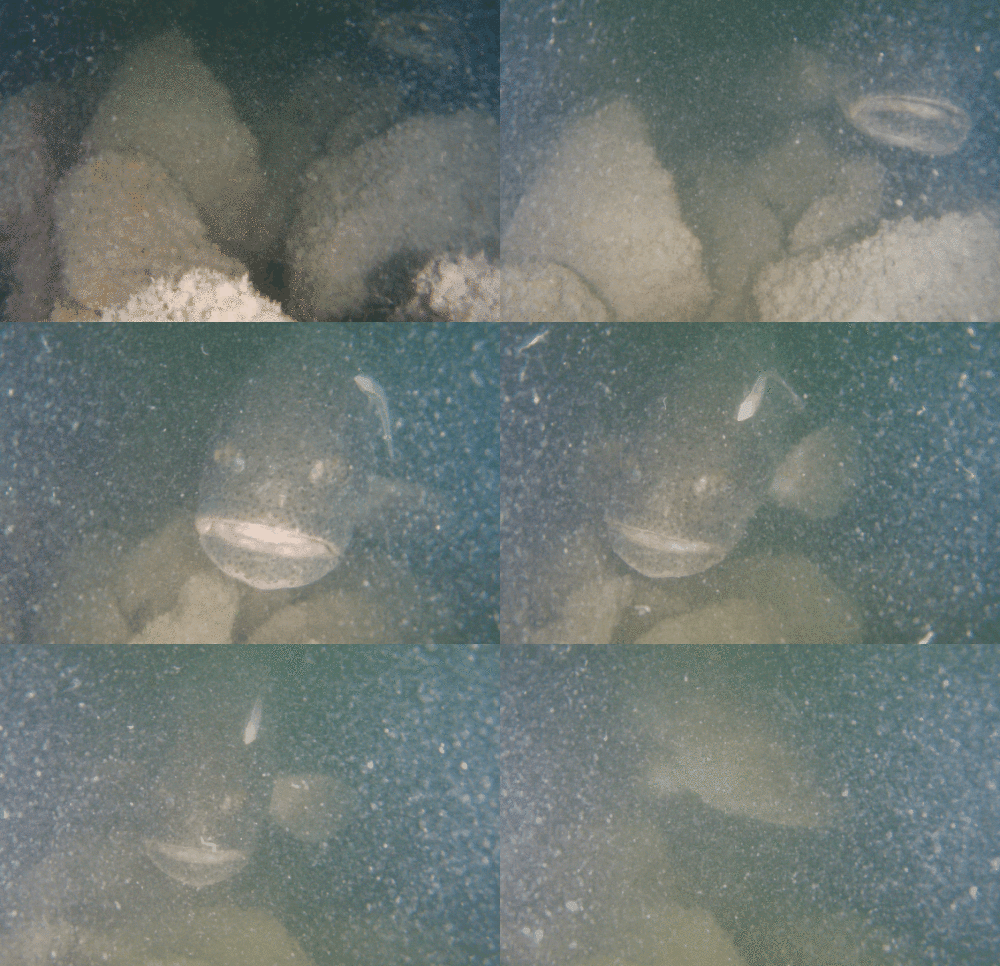
The Atlantic goliath grouper (Epinephelus itajara) is the largest member of the sea bass family in the Atlantic Ocean: up to 2.5 m and 363 kg. It is born female, can become male as it ages, and communicates at spawning aggregations with a low-frequency boom audible as a physical vibration in the water.
The Atlantic goliath grouper is the kind of animal that stops experienced divers mid-stroke. At close range, the scale is difficult to reconcile: a fish as heavy as a thoroughbred horse, hovering without apparent effort in front of a coral head, regarding you with the calm expression of something that has been doing exactly this for thirty years and will still be doing it long after you are gone.
It is also, in quiet terms, one of the stranger fish on the reef: a protogynous hermaphrodite that arrives in the world female and may leave it male, in between making sounds that you feel in your ribcage rather than hear.
How to identify an Atlantic goliath grouper
Size is the primary field mark. Even at modest ages, goliath groupers are much larger than any other grouper species on an Atlantic reef. Adults are typically 1–1.5 m in routine encounters; the largest verified individuals reach 2.5 m. The body is very deep and laterally compressed, with a large blunt head, a wide mouth and the characteristic grouper profile: rounded dorsal, broad pectoral fins and a distinctive rounded tail.
Colouration is brown or yellow-brown with irregular dark spots and blotches across the body and fins. Juveniles are much more strongly patterned, with pronounced dark brown and yellow banding. The pattern fades and becomes more diffuse with age. Adults are often encrusted with small crustacean parasites attended by cleaning fish, so the body surface may appear textured at close range.
The companion species most likely to be confused with a goliath grouper is the Warsaw grouper (Hyporthodus nigritus), but the Warsaw is black-grey rather than brown and lacks spots. No other grouper in the Atlantic approaches the goliath's size at any life stage.
Where goliath groupers live
The species ranges across the tropical and subtropical Atlantic, from Florida and the Gulf of Mexico south through the Caribbean and along the coast of Brazil to Santos. On the eastern Atlantic side, it occurs in West Africa from Senegal to Angola. Adults occupy coral reefs, rocky ledges, wrecks and hard-bottom areas at depths of 5–100 m. They are strongly site-faithful: an individual may spend years associated with a particular rock or ledge structure.
Juvenile goliath groupers live in mangrove estuaries for their first four to six years. The dense tangle of mangrove roots provides cover from predators during the vulnerable early growth phase. This means the species is doubly sensitive to coastal development: reef degradation harms adults while mangrove clearance cuts recruitment.
The largest populations remaining are in Florida, particularly in areas of south Florida and the Keys where the fish have been legally protected since 1990.
The sex change
Goliath groupers are protogynous hermaphrodites: all individuals are born and mature initially as females. As they grow larger and older, some transition to male. The transition is driven partly by social context, and in some grouper species is reversible if the local social structure changes.
The practical consequence is that the largest, oldest fish in any population are disproportionately male. Heavy fishing of large adults therefore skews sex ratios sharply toward female, reducing the number of spawning males available. This is a documented problem in heavily fished grouper populations worldwide and compounds the slow recovery of overexploited stocks. See also the ribbon eel, another reef species with a sex-change life history, and the spotted garden eel for contrast.
The boom
Goliath groupers produce a low-frequency sound, typically described as a boom or thud, by rapidly contracting specialised sonic muscles attached to the swim bladder. The sound travels efficiently through water and can be perceived by nearby divers as a physical pulse, felt through the chest and abdomen rather than heard through the ears.
The boom is most intense during spawning aggregations, where dozens to hundreds of fish gather at specific deep-reef sites, typically in August and September in Florida. The sound functions to coordinate spawning timing and as a competitive display between males. Aggregation sites are predictable year to year, which historically made the species extremely vulnerable to targeted fishing during the spawning season.
Hunting: an ambush predator
The goliath grouper does not chase prey. It hunts by waiting. The animal positions itself near structure, matches its background colouration as well as a fish of its size can, and waits for prey to come within range. The kill is an extremely fast lateral lunge and a simultaneous expansion of the mouth that generates powerful suction, drawing prey in from a surprising distance.
Primary prey is spiny lobster, followed by fish, octopus, stingrays and juvenile sea turtles. The mouth is large enough to take substantial prey, and the suction mechanism is proportionally powerful; in documented observations, goliath groupers have attempted to take speared fish from divers. This has contributed to an undeserved reputation for aggression, though the fish is reacting to the vibration signatures of a struggling fish, not targeting the human.
Compare this ambush strategy to the very different reef predator described in the coral reef animals guide, and to the giant squid for another deep-water species defined by large size and a suction-based capture mechanism.
Atlantic goliath grouper: frequently asked questions
How big do Atlantic goliath groupers get?
Up to 2.5 m length and 363 kg weight, making them the largest member of the sea bass family in the Atlantic. Reaching maximum size takes several decades. Most individuals encountered on dives are 1–1.5 m, which is still substantially larger than any other grouper on the same reef.
Do Atlantic goliath groupers change sex?
Yes. They are protogynous hermaphrodites: all are born female and some transition to male as they grow older and larger. The largest fish are typically male. Fishing pressure on large adults therefore disproportionately removes males, skewing population sex ratios.
What does a goliath grouper eat?
Mainly spiny lobster, fish, octopus and stingrays, taken by ambush with a rapid lunge and powerful suction. They wait motionless near structure and strike when prey moves within range. Young sea turtles are also recorded prey. They do not actively chase targets.
What is the booming sound a goliath grouper makes?
A low-frequency boom produced by contracting sonic muscles attached to the swim bladder. It is used during spawning aggregations to coordinate timing and as competitive display. Nearby divers feel it as a physical vibration in the chest rather than hearing it through the water.
Where do juvenile goliath groupers live?
In mangrove estuaries for their first four to six years, where the root systems provide shelter from predators. They transition to coral reefs and rocky ledges as they grow. Mangrove clearance directly limits recruitment by eliminating this nursery habitat.
The next thing you see could be
your first catch.
Kaught is live on the App Store and Google Play. Free to start, and your first catch is one photo away.
Free to start · Live on the App Store and Google Play
Species data, type, rarity tier and measurements are drawn from the Kaught catalog, built on open biodiversity records from GBIF and iNaturalist. Rarity reflects how often a species is observed in the wild, not its conservation status.