
Evolution story
The Ribbon Eel: the eel that is born male and becomes female
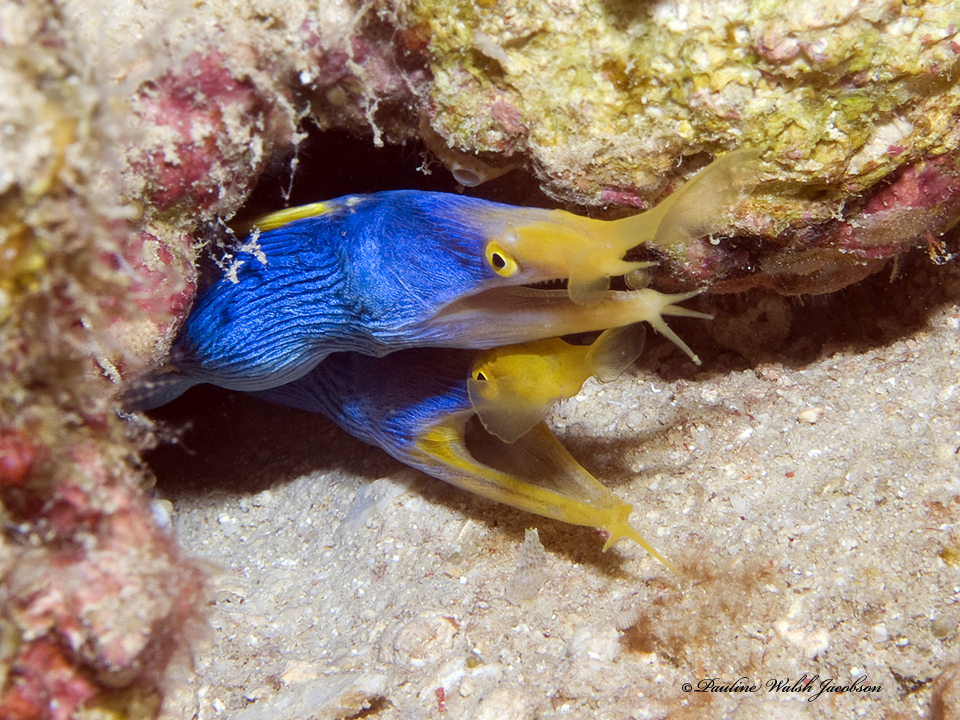
The Ribbon Eel (Rhinomuraena quaesita) is the only moray eel known to change sex routinely. Every individual starts life male, then transitions to female. The colour signals the stage: black (juvenile), vivid electric blue (adult male), yellow (female). It is unique to a single genus and Epic tier in Kaught.
The Ribbon Eel is one of the most visually striking animals on an Indo-Pacific reef: a metre of electric blue or vivid yellow, rippling gently in the current with the head extended from a sandy burrow. But the colour is not just decoration. It is a life-stage indicator, and what it indicates is biologically remarkable. The Ribbon Eel is a sequential hermaphrodite, and all the individuals you will ever see as blue males will one day become yellow females.
The three colour phases and what they mean
The Ribbon Eel passes through three visually distinct phases in its life, and each is a different functional sex or pre-sexual stage:
- Juvenile (black with yellow dorsal stripe): small, immature, not yet reproducing. The black-and-yellow pattern is found in individuals under roughly 65 cm. Juveniles are occasionally described as a separate species in older literature.
- Adult male (electric blue with yellow dorsal fin, jaw edges and nostril tubes): sexually mature males, typically 65 to 94 cm. The blue is vivid and consistent, one of the brightest colorations of any reef fish. At this stage the animal produces sperm and can mate.
- Female (uniformly yellow): the final stage, reached after a sex change from the male phase. Females are typically the largest individuals and are yellow across the body, including the dorsal fin and head.
The transition from male to female is gradual and takes several weeks. The colour changes incrementally and the gonads reorganise from sperm-producing to egg-producing tissue. Once the change is complete, it does not reverse.
What is sequential hermaphroditism?
Sequential hermaphroditism is the strategy of functioning as one sex first and then permanently changing to the other. It is distinct from simultaneous hermaphroditism (being both sexes at once, as in earthworms) and from the developmental variation seen in some other species.
The Ribbon Eel's version, protandry, male first, then female, is shared by roughly 2% of fish species, most famously the clownfish (the species in the Nemo films, where adults are protandric: if the dominant female dies, the dominant male changes sex to replace her). In the Ribbon Eel, the entire population follows this direction, not just individuals responding to the loss of a partner.
Why would a fish evolve this?
The explanation is the size-advantage hypothesis, one of the most elegant ideas in evolutionary biology. In many reef fish, the benefit of being large is not equal across sexes. Being large as a female means you can produce many more eggs, larger, higher-quality eggs, greatly increasing your reproductive output. Being large as a male provides some advantage, but sperm are cheap and small males can still fertilise successfully.
For a species where this asymmetry holds, the optimal strategy for a long-lived individual is: spend the smaller, younger years as a male (still reproducing but with modest reproductive gain from added size), then switch to female once large enough to gain maximum reproductive benefit from size. This is exactly what the Ribbon Eel does.
The same logic runs in reverse in some species: protogynous hermaphroditism, female first, then male, occurs in fish where large males have outsized reproductive advantage through territory holding or combat. Wrasses and groupers are examples. The direction of the change tracks which sex benefits most from being large.
The leaf-nosed nostrils
The Ribbon Eel's most distinctive feature after its colour is the pair of greatly expanded anterior nostril tubes, flared and leaf-like, protruding from the tip of the snout. These are olfactory organs, not a feeding structure. The enormous surface area is adapted for detecting chemical signals, pheromones, prey cues, conspecific odours, in the water at very low concentrations.
All moray eels have enlarged anterior nostrils, a family trait. The Ribbon Eel takes this to an extreme degree that is unique within the family Muraenidae. It is the only member of the genus Rhinomuraena (the name means "nose moray"), a monotypic genus that has no close relatives with comparable nostril morphology. This makes it a striking example of character displacement: a trait present in modest form across a family, pushed to its maximum expression in a single lineage.
Habitat and behaviour
The Ribbon Eel is a burrowing species. It lives with its body coiled in a sand or rubble burrow, the head and first 20 to 30 cm of body projecting into open water, swaying with the current. The burrow is its shelter, retreat and home range. Individuals can occupy the same burrow for months.
It is found across the tropical Indo-Pacific from the Red Sea and East Africa east to Japan, the Philippines, Indonesia, Australia and Pacific islands, at depths of 1 to 57 m. It prefers reef edges and sandy patches adjacent to coral structure rather than open sand flats or dense coral.
Diet is primarily small fish, ambushed when they pass the burrow entrance. The Ribbon Eel opens its mouth suddenly to create a pressure wave that draws fish toward it, an inhalation strike, faster than it appears from the outside.
Sex change in the broader context of reef fish biology
The Ribbon Eel is not alone in changing sex on a reef. Clownfish, parrotfish, wrasses and groupers all include hermaphroditic species. What makes the Ribbon Eel distinctive is the combination: it is the only moray eel that changes sex routinely (other morays show occasional, poorly-documented sex variation), it does so unidirectionally across the entire population, and the change is directly visible as a dramatic colour shift across the whole animal.
The marbled newt offers a different take on developmental biology: an amphibian that can regrow a lost limb, an entirely separate mechanism but the same underlying theme of biological flexibility. For more extreme Indo-Pacific species, see the dragon seamoth, which sheds its entire outer skeleton rather than changing sex.
Ribbon Eel: frequently asked questions
Does the Ribbon Eel change sex?
Yes. All Ribbon Eels begin life as males, then transition to female as they mature. The colour change is visible: adult males are vivid electric blue with a yellow dorsal fin; females are uniformly yellow. The transition takes weeks and is irreversible.
What do the different colours mean?
Colour indicates life stage. Juveniles: black with a yellow dorsal stripe. Adult males: vivid electric blue with yellow dorsal fin, jaw edges and nostril tubes. Females: uniformly yellow. Each colour is a different functional phase of the same individual's life.
Why does the Ribbon Eel change sex?
The size-advantage hypothesis: being large as a female confers greater reproductive benefit (more and larger eggs) than being large as a male. By starting male when small, then switching to female once large, individuals maximise lifetime reproductive output.
Where does the Ribbon Eel live?
In tropical Indo-Pacific reefs from the Red Sea and East Africa east to Japan, Australia and the Pacific Islands, at depths of 1 to 57 m. It lives in burrows in sandy or rubble seafloor with the head and front quarter of the body extended.
Is the Ribbon Eel dangerous?
No. It is non-aggressive and retreats into its burrow if approached. It can bite defensively if a hand is placed near the burrow entrance, but unprovoked attacks do not occur.
What are the leaf-like structures on the Ribbon Eel's nose?
Greatly enlarged anterior nostril tubes, adapted for detecting chemical signals in the water. All moray eels have enlarged nostrils; the Ribbon Eel takes this to an extreme unique within the family. The genus name Rhinomuraena means "nose moray."
The next thing you see could be
your first catch.
Kaught is live on the App Store and Google Play. Free to start, and your first catch is one photo away.
Free to start · Live on the App Store and Google Play
Species data, type, rarity tier and measurements, is drawn from the Kaught catalog, built on open biodiversity records from GBIF and iNaturalist. Rarity reflects how often a species is observed in the wild, not its conservation status.