
Legendary spotlight
Grey Wolf: the apex canid and the ancestor of every dog on Earth
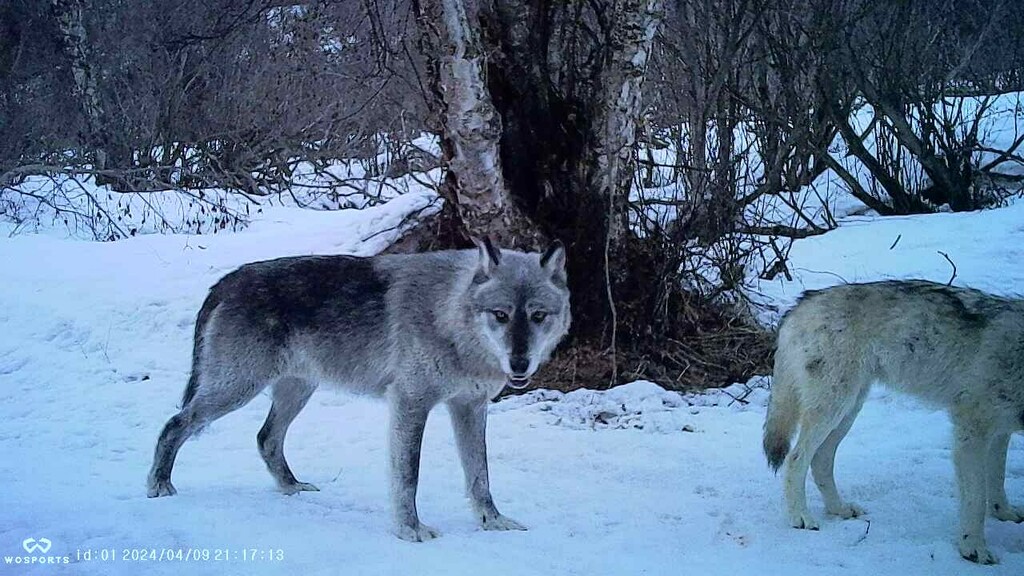
The grey wolf (Canis lupus) is the most wide-ranging wild land predator on Earth: a large, cooperative pack hunter found across the Northern Hemisphere from North America to East Asia. It is also the direct ancestor of every domestic dog, from a Chihuahua to a Great Dane.
The grey wolf is the template from which every dog on Earth was drawn. It hunts moose in Canadian boreal forest, reindeer on Arctic tundra and wild boar in European woodland. It lives in every cold and temperate habitat in the Northern Hemisphere where prey is large enough to bother with. And it is among the hardest animals in the Kaught catalog to ever see in the wild: not because it is rare, but because it actively chooses not to be seen.
How to identify a grey wolf
Size is the first clue. A grey wolf stands 60–90 cm at the shoulder and weighs 25–70 kg, depending on latitude and sex: males from northern populations routinely outweigh a large German Shepherd by 20 kg. The build is unmistakably powerful: a deep chest, long legs, enormous paws and a broad, domed head.
The coat varies widely. Arctic wolves are white; central European and North American wolves are most often grey-brown; some populations include pure black individuals. The key field mark at distance is the tail: straight, held horizontal or low, never curled over the back. A curled tail means dog.
The face has a broad forehead and a distinctive mask where darker fur around the eyes and muzzle contrasts with pale cheeks. The ears are erect, medium-sized and rounded, not the tall pointed ears of a German Shepherd. The stride is direct and fluid, the front and back paw prints falling almost in a single line, an efficient trot that can be sustained for hours.
Where grey wolves live
The grey wolf has the widest natural range of any wild land mammal other than humans. It occupies boreal forest, tundra, mountain ranges, steppe and even semi-desert, from Alaska and Canada across the American West, through the forests of eastern Europe, the mountains of southern Europe, Russia, Central Asia, China, Mongolia and the Korean Peninsula.
Wolves need two things: large ungulate prey and enough space. A pack's territory ranges from 80 km² in prey-rich forest to over 2,000 km² on Arctic tundra, where caribou herds move across vast distances. Within that territory, the pack travels constantly, covering 20–50 km in a night.
In recent decades, wolves have returned naturally to parts of western Europe, including Germany, France, Switzerland and the Netherlands, spreading from a remnant population in the Italian Apennines.
How wolf packs hunt
The pack is the wolf's primary adaptation. A single wolf can kill a deer or a young moose, but a pack can take an adult bull moose, the largest deer on Earth. The strategy is cooperative endurance hunting: locate a herd, select an individual, chase it to test for weakness, then close in once a vulnerable animal is identified.
Individual pack members take turns leading the chase, rotating to the front as others fall back to recover. The pursuit can last for hours over many kilometres. Once the prey tires, the pack surrounds it, and the kill is made with bites to the throat or nose. The alpha pair feeds first; subordinates follow a strict but flexible hierarchy.
Wolves also scavenge and will cache surplus food, returning to buried kills when hunting is poor. A pack of eight can kill one large ungulate per week on average in productive habitat.
Communication: the howl
Wolf howls carry up to 10 km and serve three purposes: to reassemble a scattered pack, to advertise territory to neighbouring packs, and to coordinate before a hunt. Each wolf's howl is individually distinct. Pack members recognise one another by voice and will howl in chorus, the overlapping harmonics making the group sound larger than it is.
Body language and scent are equally important at close range. A dominant wolf holds its tail high and ears erect; a subordinate tucks its tail and lowers its body. Scent marks on trees and rocks announce pack identity, reproductive status and the freshness of a patrol.
The dog connection
Every domestic dog on Earth (Canis lupus familiaris) is a grey wolf. Not descended from wolves: is a wolf, reclassified as a subspecies. Grey wolves and domestic dogs share 99.9% of their mitochondrial DNA, have identical chromosome counts and can still produce fertile offspring together.
Domestication occurred at least 15,000 years ago, probably in East or Central Asia, from a now-extinct wolf population. The exact process is debated: some researchers favour deliberate taming by early humans; others favour self-domestication, in which wolves that were less fearful of people gained access to camp scraps and gradually diverged. What is not debated is the result: the dog is the oldest domesticated animal on Earth, predating cattle, sheep and crops by several thousand years.
Why it earns the Legendary tier
The Kaught catalog assigns rarity based on how often a species turns up in real-world observations, not on conservation status. Grey wolves are present across an enormous range, but they live at low density, are largely crepuscular and nocturnal, and actively avoid people. In areas where they are hunted, they become almost entirely nocturnal and keep well away from roads and settlements.
Most people who live in wolf country go their entire lives without a close, unambiguous sighting. A genuine encounter in the wild, not a distant shape across a valley but a real look at a real wolf, earns four diamonds in the catalog. See also: Eurasian Lynx and nocturnal animals for the challenge of finding the continent's other apex predators, and the golden jackal for the smaller wild canid now spreading north and west across Europe into wolf country.
Three facts about grey wolves worth knowing
- A wolf's jaw can generate a bite force of around 1,500 psi, roughly double that of a German Shepherd, strong enough to crush the leg bone of a moose in a single bite.
- Pack size averages 5–10 animals but varies enormously: packs of 20–30 have been recorded in Yellowstone where bison are the primary prey.
- Wolves that leave their birth pack in search of a mate are called dispersers; they have been tracked travelling over 1,000 km alone before founding a new pack.
Grey wolf: frequently asked questions
What does a grey wolf look like?
A large canid, 60–90 cm at the shoulder, with a deep chest, long legs, broad domed head and a straight tail held low or horizontal. Coat colour ranges from white in Arctic populations to grey, brown or black further south. Size and a non-curling tail distinguish it from any domestic dog.
Where do grey wolves live?
Across the Northern Hemisphere: boreal forest and tundra in North America, forest and mountain ranges across Europe, and steppe, taiga and mountain habitat through Russia, Central Asia and East Asia. They occupy almost every cold and temperate habitat where large prey is present.
How do wolf packs hunt?
Cooperative endurance hunting. Packs locate a herd, select an individual and chase it over distance, testing for weakness. Wolves rotate at the front to conserve energy, close in once prey tires, and bring it down with bites to the throat or nose. A pack can take prey many times the size any single wolf could kill.
Are grey wolves dangerous to humans?
Healthy wild wolves virtually never attack people. Documented attacks are extremely rare and almost always involve wolves that have lost their natural wariness through being fed. Where wolves are hunted they flee people entirely. The risk from wild wolves is negligible.
Is the domestic dog a grey wolf?
Yes. The domestic dog (Canis lupus familiaris) is a subspecies of grey wolf. They share 99.9% of mitochondrial DNA, have identical chromosome counts and can still interbreed. Domestication occurred at least 15,000 years ago, making the dog the oldest domesticated animal on Earth.
Why is the grey wolf Legendary in Kaught?
Kaught's rarity reflects how often a species is actually observed in the wild, not its conservation status. Grey wolves live at low density, are largely nocturnal and actively avoid people. A genuine unambiguous close encounter in the wild is exceptional, placing the grey wolf at the Legendary tier.
The next thing you see could be
your first catch.
Kaught is live on the App Store and Google Play. Free to start, and your first catch is one photo away.
Free to start · Live on the App Store and Google Play
Species data, type, rarity tier and measurements, is drawn from the Kaught catalog, built on open biodiversity records from GBIF and iNaturalist. Rarity reflects how often a species is observed in the wild, not its conservation status.