
Behaviour explainer
African wild dog: the pack hunter that succeeds where lions and hyenas fail
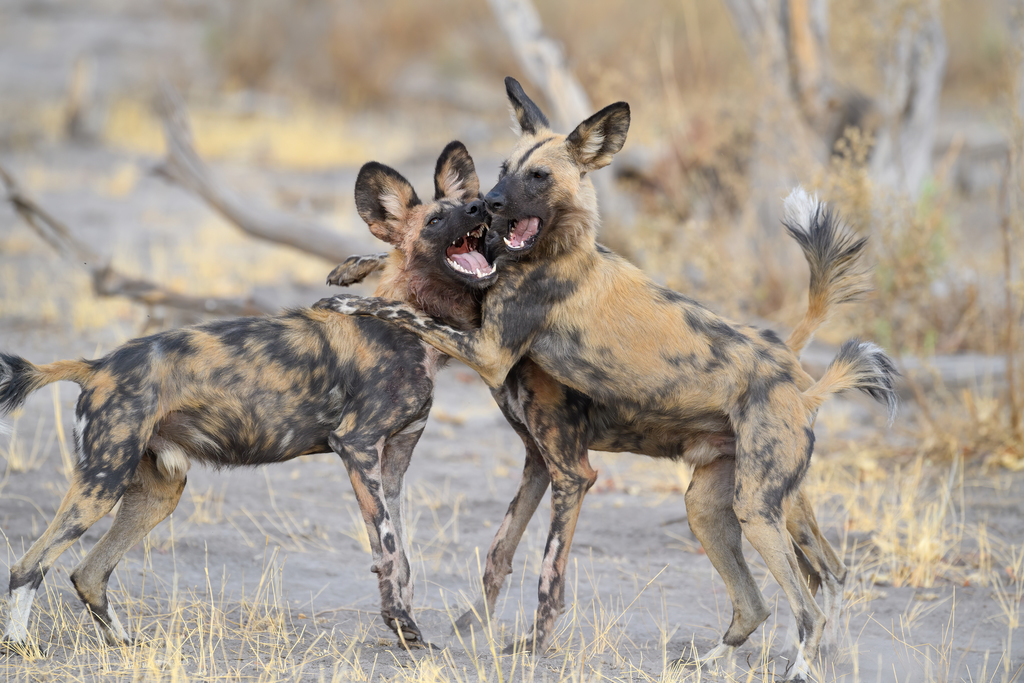
The African wild dog (Lycaon pictus) succeeds on roughly 80% of hunts, making it the most effective large pack predator on Earth. It achieves this through endurance running, constant communication and a social structure so cooperative that the pack feeds injured and sick members before itself. It is not a dog, wolf or hyena: it belongs to its own genus with a completely separate evolutionary history.
Lions get the headlines but the numbers tell a different story. A lion pride succeeds on roughly one in five hunts. A pack of African wild dogs succeeds on four in five. The gap is not explained by speed or strength, neither of which the wild dog has in excess. It is explained by cooperation, endurance and the kind of social intelligence that treats every pack member as worth keeping alive.
How to identify an African wild dog
The coat is the first and most reliable field mark. Each African wild dog is painted with a unique pattern of black, white and yellow-brown blotches, no two individuals identical. The scientific name Lycaon pictus means "painted wolf-like animal". The large, rounded ears, broader and more disc-like than a domestic dog's, sit high on the head and swivel independently to track sound. The muzzle is black, the tail usually white-tipped, and the legs are long and slender, built for distance rather than explosive power.
Size is roughly that of a large domestic dog: 17 to 36 kg, with males and females similar in weight. The build is lean and athletic, with a deep chest for aerobic capacity and relatively small feet. Unlike every other canid except the cheetah, the African wild dog cannot retract its claws, and its foot structure, with four toes rather than five on the front feet, is another distinction from wolves and dogs.
The 80% hunt: why endurance beats ambush
Most large predators are sprint hunters or ambush specialists. The leopard closes a gap in a short explosive burst. Lions work as a group but the final lunge is still brief. African wild dogs work on a completely different model: they run their prey into the ground.
A hunt typically begins with the pack converging on a herd and identifying a target. Once selected, that animal is chased continuously at 50 to 60 km/h. Dogs at the front of the pursuit rotate back as they tire, replaced by fresher pack members who have been running behind. The effect is a relay: the prey animal runs flat-out without rest, while no single dog ever fully exhausts itself. Chases typically cover 2 to 5 km but can extend to 10 km in open terrain. Eventually the prey animal slows, and the pack closes.
During the chase, constant high-pitched contact calls keep the pack coordinated. Faster dogs can circle ahead to cut off escape routes. The whole operation is collaborative in a way that distinguishes it from even the most coordinated lion pride hunt.
Social structure: the pack as a single organism
A pack is led by a dominant breeding pair. Non-breeding pack members, often the offspring of previous years, act as helpers: they guard the den while pups are young, bring food back by regurgitating it, and care for injured or sick individuals. A dog that cannot walk is fed by healthy pack members until it recovers or dies. Pack cohesion runs so deep that members have been observed refusing to abandon injured companions during hunts.
Before each hunt, the pack engages in a greeting ceremony: a brief, excited bout of touching muzzles, pressing flanks and vocalising together. Studies suggest this serves as a kind of vote on whether to begin the hunt, with more participation correlating to the pack actually departing. It may be the closest thing observed to collective decision-making in a non-primate carnivore.
Litters can number up to 21 pups, the largest of any canid. The entire pack participates in raising the young, and pups take priority at feeding time over all but the breeding pair.
Diet and prey
The primary prey across most of the range is impala, wildebeest calves and similar medium-sized ungulates, but pack size determines what the dogs can tackle. Large packs in good prey areas regularly take adult wildebeest and zebra. A single dog catching a hare is also common and contributes meaningfully to an individual's energy budget.
Unlike hyenas, African wild dogs almost never steal from other predators. If a kill is usurped by lions or a hyena clan, the pack retreats and hunts again. Their high success rate makes this less costly than a confrontation: another kill is usually accessible within hours.
Range and where to find them
African wild dogs once ranged across most of sub-Saharan Africa. Today they are concentrated in southern Africa and the Serengeti-Mara ecosystem. Botswana, Zimbabwe, Tanzania and Kenya hold the largest remaining populations. Large national parks and wildlife conservancies with intact prey populations are the best places to look.
They are active at dawn and dusk, and sometimes through cooler midday periods. A pack at rest is easy to approach; a pack on a hunt is one of the fastest-moving spectacles on the savanna, covering ground quickly enough to leave vehicles behind on poor roads.
The Kaught catalog records African wild dogs at the Common tier based on observation frequency across their range. This is a reminder that in the catalog, tier reflects recording frequency rather than how familiar an animal feels. Wild dog sightings in core habitat are reasonable; outside protected areas they are much harder to find.
African wild dog: frequently asked questions
What is an African wild dog?
A large, highly social canid found in sub-Saharan Africa with a unique mottled black, white and yellow-brown coat, large rounded ears and a white-tipped tail. It belongs to its own genus, Lycaon, separate from wolves and dogs, and weighs 17 to 36 kg.
Why are African wild dogs such successful hunters?
Their success rate of around 80% comes from endurance rather than speed. The pack chases prey at 50 to 60 km/h for up to 5 km, rotating which dog leads so no single animal tires, while the prey runs flat-out without rest until it slows enough for the pack to close.
What do African wild dogs eat?
Primarily medium-sized ungulates: impala, wildebeest calves, gazelles and reedbuck. Large packs can take adult wildebeest and zebra. Smaller prey including hares is taken opportunistically by individual dogs.
Are African wild dogs related to domestic dogs?
No. The African wild dog belongs to its own genus, Lycaon, with a single living species. Despite the name, it is not a direct ancestor or close relative of domestic dogs and has evolved entirely independently.
How do African wild dogs communicate?
Through high-pitched contact calls including a distinctive 'hoo' to regroup scattered pack members, and body language including muzzle-touching and flank-pressing. The unique coat pattern of each individual may also help pack members identify each other at a distance during a hunt.
Where do African wild dogs live?
Open savanna, woodland and arid zones across sub-Saharan Africa. The largest populations today are in Botswana, Zimbabwe, Tanzania and Kenya. They require large territories and healthy prey populations, and are mostly found inside national parks and wildlife conservancies.
The next thing you see could be
your first catch.
Kaught is live on the App Store and Google Play. Free to start, and your first catch is one photo away.
Free to start · Live on the App Store and Google Play
Species data, type, rarity tier and measurements is drawn from the Kaught catalog, built on open biodiversity records from GBIF and iNaturalist. Rarity reflects how often a species is observed in the wild, not its conservation status.