
Evolution story
Why Female Butterflies Look Different From Males
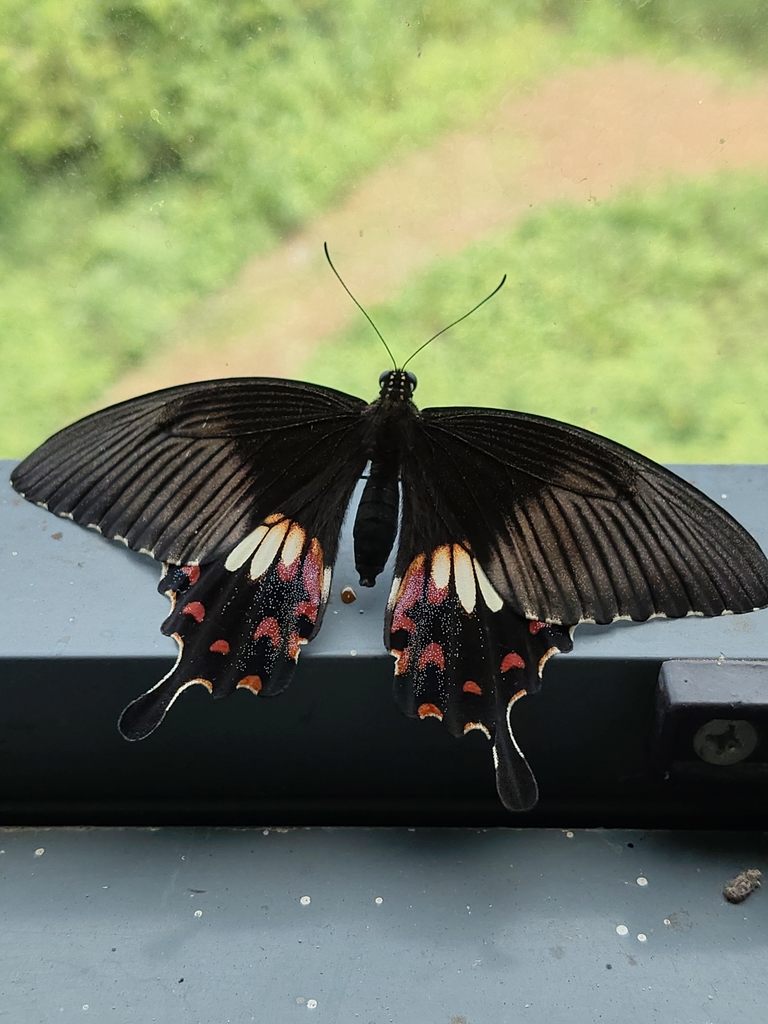
Why do female butterflies look different from males? In the Common Mormon swallowtail (Papilio polytes), some females keep the male's plain black-and-white pattern. Others become near-perfect copies of a toxic species, a disguise called Batesian mimicry, switched on by a single gene built around her own sex-determining gene.
Put a male and a female Common Mormon swallowtail side by side and you might assume they're two different species. Every male looks the same: black wings crossed by a band of white spots, no tails, nothing unusual. The female can match him exactly, or she can be something else entirely, a near-perfect double of a completely different, toxic butterfly. Why do female butterflies look different from males here, when in most species they don't? The short answer is that evolution handed females an escape hatch the males never needed, and recent genetics explains exactly how she opens it.
Why do female butterflies look different from males?
In most swallowtails, males and females wear the same pattern, just as male Common Mormons always do. But female Common Mormons (Papilio polytes) are polymorphic: each one develops into one of several possible forms. Some match the male's plain black-and-white pattern. Others are paler and more rounded, with red and pink spotting along the hindwing and long tails trailing from each wing tip, a pattern borrowed almost wholesale from a toxic species sharing her range. Where predators have already learned to avoid that toxic look, the mimetic females get an easier ride.
Meet the butterfly she's copying
The model is usually a rose swallowtail in the genus Pachliopta, a group whose caterpillars feed only on Aristolochia vines and store the plant's aristolochic acids for life. A bird that bites into one gets a mouthful of poison it won't forget, and it quickly learns to leave anything with that red-spotted, white-flashed wing pattern alone. The mimetic Common Mormon female carries no toxin of her own. She's simply dressed for the part, a textbook case of Batesian mimicry: a harmless species borrowing the warning colours of a dangerous one, at no biological cost beyond growing the right pattern.
The gene that rewrites her wings
For decades biologists knew the mimicry switch was inherited as if it were a single gene, passed down as one block rather than scattered across many traits. In 2014, researchers sequencing the Common Mormon's genome traced the switch to doublesex, the very gene that determines whether a butterfly develops as male or female in the first place. A cluster of linked genetic differences around doublesex, inherited together as one unit known as a supergene, acts like a single dimmer switch bolted onto the wing-pattern machinery, flipping an entire wing design on or off in one move instead of requiring dozens of separate mutations to line up.
Why only females mimic, never males
No male Common Mormon has ever been recorded wearing the mimetic pattern; the switch only does anything inside a female body. A few things are thought to keep it that way. Females fly lower and slower than males because they carry eggs, so a convincing disguise pays off more for her than for him. Males rely on recognising the plain black-and-white pattern to find mates of their own species, so a mimetic male would struggle to get recognised at all. And mimicry only works while the toxic model stays more common in the air than its copies; if every female wore the disguise, predators would eventually learn the pattern is often a bluff. Keeping some females in the ordinary pattern, alongside the mimics, spreads that risk across the population.
Where to find the Common Mormon swallowtail
Common Mormons are garden and orchard butterflies across South and Southeast Asia, from India and Sri Lanka through southern China to Taiwan and Indonesia. Caterpillars feed on citrus leaves (lime, lemon and orange trees), which makes the species a familiar, sometimes unwelcome, visitor to fruit growers, though the damage rarely amounts to much on a mature tree. Adults are fast, strong fliers that visit flowers through the heat of the day and roost low in shrubs overnight. Which female pattern turns up, and how common the mimetic form is, shifts from place to place depending on which toxic model lives locally.
How rare is the Common Mormon swallowtail in Kaught?
In the Kaught catalog the Common Mormon swallowtail sits at the Common tier, one diamond out of four. As with every species in the catalog, that reflects how often it's actually logged in the wild, not any judgement about its future. It's a familiar, fast-breeding garden butterfly across a huge stretch of Asia, so sightings pile up quickly, male and female alike, whichever pattern she happens to be wearing that generation.
For more on one species borrowing another's colours to survive, see how chameleons change colour for a completely different trick, and the mimic filefish, a reef fish that copies a toxic pufferfish the same way. The monarch butterfly's own mimicry story, with the viceroy copying it, pairs well with this one, and the blueface angelfish shows a reef fish rewriting its whole pattern for a different reason: growing up.
Why female butterflies look different: frequently asked questions
Why do female butterflies look different from males?
In species like the Common Mormon swallowtail, females carry an extra genetic switch males do not use. It lets some females copy the wing pattern of a toxic butterfly that predators already avoid, a disguise called Batesian mimicry, while males always keep the same ordinary pattern.
What is Batesian mimicry?
Batesian mimicry is when a harmless species evolves to look like a dangerous or toxic one, borrowing the warning colours without the actual toxin. Predators that have learned to avoid the toxic model also avoid its harmless copy, at no biological cost to the mimic.
Is the Common Mormon swallowtail poisonous?
No. It carries no toxin of its own. Mimetic females simply resemble a toxic Pachliopta rose swallowtail that does carry poison from its caterpillar's toxic host plant, which is enough to make predators avoid both species.
Why don't male Common Mormon butterflies mimic too?
Males rely on a single recognisable pattern so other Common Mormons can identify them as mates, and mimicry only works if the toxic model stays more common in the air than its copies. Keeping males uniform, and only some females mimetic, protects both jobs at once.
What triggers which pattern a female gets?
A supergene built around the doublesex gene, the same gene that sets her sex in the first place. A cluster of linked genetic differences near doublesex is inherited as a single switch, flipping her entire wing pattern between the ordinary form and the mimetic one.
Where does the Common Mormon swallowtail live?
Gardens, citrus orchards and forest edges across South and Southeast Asia, from India and Sri Lanka to southern China, Taiwan and Indonesia. Caterpillars feed on citrus leaves, making it a familiar visitor to fruit growers across its range.
The next thing you see could be
your first catch.
Kaught is live on the App Store and Google Play. Free to start, and your first catch is one photo away.
Free to start · Live on the App Store and Google Play
Species data, type, rarity tier and measurements, is drawn from the Kaught catalog, built on open biodiversity records from GBIF and iNaturalist. Rarity reflects how often a species is observed in the wild, not its conservation status.