
Exotic spotlight
Dragon Seamoth: the armoured fish that walks on its fins
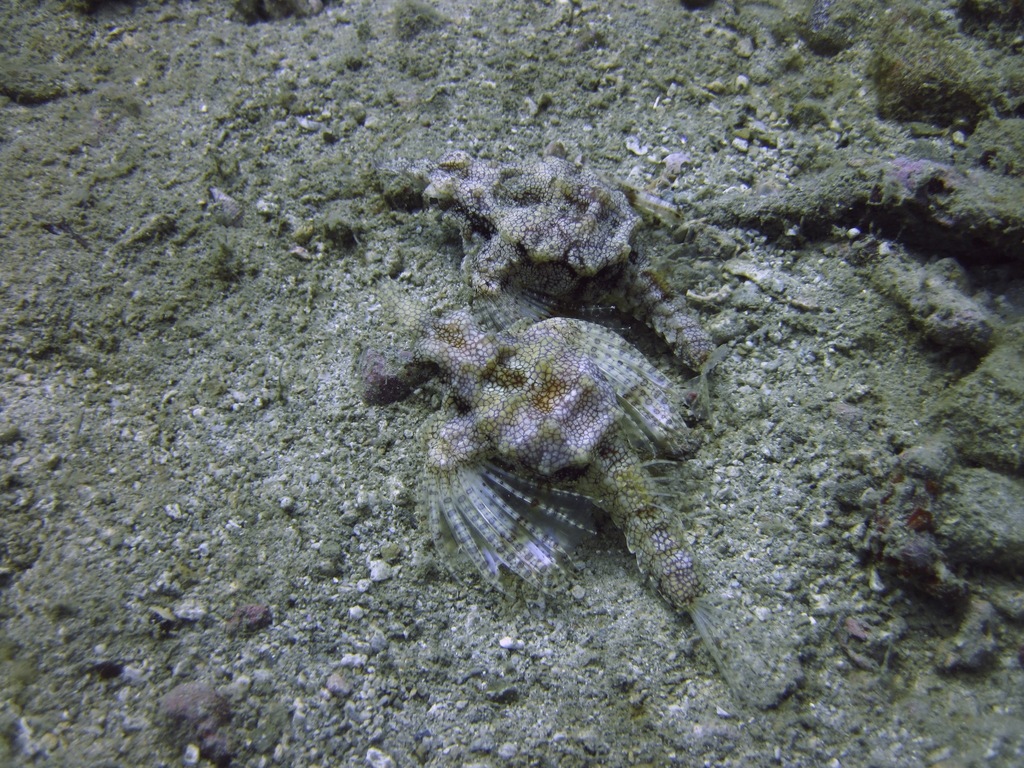
The Dragon Seamoth (Eurypegasus draconis) is a tiny armoured fish of Indo-Pacific reefs that walks across the seafloor on leg-like pelvic fins, sheds its entire outer skeleton periodically to shed parasites, and pairs for life. Legendary tier in Kaught: a confirmed sighting is genuinely rare.
Most fish you can name swim. The Dragon Seamoth walks. It moves across sandy, rubble-strewn seafloor on a pair of modified pelvic fins that have become articulated, limb-like structures, pushing it forward in a slow, deliberate stroll. It is one of the strangest locomotion strategies in the vertebrate world, and one of the least-observed animals in the Kaught catalog.
What does a Dragon Seamoth look like?
Small, flat and encased in armour. The body is entirely enclosed in fused bony plates, giving it a rigid, box-like profile roughly 15 cm long. The pectoral fins spread wide like wings or a manta's pectorals, horizontally, adding to the impression of something more like an armoured spacecraft than a fish. The face is distinctly dragon-like: a flattened, projecting snout with a small downward-facing mouth, and eyes set high on the head.
Colouring varies from sandy beige to mottled brown, matching the substrate closely. The wing-like pectoral fins sometimes show faint stripes or spots. The pelvic fins, the walking legs, are smaller and tucked underneath.
How it walks
The pelvic fins of most fish are used for stability and slow manoeuvring. In the Dragon Seamoth, each has evolved into a rigid, segmented rod with articulated rays at the tip. The fish places these on the substrate and walks in an alternating gait, left-right-left, much like a slow-motion tetrapod. It can swim when it needs to, using the broad pectoral fins, but swimming appears to be reserved for escaping threats. Routine movement is entirely pedestrian.
It forages as it walks, pointing the rostral snout downward into sand and debris to pick out tiny crustaceans, worms and small invertebrates. The mouth is small and the feeding style methodical.
The shed that no other vertebrate performs
Living inside a bony exoskeleton creates a problem: things settle on it. Algae, parasites and encrusting organisms colonise the rigid surface over time, and the fish cannot groom them off. The Dragon Seamoth's solution is radical: it sheds its entire outer skeleton in one piece, a process called ecdysis, observed in crustaceans but not in any other vertebrate. The fish emerges from the old armour, which lifts free as a complete hollow cast of the body, and regrows a fresh, clean set of plates over the following weeks.
This was first documented in aquarium specimens and has since been observed in the wild. It is the only vertebrate known to routinely moult a mineralised external skeleton.
Pairing behaviour
Dragon Seamoths have been observed living in stable pairs over the same patch of seafloor for extended periods. A pair forages together, rests in proximity and appears to synchronise daily routines. Pair bonds in fish are unusual, and long-term pairing on a defended territory is especially rare outside of coral reef species such as some seahorses and jawfish. Whether this fidelity persists across full breeding seasons is still being studied.
Spawning takes place in open water: the pair rises from the substrate, releases eggs and sperm, then returns. Larvae are pelagic before settling to the benthic adult lifestyle.
Where and when to look
The Dragon Seamoth's range spans tropical Indo-Pacific shallows: Red Sea, East Africa, the Indian Ocean, Southeast Asian reef systems, Japan and northern Australia. It favours sandy rubble areas at the base of reefs or on open flats between patch reefs, typically at 1 to 50 metres depth. It does not sit on coral; it is a seafloor animal.
Finding one takes patience and a slow pace. The camouflage is excellent. Experienced divers scan sandy patches systematically, looking for the slightly raised outline and the subtle movement of the walking fins. Many divers report swimming directly over Dragon Seamoths without noticing them. The Legendary tier in Kaught reflects this: a confirmed, clear sighting of this species in citizen-science records is uncommon even among dedicated reef divers.
Three things that make this fish genuinely unusual
- It walks, not swims. The articulated pelvic fins are one of the clearest examples of functional limb evolution in living fish, short of the full transition seen in the fossil record.
- It sheds a vertebrate exoskeleton. No other living vertebrate is known to moult a complete mineralised outer skeleton; this is a behaviour we associate with arthropods, not fish.
- It is the only member of its genus. Eurypegasus draconis has no close relatives in the same genus; the broader family Pegasidae contains only five species total, all unusual.
For more on the extremes of the animal kingdom, see our strongest animals in the world ranking, or read about the fire salamander, another species with a surprisingly strange biology. The ribbon eel is another Indo-Pacific marine species with a biology that defies expectations.
Dragon Seamoth: frequently asked questions
What is a Dragon Seamoth?
A small Indo-Pacific marine fish, up to 15 cm long, encased in rigid bony armour and equipped with modified pelvic fins it uses to walk across the seafloor. Legendary tier in the Kaught catalog, among the rarest-observed marine fish.
Where does the Dragon Seamoth live?
In shallow tropical and subtropical Indo-Pacific waters, from the Red Sea and East Africa east to Japan and Australia, on sandy or rubble seafloor near reefs, typically at 1 to 50 metres depth, often partially buried.
How does the Dragon Seamoth move?
It walks. Its pelvic fins have evolved into leg-like appendages with articulated rays that push against the substrate in an alternating gait. It can swim but mostly strolls along the bottom foraging for tiny crustaceans and worms.
Why does the Dragon Seamoth shed its skin?
Its bony outer plating cannot grow, so it sheds the entire rigid outer skeleton in one piece to remove algae and parasites. It then regrows the armour. No other vertebrate is known to do this.
Why is the Dragon Seamoth Legendary in Kaught?
Kaught's rarity tier reflects how often a species is actually observed in the wild. The Dragon Seamoth's excellent camouflage, preference for sandy rubble away from busy reef walls and naturally small size make confirmed sightings very rare in citizen-science records, placing it at Legendary.
Is the Dragon Seamoth dangerous?
No. It is entirely harmless: a small, slow, camouflaged bottom-dweller with no venom and no aggressive behaviour toward people. Its only defence is to stay very still and look like the seafloor.
Do Dragon Seamoths mate for life?
Observations show stable pairs foraging and resting together over extended periods. Whether this constitutes strict long-term monogamy is still under study, but prolonged pair bonding is well documented and unusual for a benthic fish.
The next thing you see could be
your first catch.
Kaught is live on the App Store and Google Play. Free to start, and your first catch is one photo away.
Free to start · Live on the App Store and Google Play
Species data, type, rarity tier and measurements, is drawn from the Kaught catalog, built on open biodiversity records from GBIF and iNaturalist. Rarity reflects how often a species is observed in the wild, not its conservation status.