Evolution story
Mexican Caecilian: the amphibian that lost its legs 250 million years ago and never looked back
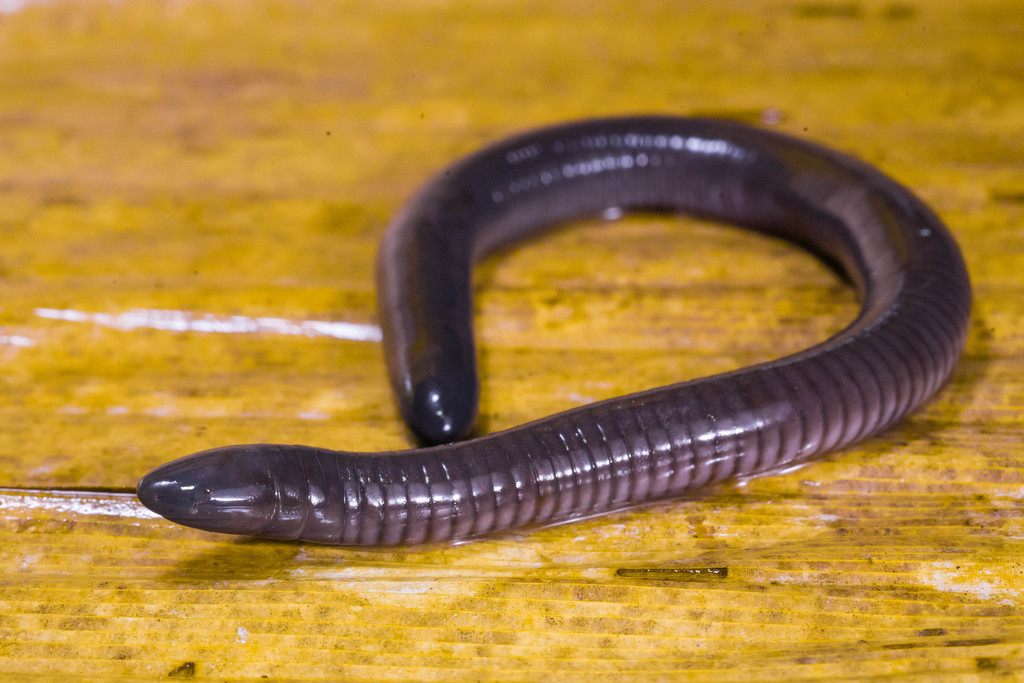
The Mexican caecilian (Dermophis mexicanus) belongs to the third order of amphibians: limbless, burrowing Gymnophiona that lost their legs roughly 250 million years ago. This legendary-tier species lives underground in Central American forest soils, gives birth to live young, and feeds them by regrowing a nutrient-rich skin layer for them to strip and eat every three days.
Most people know two orders of amphibians: frogs and salamanders. There is a third. Caecilians (order Gymnophiona) are entirely legless, largely subterranean, and almost completely unknown outside herpetology. The Mexican caecilian is one of the most derived and remarkable members of this hidden order, a four-diamond Legendary-tier catalog species that almost nobody has ever seen in the wild.
What is a caecilian?
Caecilians look like very large earthworms or, at a quick glance, snakes. They are neither. They are true amphibians with a smooth, annulated (ringed) body divided into segments called annuli, which resemble segments but are skin folds over solid muscle rather than true body divisions. Over 220 species are described, from 7 cm aquatic forms to the 1.5 m giant terrestrial species of South America.
The name comes from the Latin word for blind: many species have tiny vestigial eyes covered by skin or bone. The Mexican caecilian has reduced eyes nearly invisible under the skin surface. Instead of vision it relies on a pair of unique sensory organs called tentacles, small extrudable pits between the eye and nostril that transmit chemical information directly to the olfactory receptors. No other vertebrate has this structure.
Compare this evolutionary path to that of the marbled newt or the fire salamander, both members of the salamander order with four limbs. Caecilians split from the salamander lineage before legs were fully established in the amphibian body plan, or lost them very early after the split, and have remained legless for the last 250 million years.
How caecilians lost their legs
The earliest known caecilian fossil, Eocaecilia micropodia from the Early Jurassic of Arizona, still had tiny limbs, confirming that the caecilian body plan started with legs and lost them. By the time the modern orders diversified in the Cretaceous, the limbs were gone. The evolutionary driver was almost certainly fossoriality: burrowing through dense soil selects strongly against protruding limbs, which create drag and cannot generate the forward thrust a streamlined, muscular cylinder can.
The skull became correspondingly reinforced. A caecilian skull is one of the most heavily braced and kinetically unusual of any vertebrate: bones are fused and thickened to transmit the force of driving the head into hard earth. Many caecilians have evolved a second jaw mechanism, the "dual-jaw" kinetics of the Dermophiidae family, in which the front of the skull operates as a second independent set of jaws that can anchor into the soil while the body muscles push forward. The ability to move through a medium that would challenge any other vertebrate rests on this anatomy.
The Mexican caecilian's reproductive strategy
Most caecilians lay eggs in moist soil or give birth to live young that have completed metamorphosis in the womb. The Mexican caecilian is viviparous: females gestate live young internally for 9 to 11 months. Fetal caecilians in the womb develop specialised teeth that scrape a glandular secretion from the oviduct wall for nutrition before birth, a process called oviduct feeding.
After birth, the behaviour becomes even more unusual. The mother grows a thick outer skin layer, visibly whitened by nutrient-rich lipids, in a cycle every 2 to 3 days. The juveniles, still equipped with their specialised neonatal teeth, peel and eat this entire outer skin layer together. The mother then regrows it. The process repeats for several weeks, the mother losing up to 15% of her body mass over the provisioning period as her young put on weight. This is dermatophagy: skin-eating as a parental feeding strategy, and the only confirmed example of this behaviour in any vertebrate other than one other caecilian species.
Venom and weaponry underground
Caecilians were confirmed in 2024 to possess glands associated with their teeth that secrete toxic mucus, making some species weakly venomous: the first documented dental venom glands in any amphibian. The Mexican caecilian has sharply recurved teeth in two rows, designed to grip earthworms and soil invertebrates that it encounters by smell and tentacle-chemoreception during burrowing hunts. The bite is not medically dangerous to humans but the teeth are functionally designed to hold prey firmly against the pulling resistance of flight through soil.
Finding a Mexican caecilian
The realistic answer is: you probably will not. The Mexican caecilian is a Legendary-tier species in the Kaught catalog, four diamonds out of four, reflecting near-zero detection rates in wild observation records. The iNaturalist database, with hundreds of millions of total records, holds barely 200 confirmed sightings of the entire genus Dermophis.
They surface occasionally after heavy rain, when soil saturation forces them upward. Remote roads and tracks through lowland humid forest in Mexico's Gulf Coast states (Veracruz, Tabasco, Chiapas) and Central America (Guatemala, Belize, Honduras) are the most likely encounter sites, usually after a downpour at night. Most people who have seen one in the wild stumbled on it by accident.
The catalog species most comparable in discovery difficulty are the burrowing amphibians like the caecilian's relatives, but even the fire salamander and marbled newt surface regularly to breed. The Mexican caecilian has no such seasonal surface period. It is, by most measures, the most cryptic vertebrate in this catalog.
Mexican Caecilian: frequently asked questions
What is a caecilian?
A caecilian is a legless, burrowing amphibian belonging to the order Gymnophiona, the third order of amphibians after frogs and salamanders. Over 220 species are known, all fossorial or aquatic. They are not snakes or worms: they are true amphibians with a lineage stretching back 250 million years.
How did caecilians lose their legs?
Caecilians diverged from four-limbed ancestors 250 to 300 million years ago. Early fossils show tiny vestigial limbs. Adaptation to burrowing life drove the loss: limbs provide no advantage underground and create drag in dense soil. The skull simultaneously became heavily reinforced for head-first burrowing.
Are caecilians venomous?
Some species produce toxic secretions from glands near the teeth, confirmed in 2024 as the first dental venom glands in any amphibian. The Mexican caecilian has sharp, recurved teeth designed to grip prey underground. Its bite is not medically dangerous to humans.
How do caecilians move through soil?
By concertina movement: the body anchors at one point while muscular waves extend the head forward, then the rear catches up. Many caecilians also use a dual-jaw mechanism in the skull, the front of the skull anchors in the soil while body muscles push the rest of the animal forward.
How does the Mexican caecilian feed its young?
Mothers grow a thick, nutrient-rich outer skin layer that juveniles strip and eat every three days using specialised baby teeth. The skin regrows rapidly and the cycle repeats for several weeks. This dermatophagy is one of the most unusual parental feeding strategies known in any vertebrate.
Why is the Mexican caecilian Legendary in Kaught?
Legendary: four diamonds. The Mexican caecilian lives entirely underground, virtually never surfaces, and has almost no confirmed wild observation records. Kaught's rarity reflects observation frequency: for this species it is as close to zero as any animal in the catalog.
The next thing you see could be
your first catch.
Kaught launches soon. Join the waitlist and be first to start a collection of the living world, one photo at a time.
Free at launch · No spam, just one email on launch day
Species data, type, rarity tier and measurements, is drawn from the Kaught catalog, built on open biodiversity records from GBIF and iNaturalist. Rarity reflects how often a species is observed in the wild, not its conservation status.