
Adaptation explainer
The Glass Frog: the amphibian that hides its own blood to turn see-through
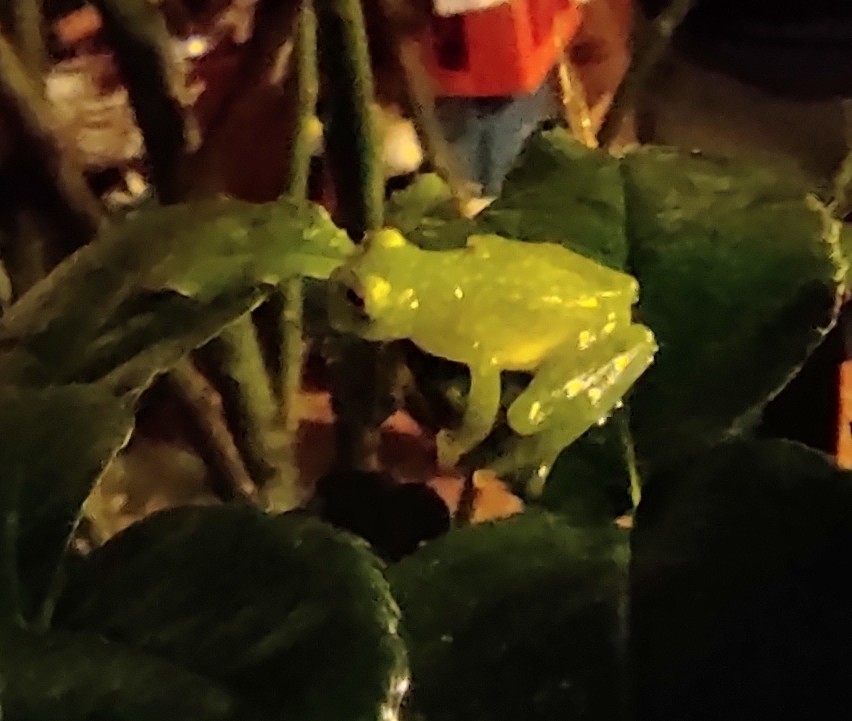
Fleischmann's glass frog (Hyalinobatrachium fleischmanni) sleeps with its belly turned nearly see-through. It pulls up to 89% of its red blood cells into its liver, hiding the red tint that would otherwise show through its skin, then lets its blood flow normally again the moment it wakes.
Hold a Fleischmann's glass frog up to the light and you can watch its heart beat. That is the reputation glass frogs have carried for decades: skin so clear you can see straight through to the organs underneath. But the full story of how a glass frog turns transparent, and how much of it is genuinely see-through, is stranger and more recent than the folklore suggests. Most of it was only caught in the act by a single 2022 study that finally measured the trick while it happened.
How a glass frog turns transparent
Researchers studying Fleischmann's glass frog used calibrated colour photography to repeatedly measure the transparency of eleven individual frogs across five states: deep sleep, normal waking activity, calling to mates, after exercise, and under anaesthetic. The sleeping frogs came out dramatically clearer, between 34% and 61% more transparent on their undersides than during waking activity. Optical spectroscopy pinned down the cause: circulating red blood cells dropped by as much as 89% while the frogs slept, and that missing blood hadn't gone anywhere dangerous. It had been rerouted and concentrated almost entirely inside the liver.
Where all that blood actually goes
Simply stuffing 90% of a body's red blood cells into one organ should still leave a visible red lump under translucent skin, but the glass frog's liver has a second trick working in its favour. Its surface is lined with a layer of reflective guanine crystals, tiny structures that function like a built-in mirror, bouncing light back before it ever reaches the densely packed blood cells inside. The liver effectively hides its own cargo. The result is a frog whose belly, viewed from below, shows pale connective tissue and bone rather than a shifting red organ.
The clotting problem no one expected
The finding that pulled in interest well beyond herpetology was what the glass frog doesn't do. In most vertebrates, including humans, cramming that many red blood cells into so small a space in minutes would be a medical emergency, the kind of extreme clumping that triggers dangerous blood clots. A glass frog does this every single day it sleeps and wakes again with no apparent harm, restoring normal circulation the moment it becomes active. That reversible, on-demand control over clotting is now being studied for what it might teach human thrombosis research, a rare case of amphibian camouflage turning into a lead for cardiovascular medicine.
Only half the frog goes see-through
None of this makes the whole animal invisible, and that's the part the folklore usually skips. Only the pale skin on the underside becomes highly translucent. The frog's back stays a solid, opaque leaf-green, textured and speckled to match the foliage it sits on, so a glass frog viewed from above or behind simply reads as a small green frog. The transparency only matters for an animal resting where it spends most of the day: tucked beneath a leaf, belly facing down toward whatever is hunting from below. A visible red underside would throw a dark, easy-to-spot silhouette against a sunlit leaf. A blood-hidden one does not.
Where to find a Fleischmann's glass frog
This species keeps to lowland and mid-elevation rainforest canopy above fast, clear streams, from eastern Honduras and Nicaragua south through the Tilarán mountains and Central Valley of Costa Rica. By day it presses flat against the underside of a leaf overhanging the water. After dark, males climb to a leaf-tip perch and call to attract mates, then guard the resulting egg clutch, laid on the topside of a leaf above the stream, until it hatches. The tadpoles need no help getting to the water: they simply drop or wriggle straight down into the current below.
Is a glass frog dangerous to handle?
No. It carries no venom and poses no threat to people. What it does carry is extremely thin, permeable skin that dehydrates fast outside humid rainforest air, and a body small enough to be injured by careless fingers. The right way to enjoy one is to look, photograph if you can do it without touching, and leave it exactly on the leaf where you found it.
How rare is the glass frog in Kaught?
In the Kaught catalog, Fleischmann's glass frog sits at the Rare tier, two diamonds out of four. That reflects how rarely the species is actually confirmed by real observers, not its conservation status. A frog barely the size of a thumbnail, calling for only a short window after dark from a stream-side canopy, and camouflaged green even when it is sitting in plain sight from above, is genuinely difficult to log with confidence, whatever its true numbers in the forest.
Three things worth knowing about glass frogs
- Centrolenidae is found only in Central and South America. Every case of see-through skin among frogs worldwide traces back to this one family, not a trait shared broadly across amphibians.
- Some glass frog species show bones that look faintly green under certain light, a side effect of biliverdin, a bile pigment, and herpetologists use exactly this kind of detail to tell closely related species apart.
- Parental care ends the moment the eggs hatch. There is no carrying the young to water: the leaf is simply positioned over the stream from the start, so gravity finishes the job.
Camouflage in the amphibian world takes far stranger forms than colour-matching. The marbled newt skips hiding altogether and regrows a lost limb instead, while the common rain frog answers a threat with volume, inflating and screaming rather than trying to disappear. For where a see-through belly ranks against the animal kingdom's other disguises, the glass frog belongs somewhere in the wider list of best camouflaged animals in the world, and for sheer biological strangeness it earns a place among the weirdest animals in the world.
Glass frog: frequently asked questions
What is a glass frog?
"Glass frog" is the common name for the family Centrolenidae, small nocturnal tree frogs from Central and South America whose skin, especially on the belly, is translucent enough to see the heart, liver and gut through it. Fleischmann's glass frog (Hyalinobatrachium fleischmanni) is one of the best-studied species.
How do glass frogs turn transparent?
While sleeping, a Fleischmann's glass frog pulls up to 89% of its circulating red blood cells out of its bloodstream and packs them into its liver. With far fewer red cells showing through the skin, the frog's underside becomes 34 to 61% more see-through than when it is awake.
Is the whole glass frog invisible?
No. Only the pale skin on the underside turns highly translucent. The back stays solid leaf-green with a pattern that matches foliage, so from above a resting glass frog just looks like a small green frog, not a transparent one.
Why hide its own blood while sleeping?
The leading theory is camouflage from predators hunting from below, since a belly full of visible red blood would create a dark, easy-to-spot silhouette against a backlit leaf. Packing away that many red cells would cause dangerous clotting in most vertebrates, which is why researchers are studying how the frog avoids it.
Is a glass frog dangerous or venomous?
No. Glass frogs have no venom and pose no danger to people. Their skin is thin and fragile and they dehydrate quickly out of humid air, so the safest way to enjoy one is to look, photograph if possible, and leave it exactly where it was found.
Where do Fleischmann's glass frogs live?
In the rainforest canopy above fast, clear streams from eastern Honduras and Nicaragua south through Costa Rica, always close enough to the water for tadpoles to drop straight in after hatching from eggs laid on the leaves above.
Why is the glass frog "Rare" in Kaught?
Kaught's rarity tier tracks how often a species is actually confirmed in the field, not its conservation status. A Fleischmann's glass frog is thumbnail-sized, calls only briefly at night, and stays camouflaged green above even when found, which keeps confirmed sightings genuinely uncommon.
The next thing you see could be
your first catch.
Kaught is live on the App Store and Google Play. Free to start, and your first catch is one photo away.
Free to start · Live on the App Store and Google Play
Species data, type, rarity tier and measurements, is drawn from the Kaught catalog, built on open biodiversity records from GBIF and iNaturalist. Rarity reflects how often a species is observed in the wild, not its conservation status.