
Exotic spotlight
King Vulture: the most colourful bird of prey in the Americas
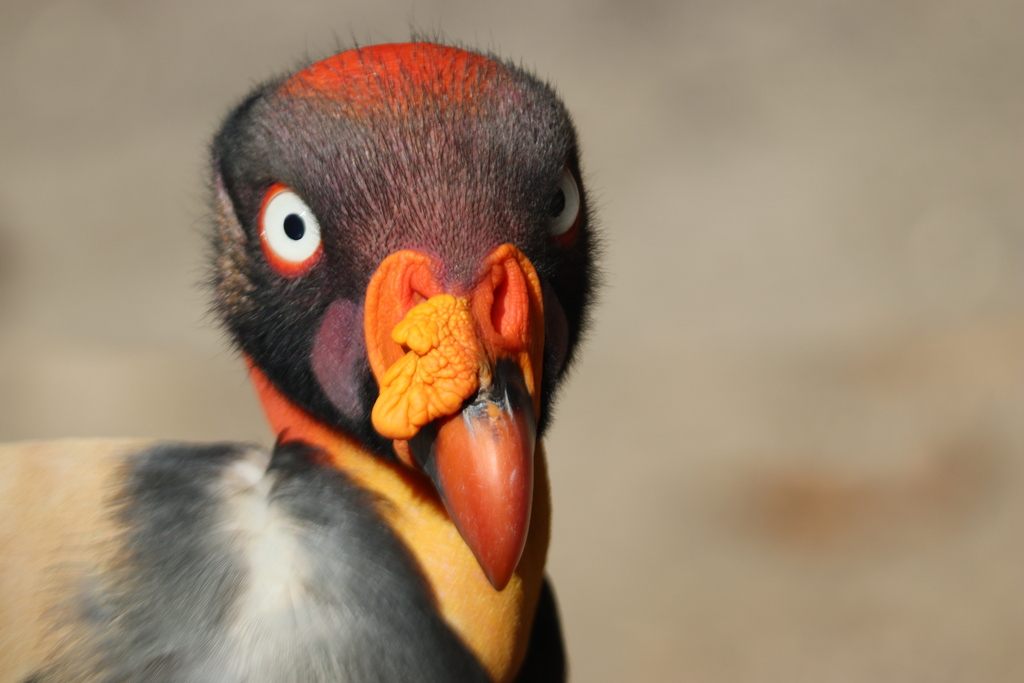
The King Vulture (Sarcoramphus papa) is a New World scavenger from tropical forests between Mexico and Argentina. Its body is white and black; its bare head blazes with orange, red, purple and yellow skin. It dominates every carcass it visits.
Most raptors are built for speed or strength. The King Vulture is built for something stranger: spectacle. Walk into the right stretch of Neotropical forest and you might see it soaring on flat wings high above the canopy, a black-and-white shape that could almost pass for something ordinary, until it descends and you see the head.
How to identify a King Vulture
In the air the King Vulture shows a distinctive two-tone pattern: a pale cream or white body and underwing coverts set against jet-black primary and secondary feathers and a black tail. The wings are broad and held flat in a soar, without the dihedral (upward tilt) of a Turkey Vulture. At a distance that can be enough to nail the ID.
At rest or close range, there is nothing like it in the Americas:
- Head: completely bare, with skin coloured orange, red, yellow and purple in distinct zones around the face, crown and collar.
- Bill: strongly hooked, black-tipped, with an orange base and a fleshy orange wattle (the caruncle) sitting on top of the upper mandible base.
- Eyes: white irises surrounded by a vivid red orbital ring, making them look almost backlit.
- Ruff: a grey feather ruff around the base of the neck separates the bare head from the white body.
Juveniles are entirely dark brown and lack the colourful head, taking four to five years to reach full adult plumage, similar to the time it takes a Bald Eagle to grow its white head.
Where does the King Vulture live?
King Vultures are birds of lowland tropical forest. The range runs from the rainforests of southern Mexico through all of Central America and down through South America to northern Argentina, taking in the Amazon basin, the Pantanal and the Atlantic Forest. They are almost entirely absent above 1,500 m elevation: highland grassland and Andean cloud forest are the territory of the Andean Condor, not the King.
Within that range they need large, unfragmented forest. They soar on thermals over the canopy, dropping when they detect a carcass below, and they need enough contiguous habitat to find food reliably. Logged or heavily degraded forest holds far fewer individuals.
What does a King Vulture eat?
Carrion, exclusively. The King Vulture eats nothing but dead animals. It finds its meals primarily by following Turkey Vultures, which locate carcasses by smell (their olfactory system is unusually well developed for a bird). Where the Turkey Vulture goes, the King eventually arrives, and when it does, the Turkey Vultures move back.
The reason for that displacement is the bill. A King Vulture's hooked bill is far more powerful than a Turkey Vulture's or Black Vulture's, and it can tear through the thick hide of a large mammal carcass that smaller vultures simply cannot open. In this way the King creates access to food for the whole vulture community: it breaks the carcass open, then all species feed. This feeding hierarchy makes the King genuinely useful, not just dominant.
In terms of sheer bite force at a carcass, it ranks among the most powerful bills in any avian scavenger. For a broader look at how that compares across species, see our record-holders ranking.
Why is the head so colourful?
This is the question every first-time observer asks, and the honest answer is that the full function of the King Vulture's head colouration is still being studied. What is clear from observation is that the bare skin changes colour with age and condition: young adults have duller, less saturated hues, and mature dominant birds carry deeper, brighter colour.
The leading hypothesis is social signalling. At a carcass, King Vultures establish a rank order, and a bolder, brighter head may communicate "I am a high-ranking, experienced bird" to rivals. This is a similar principle to the Bearded Vulture's deliberate iron-staining, where darker orange feathers signal dominance. In both species, the colour carries information about the individual wearing it.
The bare skin itself has a simpler advantage: feathers around the head and face would mat with blood and bacteria during deep feeding inside a carcass. Bare skin is far easier to keep clean.
Is the King Vulture related to eagles and hawks?
Yes and no. The King Vulture belongs to the family Cathartidae, the New World vultures, which includes Turkey Vultures, Black Vultures, the California Condor and the Andean Condor. All Cathartidae are now placed in the order Accipitriformes alongside the hawks and eagles, based on molecular evidence.
Crucially, Cathartidae are not closely related to Old World vultures (griffon vultures, white-backed vultures, the Bearded Vulture). Those belong to a completely separate lineage within Accipitriformes. The two groups arrived at the vulture body plan independently, driven by the same ecological pressure: a continent full of large dead animals and a sky full of thermal lift. This is textbook convergent evolution.
Within Cathartidae, the King Vulture sits in its own genus, Sarcoramphus, Latin for "flesh beak," with no living close relatives.
Behaviour and breeding
King Vultures are largely silent birds. Unlike many raptors, they have no song and rarely call; their social communication happens visually, through posture and head colouration. They soar alone or in pairs, riding thermals for long periods with minimal flapping, covering large distances on the energy from rising air.
Breeding is slow. A pair produces a single egg each year, laid in a hollow tree trunk, cliff crevice or similar cavity. Both parents incubate for 52 to 58 days. The chick stays in the nest for about three months, fed by regurgitation, and remains dependent on the parents for several months after fledging. The total investment per breeding attempt is high, which is typical for large, long-lived birds.
The King Vulture in the Kaught catalog
In Kaught the King Vulture carries the Epic tier, three diamonds out of four. That reflects how often the species turns up in real-world sightings recorded on iNaturalist. King Vultures are birds of intact lowland forest, they soar at altitude, and they spend much of their time over closed canopy rather than perching in the open. Seeing one at eye level, or even low enough to make out the head colours without binoculars, is a genuine event. The Epic tier reflects that scarcity of real encounters, not any statement about whether the species faces pressure in the wild.
The catalog type is Bird. There is no secondary type: the King Vulture is not restricted to a single biome cluster in the way that, say, a wetland specialist is; it moves across large territories of tropical forest wherever thermals and carrion take it.
King Vulture: frequently asked questions
What does a King Vulture look like?
The King Vulture has a white body, black flight feathers and tail, and a bare head blazing with orange, red, purple and yellow skin. The bill base carries a fleshy orange wattle called a caruncle. Its eyes are white with a vivid red orbital ring.
Where do King Vultures live?
King Vultures live in tropical lowland forest from southern Mexico through Central America to northern Argentina. They soar over continuous forest canopy and are rarely found above 1,500 m elevation.
What do King Vultures eat?
King Vultures eat carrion exclusively. They follow Turkey Vultures to carcasses, where their powerful hooked bill tears open thick hide that smaller vultures cannot penetrate. They are the dominant scavenger at every shared feeding site.
How big is a King Vulture?
King Vultures are 67-81 cm long with a wingspan of 1.2-2.0 m and weigh 2.7-4.5 kg. This makes them larger than Turkey Vultures and Black Vultures but smaller than Andean Condors.
Why is a King Vulture's head so colourful?
The vivid orange, red, purple and yellow bare skin on the King Vulture's head is thought to signal social dominance. Brighter colour and a larger caruncle correlate with higher rank at a carcass. The bare skin also stays cleaner during feeding than feathers would.
Why is the King Vulture "Epic" rarity in Kaught?
Kaught's rarity tiers are based on how often a species is observed in the wild, not its conservation status. The King Vulture is at the Epic tier because sightings are uncommon: it soars high over closed-canopy forest and is rarely seen at eye level.
The next thing you see could be
your first catch.
Kaught is live on the App Store and Google Play. Free to start, and your first catch is one photo away.
Free to start · Live on the App Store and Google Play
Species data, type, rarity tier and measurements, is drawn from the Kaught catalog, built on open biodiversity records from GBIF and iNaturalist. Rarity reflects how often a species is observed in the wild, not its conservation status.