
Adaptation explainer
Bearded Vulture: the bone-eating bird that dyes its own feathers orange
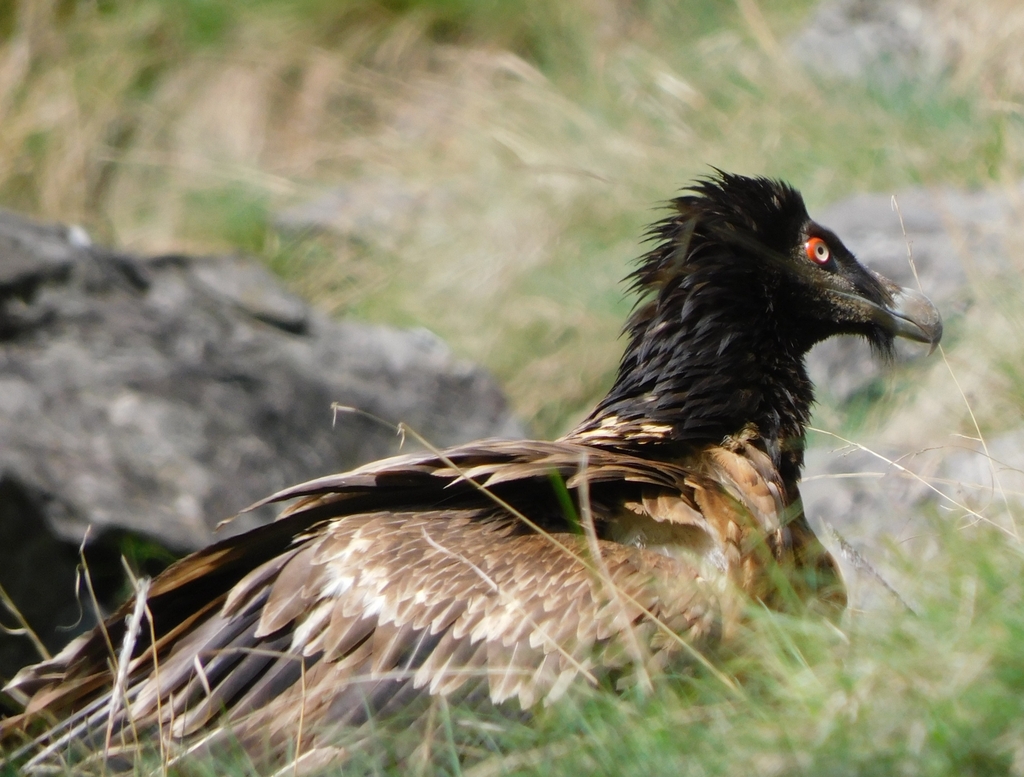
The bearded vulture (Gypaetus barbatus) is the only bird whose diet is roughly 85 to 90 percent bone. It carries bones high into the air and drops them onto rocks to crack them, then dissolves the fragments in a stomach with near-battery-acid levels of acidity. It also deliberately paints its feathers orange using iron-rich mud, a form of self-ornamentation unique among birds.
Most large scavengers compete to reach the meat at a carcass. The bearded vulture ignores the competition entirely. By the time other vultures have stripped every last scrap of flesh, the bearded vulture arrives and gets to work on what everyone else has left behind: the bones.
The problem with eating bone
Bone is structurally dense, chemically stable and mechanically hard. No other large bird has managed to make it a primary food source, and for good reason: the energy required to break bone and then digest it is substantial. The bearded vulture solved both halves of this problem through two independent adaptations.
Step one: break the bone
The bearded vulture carries bones, sometimes bones longer than its own wingspan, to altitude and drops them onto flat rock slabs called ossuaries. It has been observed returning to the same dropping site for years, polishing the rock smooth over time. A bone may take several passes from 50 to 80 metres to crack. Once cracked, the bird can swallow fragments up to 27 cm long.
The choice of ossuary is deliberate. The bird selects a flat, pale rock face that provides enough contrast to judge the angle of approach, an accurate aim, and a hard surface to maximise the impact. Young birds learn which sites to use by watching adults, then spend years perfecting the drop technique before they are reliable at it.
Step two: dissolve it
The bearded vulture's stomach acid sits at approximately pH 1, among the most concentrated of any vertebrate. At that acidity, bone fragments dissolve within 24 hours. The marrow inside, dense in fats and proteins, is available within hours of swallowing. Long bones provide marrow that other scavengers cannot reach without the bearded vulture's specific approach.
The result is a food source with almost no competition. When a large ungulate dies in the mountains of the Pyrenees, Atlas or Himalayas, a sequence of scavengers works through it in rough order: griffon vultures strip soft tissue, Egyptian vultures take smaller scraps, and the bearded vulture arrives last to claim what others cannot use.
Why the orange colour?
Bearded vultures have white or pale cream underparts as standard plumage. But adult birds in the wild are almost always a deep orange-red from throat to belly. The orange comes from dust and soil, specifically iron-oxide-rich material the bird deliberately seeks out and applies to its feathers.
This is not accidental soiling. Studies using captive birds showed that individuals without access to iron-rich mud remain white. Individuals given access choose to bathe in it. The behaviour is intentional: the bird rubs its face and breast into rust-coloured earth and muddy seeps, working the colour into the feathers over time.
The current leading explanation is social signalling. Field observations show dominant birds carry deeper, more consistent orange tones. Subordinate individuals are paler. The colour may communicate age, condition or rank without the energy cost of physical confrontation, essentially a self-applied status badge.
Identification in the field
The bearded vulture is a large, long-winged bird with a distinctive silhouette quite different from other vultures:
- Shape: long, narrow, pointed wings and a long diamond-shaped or wedge-shaped tail that distinguishes it instantly from the broad-winged, short-tailed griffon vultures it shares mountain airspace with.
- Underparts: orange-buff to deep rust on the breast and belly in adults; paler, more mottled in immatures.
- Head: pale with a small black "beard" of bristle-like feathers below the bill.
- Flight style: long, straight glides; rarely flaps; prefers ridge and cliff updrafts.
Where to find one
The bearded vulture needs mountains, cliffs and open terrain with enough large ungulate carcasses to sustain a very low-density population. Its range spans the Pyrenees (a recovering reintroduction population), the Alps (successfully reintroduced since the 1980s), the Atlas Mountains, the Caucasus, the Ethiopian Highlands and across the Himalayas. In Africa, populations persist in Lesotho, South Africa and eastern Africa.
In the Kaught catalog it sits at the Epic tier, three diamonds, reflecting the genuine scarcity of a confirmed sighting. Mountain birds of this size at very low densities over enormous territories are rarely seen by chance. A dedicated trip to the Pyrenees or Swiss Alps in good soaring weather gives the best odds in Europe.
Three things you may not expect
- Bones can make up 90 percent of the diet by mass. One adult bearded vulture requires roughly 250 to 300 g of bone per day, the equivalent of a large ungulate's leg bone every three to four days.
- The bird has been observed deliberately hunting live tortoises. It carries a tortoise to altitude and drops it onto rocks, using exactly the same technique it uses on bone. The Greek playwright Aeschylus was reportedly killed when an eagle (likely a bearded vulture, misidentified) dropped a tortoise on his bald head, mistaking it for a rock.
- Nest-building takes months. A pair begins collecting sticks, grass and fur up to two months before egg laying, constructing a nest that may reach 2 m in diameter and weigh several hundred kilograms after years of repeated use.
Bearded Vulture: frequently asked questions
How does the bearded vulture eat bone?
It carries bones up to 80 m and drops them onto flat rocks to crack them, then swallows the fragments. Its stomach acid (pH around 1) dissolves the bone within 24 hours, releasing the marrow inside.
Why is the bearded vulture orange?
Deliberately painted. Adults bathe in iron-rich mud and dust, staining their white feathers orange-red. Dominant birds carry deeper colour, suggesting it signals rank or condition to rivals.
Where do bearded vultures live?
Mountain ranges across southern Europe, Africa and Asia: the Pyrenees, Alps, Atlas, Caucasus, Himalayas, Ethiopian Highlands and parts of East and southern Africa.
What does the bearded vulture eat?
Almost exclusively bone: around 85 to 90 percent of the diet. It arrives at carcasses after other scavengers have stripped the meat and takes what they cannot use.
Why is the bearded vulture Epic in Kaught?
Kaught's rarity reflects how often a species is observed in the wild. Bearded vultures live at very low densities across remote mountain terrain. A confirmed sighting is uncommon even in their range, placing them at the Epic tier, three diamonds.
The next thing you see could be
your first catch.
Kaught is live on the App Store and Google Play. Free to start, and your first catch is one photo away.
Free to start · Live on the App Store and Google Play
Species data, type, rarity tier and measurements, is drawn from the Kaught catalog, built on open biodiversity records from GBIF and iNaturalist. Rarity reflects how often a species is observed in the wild, not its conservation status.