
Identify safely
Huntsman Spider: the giant, fast spider people mistake for something deadly
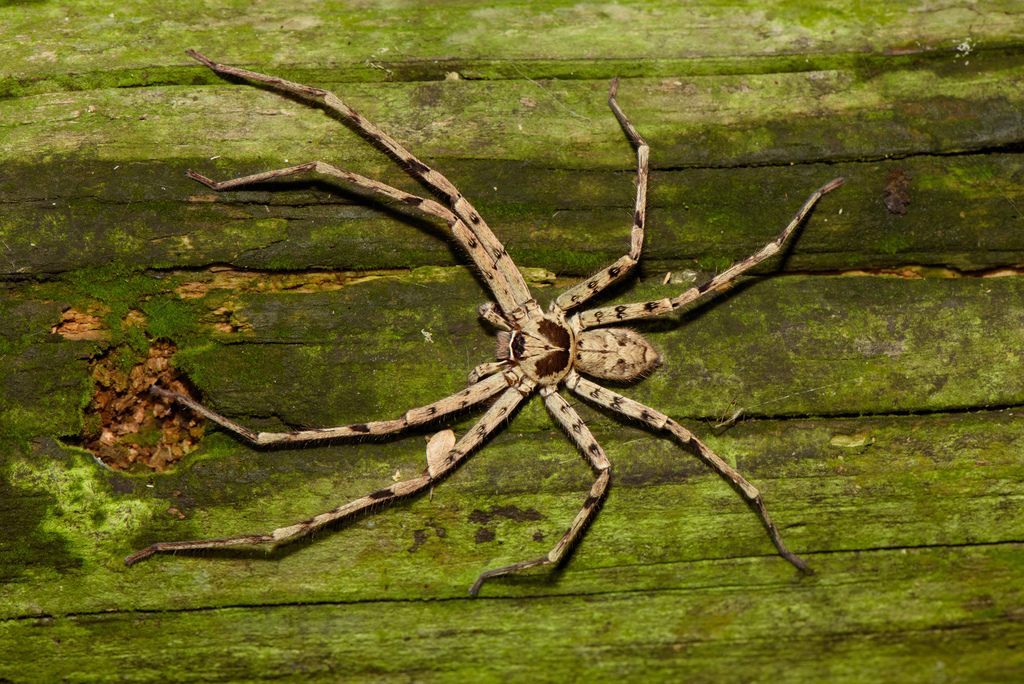
The pantropical huntsman spider (Heteropoda venatoria) is a huge, flat, fast-moving spider found worldwide in warm regions. Despite its size and speed, its bite is only mildly painful and not dangerous. It builds no web, hunts insects on foot at night, and is often mistaken for genuinely venomous species.
Few spiders cause more doorway panic than the huntsman. It's flat, impossibly long-legged, startlingly fast, and perfectly happy to sprint across a wall, a windscreen or a bedroom ceiling in full view. None of that makes it dangerous. Here's how to actually identify a huntsman spider, what its bite does and doesn't do, and how to tell it apart from the genuinely venomous species it keeps getting confused with.
How to identify a huntsman spider
A huntsman earns its "giant crab spider" nickname before it even moves:
- Body: flat and oval, 2.2-2.8 cm long, built low so it can squeeze flush against bark, walls and crevices.
- Legs: very long for the body and bent forward at the joint like a crab's rather than down like most spiders', giving a leg span of 7-10 cm.
- Colour: plain tan to grey-brown, sometimes with faint darker mottling on the legs, with no bold stripes, bands or an hourglass mark.
- Eyes: eight, arranged in two slightly curved rows of four, not six in three pairs like a recluse.
At rest it presses itself almost flat against whatever surface it's on, which is exactly how it ends up looking enormous the instant it peels off a wall and runs.
Where do huntsman spiders live?
Originally a tropical species, the pantropical huntsman has spread to warm regions worldwide by riding in cargo, especially banana shipments, which is where the nickname "banana spider" comes from. It's now established across the tropics and subtropics on nearly every continent, including introduced populations in the southeastern United States and Hawaii. By day it shelters under loose bark, rocks and leaf litter; in humid climates it moves just as readily into sheds, garages, cars and houses, where it's usually found flattened against a wall or ceiling.
Is a huntsman spider bite actually dangerous?
Not in any serious sense. The venom is built to immobilise insect prey, made mostly of peptides and proteins rather than the toxins that cause real harm in people. A bite can sting and leave swelling that lasts a few hours, but it causes no lasting damage or systemic illness in a healthy adult. Huntsman spiders are also genuinely shy: they would much rather bolt for cover than bite, and most bites happen only when one is trapped against skin or handled roughly.
Huntsman spider vs Brazilian wandering spider: the lookalike that matters
The huntsman's reputation problem comes from being confused online with Phoneutria, the Brazilian wandering spider, whose venom is genuinely medically significant. The two are easy to separate once you know what to check. A Phoneutria carries a dark stripe running down its back and palps, bold black-and-light banding on the underside of its legs, and reacts to threats by rearing up with its front legs raised, swaying side to side to flash that banded pattern. A huntsman does none of this. It's plain-coloured top to bottom, with no leg banding, and its only defence is speed.
How a huntsman spider actually hunts
Unlike almost every other spider on this site, a huntsman doesn't trap anything in silk. It hunts entirely on foot, after dark, running down cockroaches and other insects using sheer speed and reflexes rather than a web. Those crab-bent leg joints aren't just for show: they let it scuttle sideways and even backward across a vertical wall or ceiling as easily as forward.
The huntsman spider's unusual parenting
A female huntsman spins a flat, coin-sized egg sac holding anywhere from around 100 to 400 eggs, then carries it underneath her body, gripped by her pedipalps, for roughly a month. She doesn't feed during that time and loses a noticeable amount of weight. Some females go further, tearing the sac open to help the spiderlings out once they're ready to emerge, a level of parental investment that's unusual among spiders generally.
How rare is the huntsman spider in Kaught?
In the Kaught catalog the huntsman spider sits at the Common tier, one diamond out of four. That's a reminder that Kaught's rarity reflects how often a species is actually recorded in the wild, not how alarming it looks. Thanks to a huge worldwide range and a habit of turning up on the inside of a window, confirmed sightings of this spider stack up fast, which is exactly what keeps it at the Common tier.
For the lookalike spider that actually deserves the caution, the black widow spider guide covers the red hourglass that confirms it. The brown recluse spider guide tells a similar story of a fearsome reputation built mostly on misidentification, how spiders spin silk explains the glands and web types a huntsman has largely given up, and jumping spiders shows another harmless hunter that relies on eyesight instead of a web.
Huntsman spider: frequently asked questions
Is a huntsman spider bite dangerous?
Not in any serious sense. A bite can cause brief local pain and swelling lasting a few hours, but the venom is built to subdue insects, not harm people, and causes no lasting or systemic damage in a healthy adult. Huntsman spiders are shy and would rather flee than bite.
How do you identify a huntsman spider?
Look for a flat, oval body 2.2-2.8 cm long, plain tan to grey-brown with no bold stripes, and very long legs bent forward like a crab's rather than down, giving a leg span of 7-10 cm. Eight eyes sit in two slightly curved rows of four.
Where do huntsman spiders live?
Across the tropics and warm temperate regions worldwide, spread far beyond any native range by cargo shipping, especially banana shipments. They shelter by day under bark and rocks, and readily move into sheds, garages, and houses in humid climates.
How is a huntsman spider different from a Brazilian wandering spider?
The genuinely dangerous Phoneutria species have a dark stripe down the back and palps, bold black-and-light banding on the underside of the legs, and rear up with front legs raised, swaying side to side, when threatened. A huntsman shows none of this and is plain-coloured all over.
Does a huntsman spider build a web?
No. It hunts entirely on foot, running down cockroaches and other insects at night using speed rather than silk. Its long, crab-bent legs let it move sideways and backward across walls and ceilings, which is where the "giant crab spider" nickname comes from.
Why is the huntsman spider "Common" in Kaught?
Kaught's rarity tier tracks how often a species is actually recorded in the wild, not how startling it looks. Thanks to its huge worldwide range and habit of turning up in buildings, the huntsman spider is recorded constantly, placing it firmly at the Common tier.
The next thing you see could be
your first catch.
Kaught is live on the App Store and Google Play. Free to start, and your first catch is one photo away.
Free to start · Live on the App Store and Google Play
Species data, type, rarity tier and measurements, is drawn from the Kaught catalog, built on open biodiversity records from GBIF and iNaturalist. Rarity reflects how often a species is observed in the wild, not its conservation status.