
Legendary spotlight
Macaroni penguin: the most abundant penguin on Earth lives in one of its most remote places
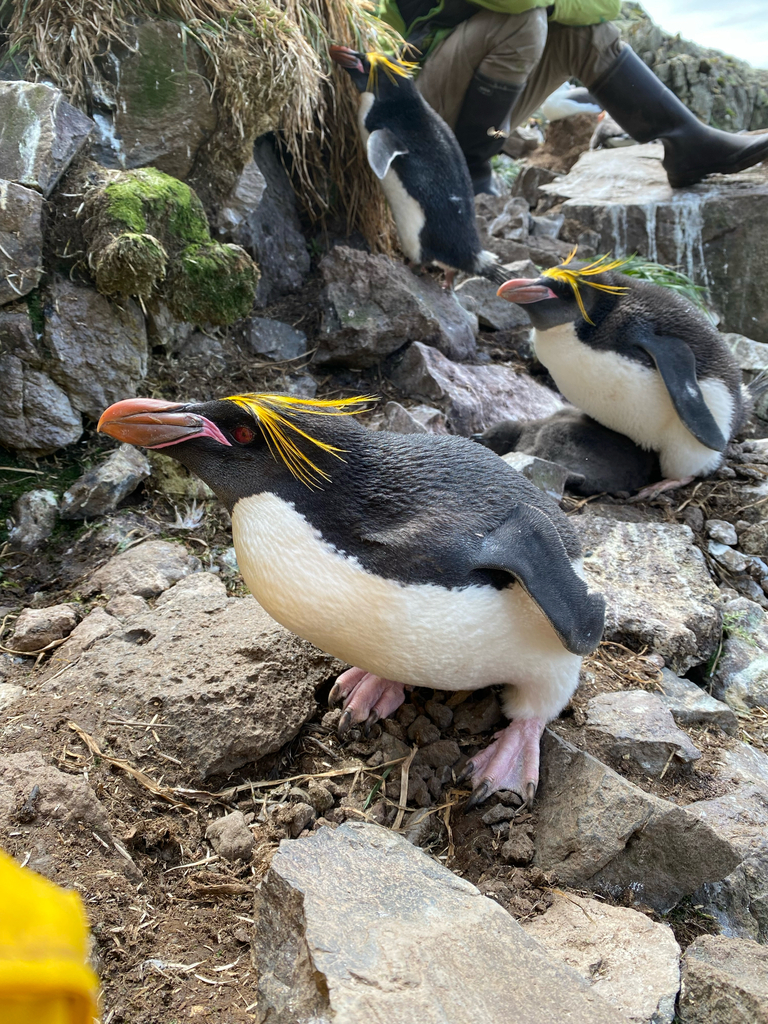
The macaroni penguin (Eudyptes chrysolophus) is the most abundant penguin species on Earth, with around 18 million individuals, yet almost nobody has seen one. Its colonies are on remote sub-Antarctic islands rarely visited by ships and almost never by casual travellers. The bird itself is unmistakable: a compact, serious-looking penguin with an absurd flourish of golden-orange crest feathers erupting from the centre of its forehead.
Numbers can mislead. The macaroni penguin is counted in the tens of millions, yet it lives almost entirely out of reach of human observers. Its breeding colonies are on windswept sub-Antarctic islands that see fewer annual visitors than the surface of Mars has rovers. In the Kaught catalog, Legendary tier does not mean rare: it means the odds of you seeing one in your lifetime, outside a specialist expedition, are vanishingly small.
Identification: the feathered hat
The macaroni penguin belongs to the crested penguin genus Eudyptes, a group defined by the bold yellow or orange feather crests that sweep back from the face. In most crested penguins the crest begins at or behind the eye. In the macaroni penguin it starts at the centre of the forehead as a dense, bright golden-orange plume that fans outward and backward above each eye, merging to a point at the bill before dividing. The effect is theatrical: a bird otherwise dressed in sober black and white appears to be wearing an elaborate wig.
The body is stocky, 66 to 76 cm tall and weighing 3 to 7 kg, with the male slightly larger than the female. The bill is heavy, reddish-brown and notched, well suited to gripping slippery krill. Eyes are red in adults, a deep crimson in direct light. The emperor penguin is far larger; the African penguin, the only other penguin likely to be seen outside sub-Antarctic waters, lacks the crest entirely.
The name
In 18th-century Britain, young men who returned from the Grand Tour of Europe wearing extravagant continental fashions, especially tall feathered hats, were mockingly called "macaronis". The slang entered popular culture in the American song "Yankee Doodle" ("he stuck a feather in his cap and called it macaroni"). British sailors observing the flamboyantly crested penguins used the same term. The name stuck.
Where they breed
The global breeding population is distributed across the sub-Antarctic: South Georgia, the South Sandwich Islands, the Kerguelen Islands, Heard Island, McDonald Island, the Crozet Islands and the northern tip of the Antarctic Peninsula. South Georgia alone holds more than five million breeding pairs, the largest seabird colony on Earth by total birds present during peak season.
A macaroni colony is an experience of overwhelming scale and noise. Hundreds of thousands of birds pack onto slopes and cliff ledges, each pair defending a nest scrape a beak-jab's distance from its neighbours. The vocalisations, a braying, drumming cacophony, are audible from ships kilometres offshore.
Breeding is tightly seasonal. Pairs arrive at colonies in October (Southern Hemisphere spring), lay two eggs in November, with the first smaller egg almost always discarded within days, and fledge chicks in March before the austral winter closes in. Males and females alternate incubation duties in shifts of days to weeks, with the non-incubating bird at sea building up fat reserves for its turn.
Diving and foraging
Outside the breeding season the macaroni penguin is a pelagic animal, spending months at sea in the Southern Ocean. It forages by pursuit-diving: entering the water and swimming rapidly after individual krill or fish. Dives typically reach 50 to 100 m in depth and last 1 to 2 minutes. Maximum recorded dives exceed 180 m, sustained for over 3 minutes.
During chick rearing, a foraging bird may make up to 400 dives in a single day trip. The krill-heavy diet of the species means the macaroni penguin, taken as a single global population, is estimated to consume around 9 million tonnes of marine prey annually. No other bird species comes close to that figure. The population is large enough that fluctuations in its consumption affect krill abundance at regional scales.
Why Legendary in the Kaught catalog?
The catalog's tier reflects observation frequency, not total population count. A species that lives in vast numbers in places almost never visited by observers will accumulate relatively few observation records. The macaroni penguin breeds on islands that are difficult and expensive to reach, sees almost no casual tourism and is absent from the zoos and aquaria where most people encounter penguins. Genuine sightings in the wild are extraordinarily rare for most observers, placing it firmly in the Legendary tier.
Contrast this with the African penguin, a species with a small total population but colonies near Cape Town that are visited by millions of tourists each year. In the catalog it sits at a lower tier because observation records are comparatively abundant. Legendary is not a conservation judgment. It is a measure of encounter probability.
The same logic explains why some colonial seabirds are far easier catches than their numbers suggest. The tufted puffin, the largest of the puffins, nests on cliffs and islands all the way from California to Japan, and the accessible colonies at the southern end of that range are photographed far more often than the remote northern ones holding most of the birds.
Macaroni penguin: frequently asked questions
What is a macaroni penguin?
A crested penguin (Eudyptes chrysolophus) native to sub-Antarctic islands, with a distinctive golden-orange feather crest at the centre of its forehead. It stands 66 to 76 cm tall, weighs 3 to 7 kg, and is the most abundant penguin species on Earth with around 18 million individuals.
Why is it called a macaroni penguin?
The name comes from 18th-century British slang for fashionable young men who wore extravagant feathered hats, called 'macaronis'. British sailors applied the same term to the golden-crested penguins. The same slang appears in the American song 'Yankee Doodle'.
Where do macaroni penguins live?
On sub-Antarctic islands including South Georgia, the Kerguelen Islands, Heard Island, the Crozet Islands and the South Sandwich Islands. South Georgia holds more than five million breeding pairs. Outside the breeding season they live at sea in the Southern Ocean.
How deep can macaroni penguins dive?
Typically 50 to 100 m, with maximum recorded dives exceeding 180 m. Dives last 1 to 2 minutes on average. A foraging bird during chick-rearing can make up to 400 dives per day.
What do macaroni penguins eat?
Primarily Antarctic krill, supplemented by small fish and squid. The global population consumes an estimated 9 million tonnes of marine prey annually, the highest of any bird species on Earth.
Why is the macaroni penguin Legendary tier in Kaught?
Kaught's tier reflects observation frequency, not total population. Macaroni penguins breed exclusively on remote sub-Antarctic islands that are rarely visited. Outside specialist expeditions, a sighting is genuinely extraordinary, placing the species in the Legendary tier despite its large global numbers.
The next thing you see could be
your first catch.
Kaught is live on the App Store and Google Play. Free to start, and your first catch is one photo away.
Free to start · Live on the App Store and Google Play
Species data, type, rarity tier and measurements are drawn from the Kaught catalog, built on open biodiversity records from GBIF and iNaturalist. Rarity reflects how often a species is observed in the wild, not its conservation status.