
Exotic spotlight
The Fire Salamander: the toxic amphibian with a polka-dot warning coat that births live larvae
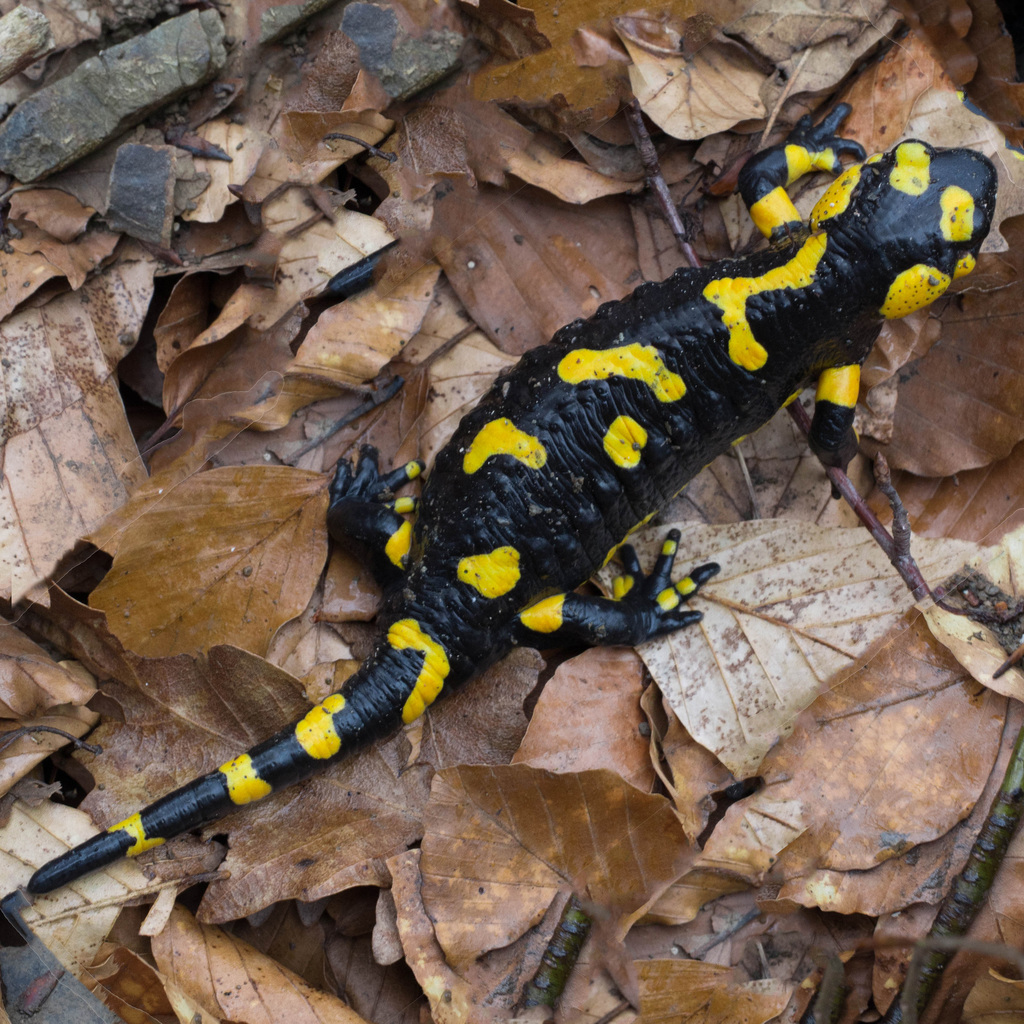
The fire salamander (Salamandra salamandra) is a stocky, slow-moving amphibian from European woodland: glossy black with bold yellow patches, toxic to predators, active mainly on rainy nights, and remarkable for giving birth to live, gilled larvae rather than laying eggs. An Epic-tier species in Kaught, genuinely unusual to encounter.
The fire salamander walks slowly, eats slugs, and looks like something designed by a graphic designer with too much creative latitude. That black-and-yellow coat is not decoration. It is a warning, and animals in European woodland have learned to respect it over millions of years of mutual evolution. This is one of the most visually arresting amphibians on the continent, and most people have never seen one.
How to identify a fire salamander
Once seen, a fire salamander is very hard to confuse with anything else in Europe:
- Colour: a wet-looking, glossy jet black body with bright yellow or orange patches, spots, or stripes. The exact pattern is variable: some individuals are mostly yellow with black borders, others are mostly black with small yellow spots. Regional subspecies show consistent pattern differences.
- Build: stocky and low-slung, with four short legs of roughly equal length, a rounded snout, and a tail that tapers smoothly without a fin or crest. Adults reach 15 to 25 cm.
- Skin texture: smooth and faintly moist, neither warty nor slimy. The skin contains parotoid glands behind the eyes that produce the toxin.
- Movement: deliberate and unhurried. The fire salamander does not flee when approached; it trusts its colouration. This makes it one of the few wild amphibians you can watch at close range.
The only European amphibian with a superficially similar pattern is the yellow-bellied toad (Bombina variegata), which is much smaller, flatter, and found only in water or immediately beside it. The fire salamander walks through the forest far from water for most of the year.
For comparison with another European amphibian worth knowing, see the marbled newt spotlight.
Is the fire salamander toxic?
Yes, and the yellow says so. The fire salamander secretes samandarine, a steroidal alkaloid, through specialised skin glands. Samandarine causes muscle convulsions and disrupted blood pressure in vertebrate predators. A fox that picks up a fire salamander will drop it very quickly, and remember the encounter.
For humans, the toxin is an irritant rather than a serious danger. Handling a fire salamander and then touching your eyes, mouth, or a cut will cause a burning sensation. The sensible approach: do not pick one up, and wash hands thoroughly after any contact. The toxin is not absorbed through intact skin in dangerous quantities.
The bold colouration is aposematism at work: a biological contract between the animal and its predators. "I am yellow and black; I will make you very uncomfortable" is information that predators rapidly learn. Fire salamanders walk slowly and openly for this exact reason.
Where to find fire salamanders
The fire salamander lives in damp, deciduous and mixed woodland across central and southern Europe. Its range runs from Spain and Portugal in the west, through France, Germany, Switzerland, the Alps, and the Balkans, extending east into Ukraine and Turkey.
Within that range it is picky about habitat. It needs:
- Old deciduous or mixed forest, particularly beech and oak woodland with deep, moist leaf litter under the canopy.
- Cold, clean, fast-flowing streams nearby for breeding. The salamander deposits larvae directly into these streams.
- Ground cover: logs, stones, and root systems to shelter under during the day and during dry or cold spells.
By day it hides. The fire salamander is almost entirely nocturnal and emerges to hunt only after dark. Your best chance of a sighting is a warm, rainy night in spring or autumn, when salamanders emerge to forage across forest paths. They will walk openly in the open if the ground is wet and temperatures are above roughly 10°C.
In winter, fire salamanders hibernate underground or in deep logs. In summer heat they remain dormant under cover. The productive windows are April to June and September to October.
How fire salamanders reproduce: live birth
This is the most biologically unusual thing about the species, and the detail most people do not know. The fire salamander does not lay eggs in the way that frogs or most amphibians do. Instead, it is ovoviviparous: the eggs are retained inside the female's body, hatching internally, and the female deposits live, gilled larvae directly into water, usually a cold upland stream or spring.
A single female can deposit 10 to 50 larvae in one session, entering the water briefly and releasing them. Those larvae have working gills, functioning limbs, and immediately begin hunting small invertebrates. They undergo metamorphosis over several weeks to months, losing their gills and emerging as miniature terrestrial salamanders.
Some Alpine subspecies take this further still, retaining the larvae through full metamorphosis and giving birth to already-formed juvenile salamanders that have never been in open water. It is a reproductive strategy that removes any dependence on standing pools, the main vulnerability of most amphibian life cycles.
The fire salamander in the Kaught catalog
In Kaught, the fire salamander registers as an Epic Amphibian, three diamonds out of four. The Epic tier reflects genuine observation rarity: despite being present across a large area of Europe, the fire salamander's nocturnal habits and preference for dark, damp nights mean that most people who walk through its habitat never see one. It is one of the library's first amphibians to reach that tier alongside the marbled newt.
Kaught's rarity reflects observation frequency, not any conservation or scientific classification. The fire salamander is present and self-sustaining across a wide range; it is simply a very easy animal to miss.
Three facts that make the fire salamander remarkable
- The yellow-and-black pattern is individually unique, like a fingerprint. Field researchers use photographs of individual pattern elements to identify the same salamander across years of monitoring.
- A fire salamander can live for over 20 years in the wild. For a small amphibian, this is exceptional. The slow pace suits a long life: it faces minimal predation and breeds reliably each year.
- The "fire" in its name does not mean it tolerates heat. The reverse is true. Medieval Europeans observed salamanders walking out of burning logs (where they had been sheltering) and assumed they were immune to fire. They are not. They were simply fleeing the heat.
Fire salamander: frequently asked questions
What does a fire salamander look like?
A stocky, slow-moving amphibian about 15 to 25 cm long with a glossy jet-black body broken by bold patches and stripes of yellow or orange. The pattern varies by region but the contrast is always striking. The skin is smooth and faintly moist-looking.
Is the fire salamander poisonous?
It is toxic but not venomous. It secretes samandarine alkaloids through its skin, which cause muscle convulsions in predators. For humans, it is an irritant: handling one and then touching your eyes or mouth will cause burning. Wash hands thoroughly after any contact and do not handle unnecessarily.
Where do fire salamanders live?
Damp, deciduous and mixed woodland across central and southern Europe, from Spain and Portugal through Germany, the Alps, the Balkans, and into Ukraine. They need proximity to cold, clean streams for breeding and prefer beech or oak woodland with deep leaf litter.
Does the fire salamander lay eggs?
No. It retains its eggs internally and gives birth to live, fully-formed gilled larvae directly into water. A female may deposit 10 to 50 larvae into a cold stream. Some Alpine subspecies go further and birth fully metamorphosed juveniles.
When is the best time to find fire salamanders?
Warm, rainy nights in spring (April to June) and autumn (September to October), in damp deciduous woodland near streams. They walk openly across forest paths after dark when temperatures are above about 10°C and the ground is wet.
Why is the fire salamander Epic in Kaught?
Kaught's Epic tier reflects how rarely a species is observed in the wild. The fire salamander is nocturnal, hides under cover by day, and is active only in specific warm-wet conditions, making genuine records notably infrequent despite a wide European range.
What does the fire salamander eat?
Earthworms, slugs, beetles, woodlice, and occasionally small frogs or young newts. It hunts at night and swallows prey whole by lunging and gripping with its small teeth.
The next thing you see could be
your first catch.
Kaught is live on the App Store and Google Play. Free to start, and your first catch is one photo away.
Free to start · Live on the App Store and Google Play
Species data, type, rarity tier and measurements, is drawn from the Kaught catalog, built on open biodiversity records from GBIF and iNaturalist. Rarity reflects how often a species is observed in the wild, not its conservation status.